Santa Carxofa – The tradition of a land made into beer

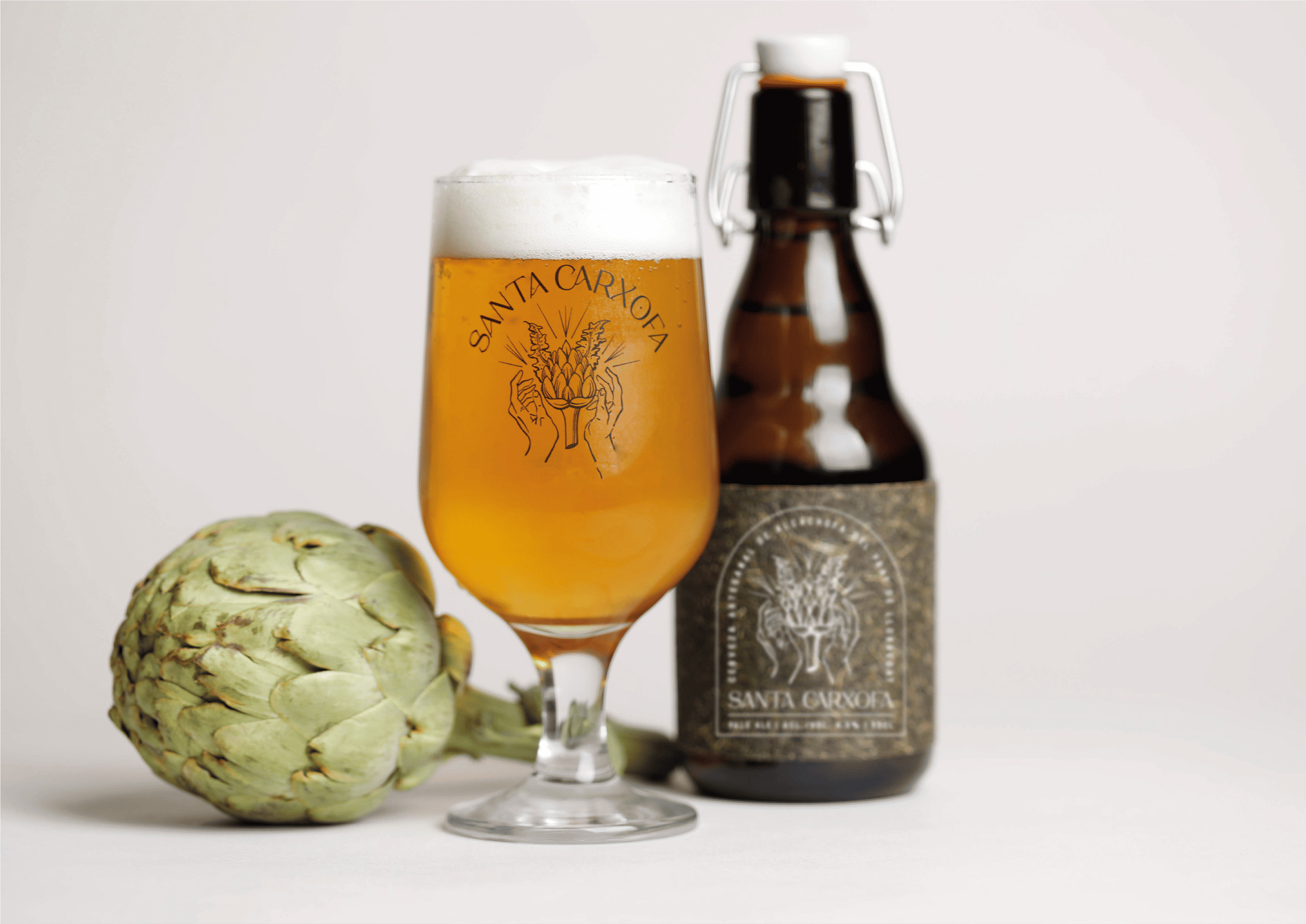
Santa Carxofa connects the past and the future, both in constant tension. Innovation and tradition come together to rethink the identity of the artichoke in a craft beer, creating short waste recirculation channels.

Define the problem/need you are solving or addressing with your project. How does it address the Open Call criteria, such as environmental impact, social engagement, circularity, user experience, resource efficiency, and community-driven solutions?

The transition to new agroeconomic models has already begun. There must be ways to move from a dominant industrial model to one of multiple autonomous and diversified systems that strengthen the food chain, support generational change and local development. The Prat carxofa (artichoke), with almost 100 years of history, is the queen of crops, representing 90% of the current harvest in Prat de Llobregat in Catalonia, a place that has been able to preserve its rural identity despite the exogenous pressures that the city of Barcelona has exerted on it. In recent years there has been an overproduction and losses of this product due to climatic changes and the poor adaptation of farmers, the artichoke surplus is discarded, donated, incinerated or sometimes transformed into compost still retaining its characteristics, so it’s necessary to reuse this healthy and versatile product that brings great potential for food exploration in a new one.

Please describe your project, reflecting on the concept, inspiration, materials, technical aspects, methods and process(es).

The new paradigms of consumption symbolize the need as humans for our roots, territoriality and culture, that is, for interaction. Santa Carxofa is a beer creation designed for people looking to experience new flavors, with a very clear objective, to transport you to Prat de Llobregat just by tasting it. It promotes the territorial capital to revalue the natural and cultural resources (the artichoke and its heritage) in the municipality, creating a link between the people belonging to the territory and its tourists. The project proposes a strategy of articulation between food processing and other economic activities such as agro-tourism that vindicates the work of farmers, promotes closer links between producers and consumers and allows the reactivation of agro-traditions. Santa Carxofa is a local, proximity and seasonal product, which is part of a regenerative solution from the consumption and strengthening of more sustainable communities, which are more resistant to crises.

What do you think makes your project innovative compared to the existing efforts and ideas in the field it addresses?

Santa Carxofa transmits the heritage of the land by connecting generations, takes advantage of an native material to enrich a community, developing short waste recirculation channels that generate greater added value. It manages to create synergies between the actors involved, making available to them the experience in circular economy and craft beer culture. It makes the population aware of the farmers’ difficulties and how their choice of a beer inspired, produced and marketed in the territory builds identity, cultural roots and a more sustainable future. In functional terms, the beer is brewed using the remaining part of the artichoke head (not the heart) and the label is artichoke paper made from the green matter of the plant (stems and leaves), a biomaterial screen-printed with the brand and the carxofa route on the back, a rural tourism activity through the artichoke crops that evokes historical and ancestral moments.

Does it impact or reflect young people need(s) and how?

The device of a craft beer fulfills its function by approaching young adults and capturing their interest in business models that are the fruit of their own territory, in this way, the new generations of farmers will preserve their crops and will have local autonomy as a factor of sustainability and development. Food is culture and values. Defending the fact that each people has the right to control their food (food sovereignty) is fundamental because we will not only maintain self-sufficient fields supported by traditional knowledge and experiences, but also facilitate decision-making when consuming a local product, because the ultimate goal is not the beer in situ but the local and relational dynamics that this can generate within the territory, as this drink puts into practice small cooperative economies, real, tasty, conscious and artisanal that claim the good values in youth.

Handrail Series

The Handrail Series transforms industrial stainless steel components into sculptural design objects, showcasing how rethinking purpose—not material—can lead to new forms without requiring new resources or manufacturing.

Define the problem/need you are solving or addressing with your project. How does it address the Open Call criteria, such as environmental impact, social engagement, circularity, user experience, resource efficiency, and community-driven solutions?

The Handrail Series utilizes prefabricated elements from a modular stainless steel railing system originally designed for architecture. By reinterpreting these components, the project creates a table lamp and a table clock without introducing new materials or tooling. This approach reduces resource consumption, avoids waste, and operates within existing production frameworks. Conceptually, the series challenges conventional notions of what needs to be “new” for a product to emerge. It provides a timely design response that aligns with evolving perspectives on production and consumption, resulting in a precise and minimal collection that emphasizes clarity, material honesty, and sustainability—not through sacrifice but through a shift in perspective. The project supports circularity, promotes social engagement, and encourages critical design thinking.

Please describe your project, reflecting on the concept, inspiration, materials, technical aspects, methods and process(es).

The Handrail Series comprises two pieces: the Stadia Clock and the Mini Handrail Lamp, both crafted from unmodified components originally designed for stainless steel railings. These industrial parts are repurposed through careful selection and composition to create bold, sculptural objects. Instead of altering the material, the design reframes it, revealing aesthetic potential in typically utilitarian elements. The process is founded on material research and theoretical exploration, emphasizing transformation through context. Manufacturing remains minimal, allowing the objects to be fully disassembled and recycled, reflecting an efficient, low-impact design methodology that demonstrates new possibilities in object culture.

What do you think makes your project innovative compared to the existing efforts and ideas in the field it addresses?

The innovation of the Handrail Series lies in its method: it doesn’t design new parts but reinterprets existing ones, challenging traditional notions of innovation in design. This series shifts the designer’s role from creator to curator, from form-giver to storyteller. The focus is not on what can be produced, but rather on how existing materials can be reframed. This perspective is ecologically responsible and culturally relevant, critiquing conventional product culture while providing an alternative that values context, function, and reimagination over mere novelty. Situated within the contemporary discourse on circular design, material reuse, and reduced production complexity, the Handrail Series is a compelling showcase of what can be achieved by innovative thinking applied to everyday materials.

Does it impact or reflect young people need(s) and how?

The Handrail Series resonates with a generation that prioritizes conscious design and meaningful consumption, reflecting a mindset focused on sustainability, transparency, and questioning the status quo. Instead of advocating for more, the project presents a thought-provoking “what if”—what if we produce less but think more critically about our choices? The transformation of architectural elements into sculptural everyday objects highlights how reduction and reuse can ignite creativity. It encourages young people to view design as both a means of expression and a form of reflection. The resulting pieces are not only functional but also philosophical, addressing a shift in how younger generations engage with objects and systems, driving home the importance of intentionality in design and consumption in pursuit of a sustainable future.

SONO

Environmental protection needs reliable data, especially in remote areas that are difficult to access. The bioacoustic sensing device SONO enables cooperation between science and volunteering in the collection of environmental and biodiversity data.

Define the problem/need you are solving or addressing with your project. How does it address the Open Call criteria, such as environmental impact, social engagement, circularity, user experience, resource efficiency, and community-driven solutions?

NGOs and environmental protection programs in remote areas face challenges due to a lack of widespread and reliable data on local biodiversity. Issues like illegal logging, poaching, and species extinction due to climate change necessitate data-driven analysis for efficient intervention. To address this, effective design must be integrated into a feasible operational system. SONO facilitates collaboration between scientists and volunteers in collecting vital environmental and biodiversity data. By encouraging collective data gathering, it transforms environmental protection into a community-driven endeavor, promoting social engagement and civic action in regions that are typically difficult to access. Additionally, SONO raises awareness among travelers about nature and wildlife conservation, fostering a deeper connection between people and their environment.

Please describe your project, reflecting on the concept, inspiration, materials, technical aspects, methods and process(es).

SONO addresses the urgent need for reliable environmental data in hard-to-reach areas. This bioacoustic sensing device monitors sound waves to gather information about illegal activities like poaching and logging and to assess species populations, using existing software-driven analysis methods. Contextualized within a sharing system, it empowers outdoor enthusiasts and volunteers to engage in environmental initiatives. The sensor can be attached to outdoor equipment via a multifunctional mount made from laser-cut spring steel or positioned stationary in nature. Volunteers collect data and maintain the sensors through data transfers and battery replacements. SONO’s technology is rooted in the citizen science initiative Soundscapes2Landscapes and developed in collaboration with Open Acoustic Devices, making it accessible and effective in promoting community involvement while gathering critical ecological data.

What do you think makes your project innovative compared to the existing efforts and ideas in the field it addresses?

SONO distinguishes itself from existing bioacoustic sensors by adopting a mobile and decentralized approach, making it innovative in its design and functionality. Unlike traditional large and high-cost installations, SONO can be mass-produced for under 100 euros, encouraging widespread usage and significantly increasing the sample size of data collected. Its large-scale distribution is facilitated through collaborations with local communities, hostels, and initiatives, enabling seamless integration into various environments. Innovative screw joints and snap-in fittings allow for easy disassembly, promoting recycling, repair, or replacement of its open-source components. This sustainable manufacturing and operational model challenges the status quo, making data collection not only scalable but also environmentally responsible, thereby aligning with contemporary needs for accessible and effective environmental protection tools.

Does it impact or reflect young people need(s) and how?

SONO resonates with young people’s aspirations for sustainable travel and their increasing awareness of environmental issues. As outdoor activities like backpacking become popular among youth seeking a balance to digital life, they face challenges regarding the carbon footprint associated with their travels. This generation is seeking ways to minimize their impact while positively contributing to the environments they explore. SONO provides answers to these pressing questions: it turns travel into an opportunity for active ecological engagement, fostering stewardship among travelers. By enabling users to collect crucial biodiversity data, SONO empowers them to make meaningful contributions to the conservation of the areas they visit. It aligns with young people’s desire to innovate sustainable tourism practices while cultivating a sense of responsibility towards nature and wildlife, thus promoting eco-friendly adventures that respect and protect the planet.

ReTurn

A deathbed that rethinks traditional practices, saves material, and creates reusable parts for a positive environmental impact.

Define the problem/need you are solving or addressing with your project. How does it address the Open Call criteria, such as environmental impact, social engagement, circularity, user experience, resource efficiency, and community-driven solutions?

The current funeral culture in Germany often follows outdated traditions and conservative practices, overlooking sustainability. ReTurn introduces a new burial approach that respects nature while ensuring an ecological farewell. Our solution addresses critical environmental concerns by eliminating airtight coffins, thus reducing material and energy consumption and preventing wax corpse formation. By utilizing a biodegradable wool shroud and mycelium, we enhance decomposition and enrich the soil instead of contributing to its pollution. This project promotes circularity and resource efficiency, igniting a community-driven shift toward sustainable burial practices. By offering an alternative that is both respectful and environmentally responsible, ReTurn encourages rethinking conventional methods and inspires a more eco-conscious relationship between life, death, and the natural world.

Please describe your project, reflecting on the concept, inspiration, materials, technical aspects, methods and process(es).

ReTurn reinterprets burial traditions by creating a sustainable alternative that reintegrates the body into the biological cycle. Inspired by nature’s decomposition processes, we designed a biodegradable deathbed featuring a wool shroud and mycelium. The wool allows for breathability and promotes natural decomposition, while mycelium accelerates organic breakdown, enriching the soil rather than contaminating it. Our concept incorporates locally sourced materials and straightforward manufacturing techniques, ensuring accessibility while minimizing environmental impact. We also consider cultural sensitivities surrounding death as we foster ecological awareness within funeral practices.

What do you think makes your project innovative compared to the existing efforts and ideas in the field it addresses?

Unlike conventional burial methods that rely on sealed coffins and slow decomposition, ReTurn offers a fully biodegradable alternative that actively supports soil health. While there are other sustainable burial concepts, our approach uniquely combines a wooden stretcher, woolen shroud, and mycelium to create an effective, affordable, and respectful solution. By eliminating the need for heavy, resource-intensive coffins, we significantly reduce material consumption and minimize environmental impact. Additionally, our method seeks to challenge the funeral industry’s reliance on expensive, energy-intensive solutions, paving the way for a more conscious and accessible approach to funerals

Does it impact or reflect young people need(s) and how?

Young people today increasingly prioritize sustainability and seek environmentally responsible choices in all aspects of life, including death. ReTurn presents an alternative that aligns with contemporary values of ecological awareness and aims to minimize environmental footprints. This innovative solution provides younger generations the opportunity to rethink traditional funeral practices and advocate for more sustainable options. By engaging communities in discussions around natural burial, ReTurn encourages social change and empowers young people to make informed, eco-conscious decisions for themselves and future generations. This project fosters intergenerational dialogue and catalyzes a shift toward practices that resonate with a shared commitment to protecting the planet for the future.

JeanEase Slippers

Giving old fabric a second life by transforming it into slippers—without using new materials. This project reduces textile waste, minimizes environmental impact, and promotes sustainability through creativity and responsible consumption.

Define the problem/need you are solving or addressing with your project. How does it address the Open Call criteria, such as environmental impact, social engagement, circularity, user experience, resource efficiency, and community-driven solutions?

Fast fashion has led to massive textile waste, with millions of tons of discarded clothing ending up in landfills each year. Many fabrics are non-biodegradable, polluting the environment for decades. The production of new textiles consumes vast amounts of water, energy, and chemicals, further harming the planet. This project offers a sustainable solution by transforming old jeans-fabrics into slippers. Instead of using new materials, discarded textiles receive a second life. The process significantly reduces waste and minimizes environmental impact. With a low-energy, eco-friendly production method, comfortable and stylish slippers are created while promoting responsible consumption. Choosing upcycled products takes a stand against waste and fast fashion, proving that sustainability and creativity can go hand in hand. Every pair of slippers saves fabric from landfills and contributes to a greener future.

Please describe your project, reflecting on the concept, inspiration, materials, technical aspects, methods and process(es).

The materials used consist primarily of jeans with a high cotton content. The core of the sole is made from three-dimensionally pressed denim fibers. Small pieces of denim are shredded in a Hollander beater, and the fibers are opened. The resulting fiber pulp is mixed with a natural binding agent and pressed into a sole mold. The binding agent gives the mixture the necessary stability and allows it to harden. A layer of denim fabric is applied to the top of the sole to protect the fiber core from abrasion. The straps are also made from denim and are glued or stapled to the underside of the sole. Finally, the rubber or leather sole is glued on. Recycled materials are used here as well, such as old leather furniture, bags, or even discarded rubber mats.

What do you think makes your project innovative compared to the existing efforts and ideas in the field it addresses?

This project stands out due to its unique combination of sustainability, upcycling, and social impact. Unlike traditional fast fashion solutions, it repurposes denim, a widely available material, turning it into durable, functional slippers without relying on new textiles. The innovative use of denim fibers as the core of the sole minimizes waste and reduces the need for virgin materials, contributing to a circular economy. Furthermore, the project directly engages young people in a social employment setting, teaching them valuable skills in sustainable production while fostering a sense of responsibility. The simplicity of the process makes it easy to understand, empowering youth and helping them transition to the professional world. By using recycled rubber or leather for the sole, the project also ensures a low environmental impact, setting it apart from other initiatives that still rely on new, resource-intensive materials.

Does it impact or reflect young people need(s) and how?

This project was developed for a social youth employment facility, providing a simple and easily understandable production process. Through hands-on work, young people engage with sustainability while learning essential production steps. The project helps them establish a routine, fostering a sense of structure and connection to the professional world. To enable the young people to work independently, visual instructions were created aswell. In addition the outcome (the finished product) aligns with young people’s needs by offering a sustainable, ethical, and creative alternative to fast fashion. It promotes conscious consumption, reduces waste, and encourages individual expression through unique, upcycled products—supporting a greener future for their generation.

BioStool

BioStool is a project that combines bio-forms and a practical design approach to reduce material usage and waste. The result was a multifunctional cardboard stool inspired by beehive structures, coated with a paper mache mixture.

Define the problem/need you are solving or addressing with your project. How does it address the Open Call criteria, such as environmental impact, social engagement, circularity, user experience, resource efficiency, and community-driven solutions?

The BioStool project addresses the need for sustainable, multifunctional furniture that reduces material waste and environmental impact. Traditional furniture production involves significant material waste and high energy use. This project offers a sustainable solution by using cardboard, a material that’s often discarded, while also repurposing its scraps to create a functional, durable stool. The stool is multifunctional and can serve as both a seating solution and side table. This approach promotes resource efficiency and a longer product life. The scrap cardboard that is produced, is repurposed into a paper mache mixture which covers the stool, minimizing waste and supporting a circular economy. The project promotes environmental responsibility, offering a zero-waste solution that can be easily recycled at the end of its life cycle.

Please describe your project, reflecting on the concept, inspiration, materials, technical aspects, methods and process(es).

BioStool is inspired by structures that appear in nature, to be more precise, the cellular structures found in beehives, human bones, and natural sponges. This inspiration led to a design that maximizes strength while minimizing material usage, resulting in a lightweight yet durable stool made entirely from cardboard. The process begins with laser cutting cardboard into specific shapes, assembling them and creating a cellular like structure that ensures structural integrity. The leftover scraps are then repurposed into a paper mache mixture, which is applied to the stool, adding texture and enhancing durability. This method reduces waste and also adds to the stool’s unique aesthetic. The stool serves as both a place to seat and a side table, demonstrating multifunctionality.

What do you think makes your project innovative compared to the existing efforts and ideas in the field it addresses?

What sets the BioStool apart is its focus on rethinking everyday objects through a sustainable design lense, without compromising functionality. Unlike traditional furniture that is made from multiple materials, BioStool uses primarily cardboard, a recyclable and widely available material, and incorporates a structure, which optimizes strength while significantly reducing material usage. The creation process also utilizes a unique process that eliminates waste, through the recycling of the produced cardboard scraps into a paper mache mixture to enhance both durability and aesthetics. This contrasts with conventional production methods that generate significant waste and rely on nonrecyclable materials. The stool’s multifunctional use, serving as both a seating solution and side table, further adds to its versatility, reducing the need for multiple products.

Does it impact or reflect young people need(s) and how?

BioStool speaks directly to the values of young people, who are increasingly concerned about sustainability and the environment. It offers a solution for those living in smaller spaces, like students or young professionals, who need multifunctional furniture. The idea of repurposing materials and reducing waste resonates with newer generations that values eco-conscious choices through everyday life. It is also a hands on, creative design that encourages DIY culture, something many young people enjoy. The BioStool doesn’t just provide a product, it also represents a mindset, which shows that thoughtful, sustainable design can be stylish and functional.

POMTER

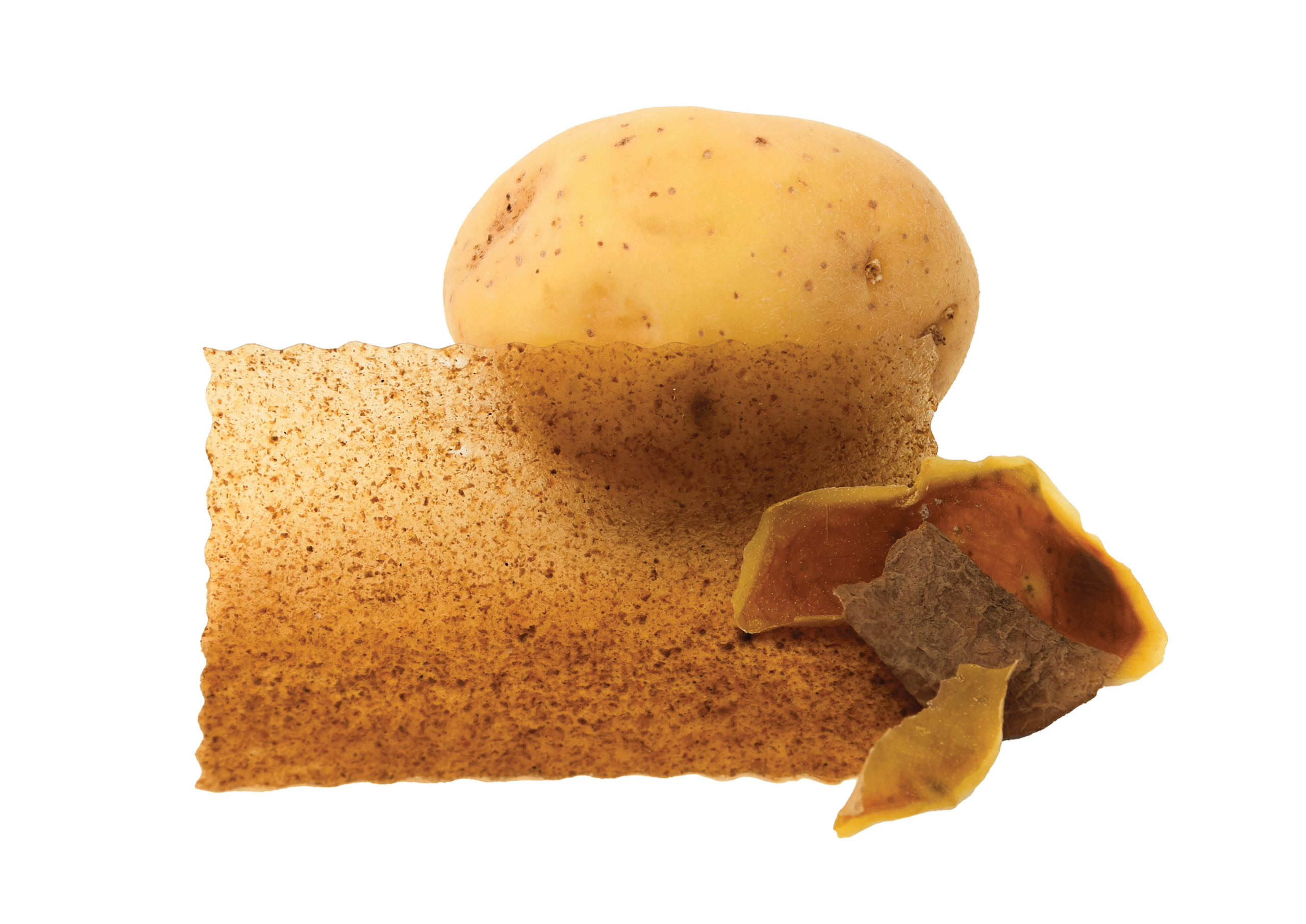
The Pomter project transforms discarded potato peels into sustainable biopolymer packaging, combining innovation, design, and circular economy for eco-friendly solutions.

Define the problem/need you are solving or addressing with your project. How does it address the Open Call criteria, such as environmental impact, social engagement, circularity, user experience, resource efficiency, and community-driven solutions?

Pomter addresses the environmental issue of excessive plastic waste by creating biopolymer packaging from discarded potato peels. This solution promotes circularity by turning organic waste into a sustainable material, reducing landfill waste. It contributes to resource efficiency, using waste that would otherwise be discarded, and offers an eco-friendly alternative to conventional plastic packaging. Additionally, the project enhances user experience by providing a functional, safe, and biodegradable packaging solution. Through this innovative approach, Pomter demonstrates the potential of design to drive sustainable change, offering a scalable solution that aligns with the global shift towards more sustainable production and consumption practices.

Please describe your project, reflecting on the concept, inspiration, materials, technical aspects, methods and process(es).

Pomter addresses the environmental issue of excessive plastic waste by creating biopolymer packaging from discarded potato peels. This solution promotes circularity by turning organic waste into a sustainable material, reducing landfill waste. It contributes to resource efficiency, using waste that would otherwise be discarded, and offers an eco-friendly alternative to conventional plastic packaging. Additionally, the project enhances user experience by providing a functional, safe, and biodegradable packaging solution. Through this innovative approach, Pomter demonstrates the potential of design to drive sustainable change, offering a scalable solution that aligns with the global shift towards more sustainable production and consumption practices.

What do you think makes your project innovative compared to the existing efforts and ideas in the field it addresses?

The concept offers a biodegradable packaging solution made from waste materials, such as potato peels, orange skins, and barley husks. These materials are widely available through the food industry or can be sourced directly from households, making it a versatile and sustainable option. The design focuses on circularity, as the packaging is fully biodegradable, minimizing waste. Unlike conventional plastic packaging, it provides an eco-friendly alternative, reducing environmental impact. The simplicity of the ingredients allows for scalability, meaning it can be produced by large companies or even individuals at home. Compared to existing solutions, this approach stands out for its use of readily available, low-cost, and biodegradable materials. As an innovative alternative to plastic, it contributes to reducing waste while promoting sustainable practices.

Does it impact or reflect young people need(s) and how?

The project aligns with the values and needs of young people today, who are increasingly aware of environmental issues and seek sustainable solutions. As the next generation of consumers, young people are driving the demand for eco-friendly alternatives, particularly in packaging. This biodegradable solution, made from waste materials, speaks to their desire for products that reduce plastic waste and contribute to a circular economy. The simplicity of the design also encourages a hands-on approach, enabling individuals, even in their own households, to participate in sustainable practices. Furthermore, the concept resonates with the growing trend of mindful consumption and personal responsibility, empowering young people to make a positive impact on the environment.

regalsystem

A solid wood shelving system that could hardly be simpler in its construction and
production and yet, as an architectural sculpture, not only provides storage space, but also structures the space itself.

Define the problem/need you are solving or addressing with your project. How does it address the Open Call criteria, such as environmental impact, social engagement, circularity, user experience, resource efficiency, and community-driven solutions?

Dealing with the question of storage space and room division is probably not one of the biggest problems of our time. But it is precisely on a small scale that we can develop the necessary profound respect for the materials, experiment with suitable production techniques and thus address and discuss fundamental questions. My design is made from a renewable raw material and does not require any composite materials, even the individual components are neither glued nor screwed together, but are simply clamped. The shelf is made only from wood and is manufactured in a way that promises a long service life, as the durability of an object must be the basic premise for sustainability. This idea is also continued in the modularity of the design: needs change and it can only be an advantage if the objects that surround us are able to cope with these changes.

Please describe your project, reflecting on the concept, inspiration, materials, technical aspects, methods and process(es).

My design is developed in solid wood and consists of only three different parts. As fasteners are not required, the shelving system can be assembled and disassembled without tools. Two half-round rods, tapered at both ends, meet in holes in a shelving board. One rod is inserted from above, the second from below. As soon as the rods together reach the diameter of the hole, they lock together with the shelf. The interplay between the short and long rods of the same shape results in a wide range of installation options. Stable and accessible from all sides, the shelf can move freely away from the wall and create new spaces.

What do you think makes your project innovative compared to the existing efforts and ideas in the field it addresses?

My design practice is based on going back and forth within my craft as I explore different approaches to the material to gain new perspectives on how the contemporary can be rooted in tradition. It is this new look at tradition that can offer the potential for innovation. A traditional technique in woodturning is the “paper joint”, on which my design is based. After turning, the workpiece can be split exactly in half lengthwise along a glued-in layer of paper. The result is a construction reduced to the essentials, which nevertheless possesses an independent and unique aesthetic. This technique also minimizes waste during the production of the half-round rods. A process that can be scaled up for serial production and is still geared towards small scale manufacturing.

Does it impact or reflect young people need(s) and how?

Objects to which an emotional bond is formed are enhanced, used more consciously and subsequently experience adequate handling, care and maintenance. It is therefore worthwhile working on how a substantial relationship between users and products, can be fostered as early as the design process. The lives of young people in particular are in a state of flux. Flexible and durable pieces of furniture are the right companions. My design is based on the idea of producing tangible objects of experience. Transparency is therefore of crucial importance: as a user, I have to understand how I can participate. The decisive factor here is that the possibility of involving the user in the completion of an object must be coherent from the design, part of the use, as it were, and must not be justified by cost minimization. Transparency favors interactivity, interactivity holds the potential of listening to the things.

La Fourmilière. Cohousing para jóvenes con diversidad funcional.

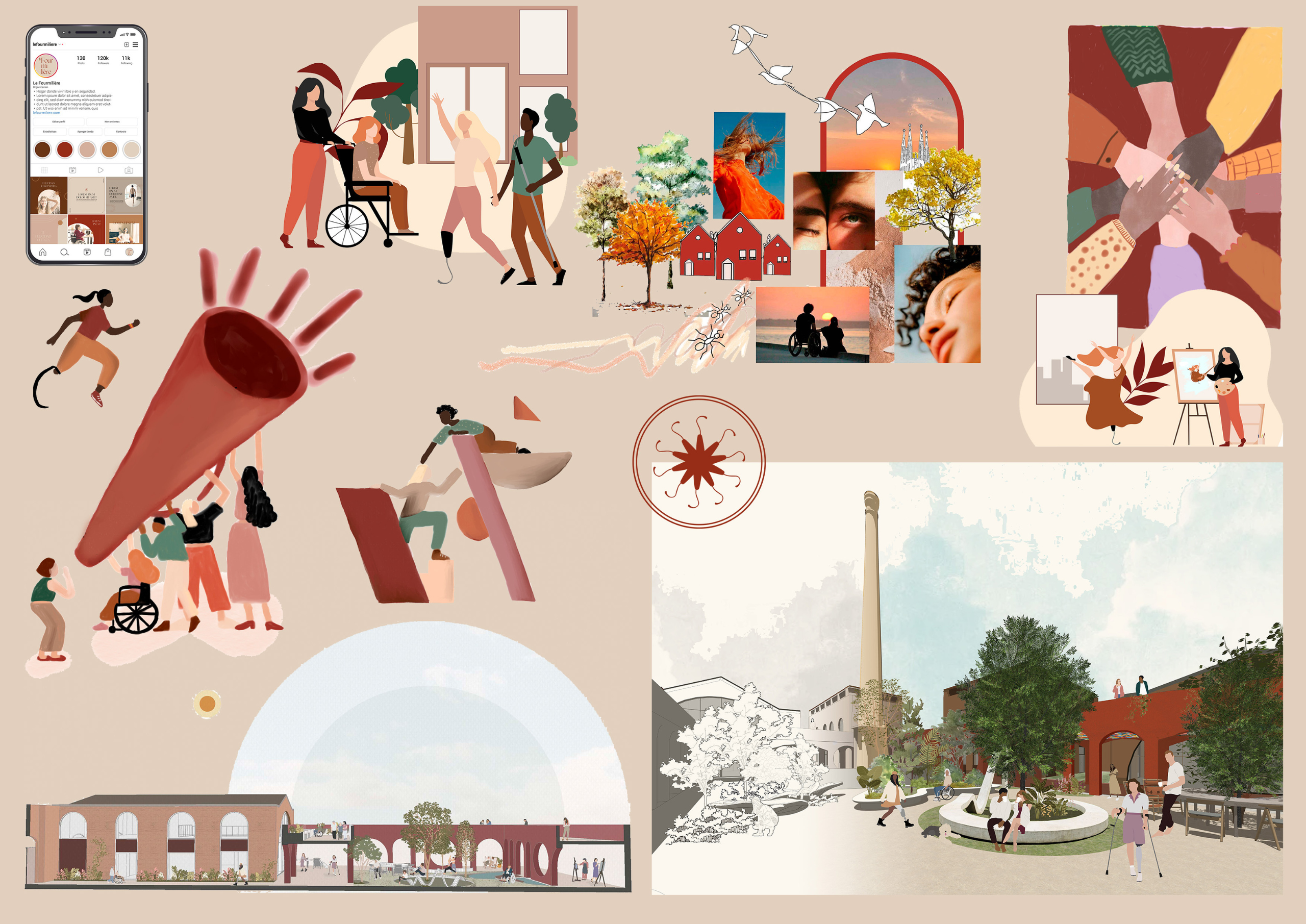
Cohousing for young people with functional diversity — a barrier-free space that promotes overall well-being, a proactive and autonomous life within a community. An accessible space, open to the neighborhood, designed with principles of neuroarchitecture, health, and sustainability in mind.

Define the problem/need you are solving or addressing with your project. How does it address the Open Call criteria, such as environmental impact, social engagement, circularity, user experience, resource efficiency, and community-driven solutions?

The origin of this project lies with young people with functional diversity. We are young individuals who often spend long periods in hospital environments, face loneliness, feel confined, and constantly battle numerous barriers that make our daily lives frustrating and exhausting. Hundreds of young people from different registered pathology groups, as well as healthcare professionals, were interviewed and surveyed to gain a deep understanding of their needs. The project incorporates principles of neuroarchitecture to design a multisensory space that fosters a sense of belonging and community, while promoting social and urban integration. Art is also used as a tool for health and emotional well-being. This project proves that there is an alternative model of residential living for these young people. Interior design has the power to care for individuals, influence their health, boost proactivity, support autonomy, and enhance emotional well-being — all while being mindful of the environment.

Please describe your project, reflecting on the concept, inspiration, materials, technical aspects, methods and process(es).

This project is thoroughly developed across more than 500 pages. It covers everything from the branding and visual identity of the community to the construction details of accessible furniture. For example, the “camouflage beds” are hospital beds designed to look like contemporary sofas, allowing young people to socialise while staying in their anti-pain (antiálgica) position — one that does not increase their discomfort. Accessibility is approached at a micro scale, offering multiple possibilities to accommodate diverse bodies. It is subtle, inclusive, and embedded into the design without being intrusive.

The project is located in a former factory in Barcelona. The complex consists of several interconnected buildings, arranged around a multisensory garden at its centre. Materials used are of natural origin, in an earthy colour palette inspired by anthills. The entire project is developed following principles of sustainability and energy efficiency. It includes thermal and photovoltaic solar panels, aerothermal systems for climate control, and rainwater harvesting systems.

What do you think makes your project innovative compared to the existing efforts and ideas in the field it addresses?

This project stems from a deeply personal place of attentive listening. It has brought hope and excitement to many young people living in vulnerability and loneliness. Through meticulous work, I wanted to prove — down to the last detail — that a different residential model for young people like us is not only possible, but necessary. We are often forgotten, seen only through the lens of dependency and decline. But we have a voice. We are still young, even if we are ill, and we do not want to live in the existing residential spaces — because they were neither created by us nor for us. The lack of truly accessible housing is a serious issue in our society. It hinders our independence and perpetuates exclusion. Every spatial decision in this project is backed by deep research to ensure that it genuinely cares for the person — physically, emotionally, cognitively, and socially. Nature and art are central sources of well-being in this space. It will also serve as a platform — a loudspeaker — and a space for cultural activities in the city, because we have a lot to say.

Does it impact or reflect young people need(s) and how?

Yes — that’s the goal: to give visibility to the reality of many young people who often have no voice. La Fourmilière is a project that, when seen, moves young people with different conditions — they feel seen, and they dream of one day being able to live there. It was designed through the active listening of hundreds of young people, interviewed and surveyed in hospitals, rehabilitation centres, their homes, or residential facilities. We need to show that another way of living is possible — a space that truly cares for us, that responds to our needs, and supports our autonomy and well-being. As Alvar Aalto said, “When you design for the most vulnerable, you are designing for everyone.” The image of the anthill (La Fourmilière) captures this spirit beautifully: ants may seem fragile, but they are incredibly strong and masters of cooperation and teamwork. This cooperative housing model would allow us to share life, experiences — and also the costs of care — together.