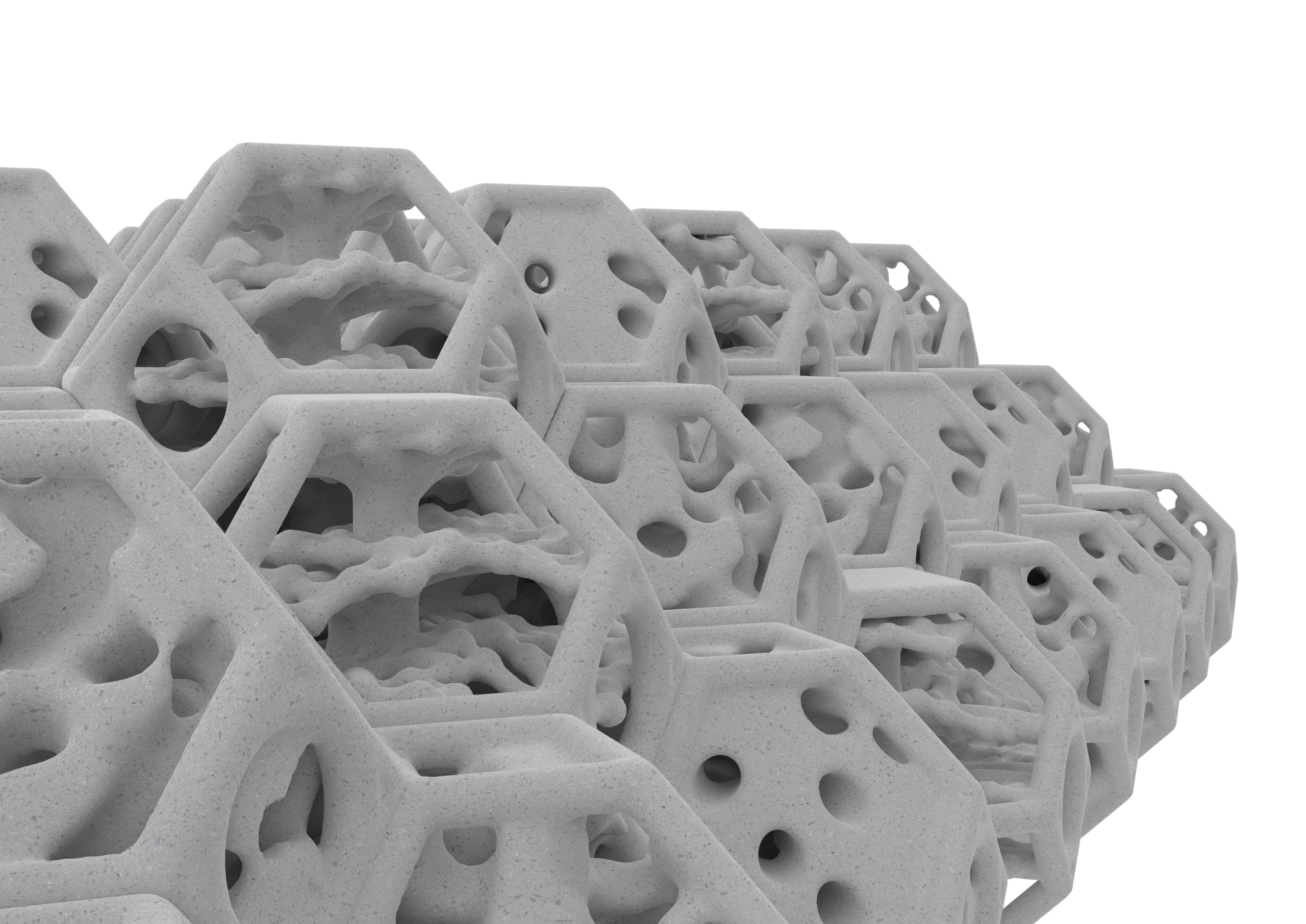
WaveHalt. Artificial reef system to prevent beach erosion in Platja Llarga

Regeneration of Tarragona’s coastal seabed by means of a modular and scalable artificial reef system

Define the problem/need you are solving or addressing with your project. How does it address the Open Call criteria, such as environmental impact, social engagement, circularity, user experience, resource efficiency, and community-driven solutions?

Coastal ecosystems are under increasing pressure from sand erosion, artificialization, and biodiversity loss. In many Mediterranean beaches, natural sediment dynamics are disrupted, leaving flat, unstable seabeds with low ecological complexity. This not only accelerates shoreline retreat but also weakens marine habitats and local socio-economic resilience. My project addresses this challenge through a modular artificial reef system designed to reduce wave energy during storm conditions while fostering native marine life. By combining coastal engineering principles with ecological design, the system promotes sediment stabilization and habitat regeneration simultaneously. It aligns with the Open Call criteria by delivering measurable environmental impact, using resource-efficient marine concrete solutions, and proposing a scalable, circular system designed for long-term ecological integration. The project also considers community stakeholders like divers, coastal users, and local authorities, ensuring that the intervention enhances both ecosystem health and public coastal experience.

Please describe your project, reflecting on the concept, inspiration, materials, technical aspects, methods and process(es).

The project proposes a modular artificial reef system designed as both a coastal protection infrastructure and a living ecological scaffold. Inspired internally by the structural logic of branching corals such as Acropora palmata, the geometry is conceived to dissipate wave energy while creating microhabitats for marine species. The design process combined biological research, coastal engineering principles, and digital simulation. Wave behavior, storm conditions, and seabed bathymetry informed the reef’s crest height, porosity, and spatial configuration. CFD simulations were used to evaluate energy dissipation and sediment interaction before prototyping. The structure is conceived for binder-jetting fabrication in marine-grade recycled concrete. The modular logic allows phased deployment, enabling scalability and adaptability to different coastal contexts while maintaining ecological functionality and structural performance.

What do you think makes your project innovative compared to the existing efforts and ideas in the field it addresses?

What makes this project innovative is its integration of coastal engineering performance with ecological regeneration within a single design framework. While many artificial reefs are primarily conceived either as habitat structures or as breakwaters, this system is developed from the outset to operate simultaneously as sediment-stabilizing infrastructure and biodiversity catalyst. The innovation lies in its performance-driven geometry: wave energy dissipation, porosity, and crest dimensions are defined through hydrodynamic analysis rather than purely volumetric or aesthetic considerations. Instead of deploying massive barrier structures, the project proposes a modular cluster system that works with natural wave refraction patterns and local bathymetry. Additionally, the reef is conceived as a scalable, adaptable system rather than a fixed object, allowing site-specific calibration. The project reframes artificial reefs as regenerative coastal systems rather than static underwater constructions.

Does it impact or reflect young people need(s) and how?

This project reflects young people’s urgent need for climate-responsive and regenerative design solutions. My generation is growing up in the context of accelerating coastal erosion, biodiversity loss, and increasing climate instability. Beaches are not only ecological systems but also social and cultural spaces that shape collective identity and well-being. By proposing a reef system that protects coastlines while restoring marine life, the project responds to the demand for solutions that are not extractive, but restorative. It also represents a shift in how infrastructure is imagined: not as rigid defense, but as adaptive, nature-integrated systems. Furthermore, the project bridges science, technology, and design. Fields increasingly interconnected in the careers of young creatives. It embodies a mindset that values interdisciplinary thinking, long-term ecological responsibility, and community awareness, aligning with the priorities and environmental consciousness of younger generations.
NEXT GEN DESIGN OPEN CALL 2026 LAUNCHED: “FUTURES WORTH LIVING” 

Five leading European design platforms invite young European designers to disrupt with purpose. 
The second edition of the Next Gen Design Competition has launched its 2026 Open Call, inviting young creatives across Europe to engage with a world in flux and address urgent global challenges through bold, regenerative, and inclusive design. Under the theme “Futures Worth Living,” the competition calls on young creatives from 18 to 35 who are born, studying, or living in Europe to challenge outdated systems and propose human-centered innovations that protect the environment, strengthen social cohesion, and reimagine how we live together.

Exceptional Opportunities for Winners

From all submissions, the jury will select 50 winning projects to join the Next Gen Design Cohort 2026, gaining outstanding opportunities for international visibility and professional development. 

The selected works will be presented through the Next Gen Design Traveling Exhibition, reaching international audiences and industry leaders. The exhibition will premiere at the Mikser Festival in Novi Pazar in June 2026, before continuing to What Design Can Do Live, Vienna Design Week, Barcelona Design Week, and Skopje Design Week later that year.

Selected designers will participate in fully funded residency programs in one of the five partner cities. During intensive 4–5 day design sprints, participants will collaborate in teams to tackle local challenges and present their solutions to expert juries. Travel, accommodation, and daily expenses are fully covered.

At each residency location, three projects will receive monetary awards from a €2,000 regional prize fund (1st Prize: €1,000; 2nd Prize: €600; 3rd Prize: €400), supporting further education and project development in circular design.

International Jury of Change-makers

Submissions will be evaluated by a diverse panel of forward-thinking innovators, social change-makers, and leading practitioners of sustainable and social design: Henriette Waal – Designer, researcher, co-founder of Atelier Luma, and artistic leader of Veenweide Atelier (The Netherlands); Juan Umbert – Entrepreneur, CEO, innovator, and creative soul (Barcelona, Spain); Nikola Radeljković – Industrial designer, Numen / ForUse (Croatia); Elli Schindler – Managing director of designaustria and designforum Wien (Austria); and Emile Smeenk – Designer, entrepreneur, and founder of Cool Bricks and Nature Nomads (The Netherlands).

How to Apply & Deadline

The call is currently open. For more information, full evaluation criteria, and submission guidelines, visit the competition page: www.nextgendesign.eu/open-call-2026/ 

Eligible designers must submit their applications, including project descriptions and visual materials, via the online form at www.nextgendesign.eu/application-form

Deadline for submissions is midnight on March 24, 2026.

For competition-related inquiries, please contact competition@nextgendesign.eu

—————————————————————

FOR THE EDITORS

For photos, visual assets and other press materials, please visit the Next Gen Design Press Pack.

For any press enquiries or more information regarding Nex Gen Design, please contact comms@whatdesigncando.com

—————————————————————

ABOUT NEXT GEN DESIGN

Next Gen Design is a three-year, multinational program that brings together research, competitions, and public events to encourage the European design sector — particularly emerging designers — to create, adopt, and promote sustainable design solutions aligned with the European Green Deal. 

Five major international design platforms and annual festivals – Skopje Design Week (North  Macedonia), Mikser Festival (Serbia), designaustria (Austria), What Design Can Do (the Netherlands), and Barcelona Creativity & Design Foundation / Barcelona Design Week (Spain) — have joined forces to launch Next Gen Design collaborative initiative aimed at strengthening youth participation in the design sector while advancing a shift toward circular, socially responsible design practices across Europe.

The initiative emerges at a moment when the world is facing intensifying climate and social challenges. Across the globe, young people have responded with remarkable energy and creativity, raising their voices and calling for more ambitious action to protect their future. Yet a clear gap persists between acknowledging these concerns and translating them into meaningful change. Next Gen Design responds directly to this challenge by creating opportunities for young designers to actively participate in shaping more sustainable and inclusive systems.

At the core of the project is the development of an innovative educational and engagement platform embedded within leading European design festivals. Combining physical and digital formats, the platform expands the role of festivals beyond cultural events, positioning them as spaces for learning, experimentation, and collaboration around circular economy principles. 

Through annual design competitions in 2025 and 2026, open calls, research surveys, events, and international residencies, the program encourages young creatives to explore how design can address environmental and social issues while imagining more resilient futures.

The partnership also highlights the role that emerging designers can play in advancing the goals of the European Green Deal. By supporting designers aged 18–35 across Europe, the project seeks to nurture a generation of professionals who view sustainability, circularity, and social responsibility as integral to their practice. In doing so, it aims to harness the creativity and innovation of young talents while fostering a deeper sense of responsibility toward communities and the planet.

The project is co-funded by the European Union through the Creative Europe Program.