ANNOUNCING THE WINNERS: NEXT GEN DESIGN 2026 “Futures Worth Living”

The shift is here—fearless, human, and driven by purpose.

We are excited to announce the 50 winning projects of the NEXT GEN DESIGN 2025 competition!

This year’s edition, themed “Futures Worth Living,” received 190 bold visions from 29 European countries. From reclaiming data sovereignty, to designing for co-creation and repairability, as well as imagining alternative food and healthcare systems and exploring more-than-human approaches, the projects reflect a bold commitment to going beyond progress—toward meaning, belonging, and collective well-being.

We extend our heartfelt gratitude to every applicant who contributed their energy and vision!

After an inspiring and demanding selection process, our international jury has chosen 50 groundbreaking projects that offer forward-thinking responses to the complexities of our time—offering human-centered, inclusive, and transformative design solutions that move us closer to futures truly worth living.

Congratulations to all the winners!

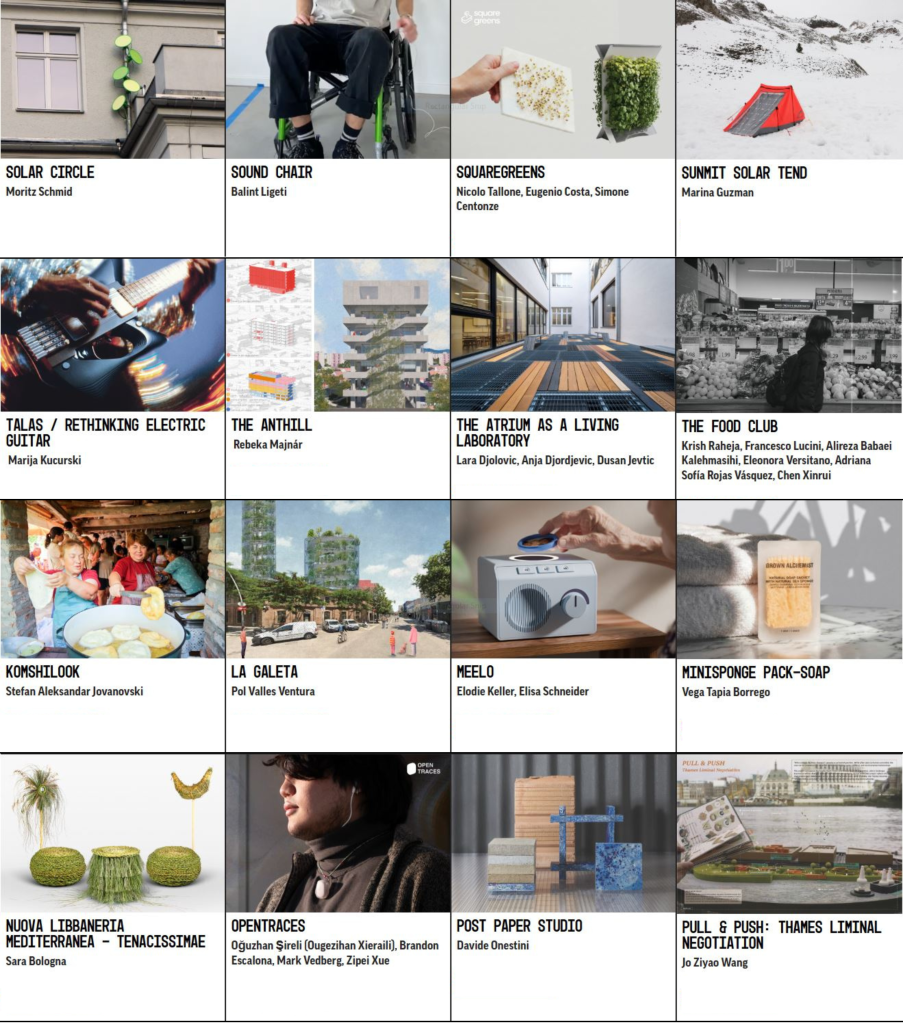
You can find the full list of selected projects below.


Aescu – Analogue self-medication error prevention for older adults with polypharmacy living at home – Niki Riehs – Austria

Balance – Break Management System for Healthcare Teams – Emily Klein – Austria

BEASTIE: Biodiversity Enhancement and Support Tool for Individuals and Ecosystems – Aakriti Singh – Spain

Biome – Juana John – Germany

Bleh! Ode to the Tongue – Jana Valdé Cusachs – Spain

Bojan – DIY inkjet printer – Jakša Bogdan – Croatia 

Bold Collection – Ibrahim Beqiri – Kosovo 

Botijo, the furniture that breathes cool air – Natalia Valverde Garrido – Spain

Can Crea — Intergenerational Cultural Center – Alessandro Pantoja Esna – Spain

Care-ierr – foldable cardboard cat transporter – Milja Brstina – Serbia

Chaiterra – Leja Rebolj – Slovenia

Chick-Inn – Borbála Kiszely, Angelique Tscherne (The Interns) – Austria

Cloud of Polyphony – Hanchen – Netherlands

CriticON – Designing Critical Thinking in the Age of Missinformation – Sebastian Melenge Valladares – Spain

Da Grigio A Verde. Campaigning for a greener and healthier city – Barbara Koniecka – Italy

Das hier ist propaganda – Janine Kerscher – Germany

Eco Doka – Giulia Principe – Netherlands

EcoRush – Design of a Didactic Game for Developing Ecological Awareness in Children – Emina Murtezić – Bosnia and Herzegovina

Flössern – in fluent – Laurn Böhm – Germany

Forecast Typeface – Kelly Azevedo Galvão – Germany

Human–Nature – Iza van der Klauw – Netherlands

Inocula – Michael Pfandl – Austria

Interloom – Josquin Fromagé – Netherlands

Just Bones – Valdís Steinarsdóttir – Iceland 

KomshiLOOK – Stefan Aleksandar Jovanovski, Angela Dimeska – North Macedonia

La Galeta – Pol Valles Ventura – Spain

Meelo – Elodie Keller, Divya Tyagi, Elisa Schneider – Germany

Minisponge Pack-Soap – Vega Tapia Borrego – Spain

Nuova Libbaneria Mediterranea – Tenacissimae – Sara Bologna – Italy

OpenTraces – Ougezihan, Mark, Brandon, Zipei (Intervening Next) – Sweden

Post Paper Studio – Davide Onestini (By the End of May) – Portugal

Pull & Push: Thames Liminal Negotiation – Jo Ziyao Wang – United Kingdom

Punt – Pere Itchart – Spain

Recognise and respond – Jesica Balakumar – United Kingdom

Seder – Self Service Denim Repair – Lena Muri – Austria

Seeds of Curiosity – Asena Bacaksiz – Italy

Solar Circle – Moritz Schmid – Germany

Sound Chair – Balint Ligeti – Hungary

Squaregreens – Eugenio Costa, Nicolo Tallone, Simone Centonze (Spinto) – Italy

Sunmit Solar Tend – Marina Guzman – Spain

Talas / Rethinking Electric Guitar – Marija Kucurski – Serbia

The Anthill – Rebeka Majnár – Hungary

The Atrium as a Living Laboratory – Lara Đolović, Anja Đorđević, Dušan Jevtić – Serbia

The Food Club – Krish Raheja, Eleonora Versitano, Alireza Babaei Kalehmasihi, Francesco Lucini, Adriana Sofia Rojas Vasquez – Italy

The Healing Campus – Katrina Deicmane – Latvia

Thor(No) Tech – Giulia De Franco – Italy

Tubler system – Marko Škrbić – Bosnia and Herzegovina

Tumble: a vertical mouse for left and right hand – Anna Kudrjavceva – Serbia

WAHA: A Modular Biopolymer-Based System for Soil Reclamation and Water Optimization in Arid Regions – Ekim Güney Öztürk – Italy

WaveHalt. Artificial reef system to prevent beach erosion in Platja Llarga – Abril Poblet Baringo – Spain

NEXT GEN DESIGN OPEN CALL 2026 LAUNCHED: “FUTURES WORTH LIVING” 

Five leading European design platforms invite young European designers to disrupt with purpose. 
The second edition of the Next Gen Design Competition has launched its 2026 Open Call, inviting young creatives across Europe to engage with a world in flux and address urgent global challenges through bold, regenerative, and inclusive design. Under the theme “Futures Worth Living,” the competition calls on young creatives from 18 to 35 who are born, studying, or living in Europe to challenge outdated systems and propose human-centered innovations that protect the environment, strengthen social cohesion, and reimagine how we live together.

Exceptional Opportunities for Winners

From all submissions, the jury will select 50 winning projects to join the Next Gen Design Cohort 2026, gaining outstanding opportunities for international visibility and professional development. 

The selected works will be presented through the Next Gen Design Traveling Exhibition, reaching international audiences and industry leaders. The exhibition will premiere at the Mikser Festival in Novi Pazar in June 2026, before continuing to What Design Can Do Live, Vienna Design Week, Barcelona Design Week, and Skopje Design Week later that year.

Selected designers will participate in fully funded residency programs in one of the five partner cities. During intensive 4–5 day design sprints, participants will collaborate in teams to tackle local challenges and present their solutions to expert juries. Travel, accommodation, and daily expenses are fully covered.

At each residency location, three projects will receive monetary awards from a €2,000 regional prize fund (1st Prize: €1,000; 2nd Prize: €600; 3rd Prize: €400), supporting further education and project development in circular design.

International Jury of Change-makers

Submissions will be evaluated by a diverse panel of forward-thinking innovators, social change-makers, and leading practitioners of sustainable and social design: Henriette Waal – Designer, researcher, co-founder of Atelier Luma, and artistic leader of Veenweide Atelier (The Netherlands); Juan Umbert – Entrepreneur, CEO, innovator, and creative soul (Barcelona, Spain); Nikola Radeljković – Industrial designer, Numen / ForUse (Croatia); Elli Schindler – Managing director of designaustria and designforum Wien (Austria); and Emile Smeenk – Designer, entrepreneur, and founder of Cool Bricks and Nature Nomads (The Netherlands).

How to Apply & Deadline

The call is currently open. For more information, full evaluation criteria, and submission guidelines, visit the competition page: www.nextgendesign.eu/open-call-2026/ 

Eligible designers must submit their applications, including project descriptions and visual materials, via the online form at www.nextgendesign.eu/application-form

Deadline for submissions is midnight on March 24, 2026.

For competition-related inquiries, please contact competition@nextgendesign.eu

—————————————————————

FOR THE EDITORS

For photos, visual assets and other press materials, please visit the Next Gen Design Press Pack.

For any press enquiries or more information regarding Nex Gen Design, please contact comms@whatdesigncando.com

—————————————————————

ABOUT NEXT GEN DESIGN

Next Gen Design is a three-year, multinational program that brings together research, competitions, and public events to encourage the European design sector — particularly emerging designers — to create, adopt, and promote sustainable design solutions aligned with the European Green Deal. 

Five major international design platforms and annual festivals – Skopje Design Week (North  Macedonia), Mikser Festival (Serbia), designaustria (Austria), What Design Can Do (the Netherlands), and Barcelona Creativity & Design Foundation / Barcelona Design Week (Spain) — have joined forces to launch Next Gen Design collaborative initiative aimed at strengthening youth participation in the design sector while advancing a shift toward circular, socially responsible design practices across Europe.

The initiative emerges at a moment when the world is facing intensifying climate and social challenges. Across the globe, young people have responded with remarkable energy and creativity, raising their voices and calling for more ambitious action to protect their future. Yet a clear gap persists between acknowledging these concerns and translating them into meaningful change. Next Gen Design responds directly to this challenge by creating opportunities for young designers to actively participate in shaping more sustainable and inclusive systems.

At the core of the project is the development of an innovative educational and engagement platform embedded within leading European design festivals. Combining physical and digital formats, the platform expands the role of festivals beyond cultural events, positioning them as spaces for learning, experimentation, and collaboration around circular economy principles. 

Through annual design competitions in 2025 and 2026, open calls, research surveys, events, and international residencies, the program encourages young creatives to explore how design can address environmental and social issues while imagining more resilient futures.

The partnership also highlights the role that emerging designers can play in advancing the goals of the European Green Deal. By supporting designers aged 18–35 across Europe, the project seeks to nurture a generation of professionals who view sustainability, circularity, and social responsibility as integral to their practice. In doing so, it aims to harness the creativity and innovation of young talents while fostering a deeper sense of responsibility toward communities and the planet.

The project is co-funded by the European Union through the Creative Europe Program.