Minisponge Pack-Soap

Minisponge rethinks the single-use bathing ritual in hospitality by merging packaging and product into one biodegradable system that reduces plastic, volume, and waste at the source.

Define the problem/need you are solving or addressing with your project. How does it address the Open Call criteria, such as environmental impact, social engagement, circularity, user experience, resource efficiency, and community-driven solutions?

Daily hygiene products are still designed within a linear consumption model based on synthetic materials, plastic packaging, and immediate disposal. This issue becomes more critical in the hospitality sector, where single-use amenities generate large volumes of waste, unnecessary packaging, and inefficient logistics. Minisponge addresses this problem by rethinking the structure of the product itself. Instead of separating packaging and product, it integrates both into a single biodegradable system. The soap-based wrapper dissolves during use, activating the sponge while eliminating packaging waste at the source.

This approach reduces material use, transport volume, and final waste, while improving user experience through simplicity and functionality. By redesigning an everyday ritual, the project contributes to circular thinking and promotes more responsible consumption patterns in both hospitality and travel contexts.

Please describe your project, reflecting on the concept, inspiration, materials, technical aspects, methods and process(es).

Minisponge is based on a simple idea: merging packaging and product into a single functional unit. The project rethinks the conventional bathing sponge by turning its wrapper into an active part of the experience. The system consists of a compressed vegetal sponge enclosed within a solid soap-based wrapper. When in contact with water, the soap dissolves, creating foam that is absorbed by the sponge, making it ready for use while the packaging disappears. The design process focused on reducing material layers and eliminating unnecessary structures, prioritising clarity and functionality. Materials were selected for their biodegradability and compatibility, allowing both elements to work as a single system. By integrating use and disposal into one gesture, Minisponge transforms a common object into a more efficient and intentional solution.

What do you think makes your project innovative compared to the existing efforts and ideas in the field it addresses?

What makes Minisponge innovative is not the material itself, but the way the system is structured. Instead of improving packaging or replacing it with alternative materials, the project removes the need for it by integrating packaging and product into a single element. The soap-based wrapper becomes part of the use, dissolving with water and disappearing during the process. This eliminates waste at the source, rather than managing it afterwards. By removing packaging as a separate layer, Minisponge proposes a structural shift in how single-use products are designed, moving from material substitution to a more integrated and efficient system.

Does it impact or reflect young people need(s) and how?

Minisponge responds to the needs of younger generations, who often travel frequently and look for practical, lightweight, and efficient solutions. Hygiene products can be bulky, restricted by liquid limits, and inconvenient to carry. The project offers a compact, solid alternative that simplifies this experience. Its format reduces volume and weight, making it easier to pack, transport, and use on the go, without compromising functionality. At the same time, it aligns with a growing awareness around waste and overconsumption. By eliminating unnecessary packaging and integrating it into the product itself, Minisponge provides a more convenient and responsible way to approach everyday hygiene while travelling.

Nuova Libbaneria Mediterranea – Tenacissimae 

The project activates regenerative rural economies by reorienting ancestral Mediterranean crafts into a circular, socially responsible design system that empowers local communities and new generations through material knowledge, collective agency, and symbolic narration.

Define the problem/need you are solving or addressing with your project. How does it address the Open Call criteria, such as environmental impact, social engagement, circularity, user experience, resource efficiency, and community-driven solutions?

Maratea, like many other rural Mediterranean areas, is experiencing a progressive erosion of economic autonomy and intergenerational continuity, due to intensive seasonal tourism and a lack of job opportunities for the young generations. Traditional craft knowledge — once embedded in everyday survival economies — is abandoned, leaving communities structurally dependent on external systems of production. This condition produces both economic fragility and symbolic disorientation: younger generations inherit territories deprived of viable models for dignified, locally grounded work. Nuova Libbaneria Mediterranea responds to this structural gap by constructing an alternative micro-economy rooted in craft knowledge, collective production, and locally sourced innovative materials. Through collaboration with young designers, the project addresses the urgent need to reactivate dormant competencies as infrastructure for future-oriented and resilient systems.

Please describe your project, reflecting on the concept, inspiration, materials, technical aspects, methods and process(es).

Tenacissimae is both a collection and a system, reinterpreting Maratea’s traditional “libbani” (vegetable ropes historically woven by women in a barter-based survival economy) into contemporary functional and poetic objects. Recovered through archival research and interviews by Nuova Libbaneria Mediterranea, the ropes are handwoven from an abundant indigenous grass called “tagliamani” (hand-cutting). Production is community-based, small-scale, and technology-independent, with a group of newly trained artisans preserving and cultivating this ancestral knowledge. The Tenacissimae collection includes different outdoor furniture pieces with variable headrests, ideally elevating the posture of the women who wove the history of the city with their hands, symbolically crowning them with haloes. The title references the tenacity of both the grass and the makers – from the past as well as from the present. Besides the furniture pieces, Sara Bologna and Libbaneria are currently developing a new collection of small objects and jewellery intended to address new markets.

What do you think makes your project innovative compared to the existing efforts and ideas in the field it addresses?

The innovation of Tenacissimae lies in its situated and material-based systemic integration. The project addresses:

Economic sustainability, through the generation of alternative rural income streams.
In addition to these recognized dimensions of sustainability, its explicit leverage of symbolism and narrative distinguishes it from other heritage revival initiatives. Tenacissimae reframes artisanal traditions as active systems of knowledge and as a resource for constructing, both materially and imaginatively, futures worth inhabiting, re-orienting value systems from extractive to relational economies.
By placing young generations at the center of knowledge transmission and economic activation, through both residency and training programs, but also through the creation of new territorial narratives, the project contributes to regenerative, decentralized, and culturally rooted models of production. Environmental sustainability, through new uses of natural, locally abundant and low-impact materials and processes; Social sustainability, through skill transmission, community empowerment and collective production;

Does it impact or reflect young people need(s) and how?

The project addresses key needs of young people in rural contexts: access to professional development, hands-on skill acquisition, and cultural belonging.
Through residency programs, young designers and professionals gain exposure to a living craft ecosystem, exchanging knowledge while confronting real-world challenges often absent from formal education. Simultaneously, by generating new imaginaries rooted in ancestral techniques and material culture, the project responds to the need for cultural identity, inspiration, and connection to local heritage.
In addition to that, Nuova Libbaneria Mediterranea also activates training programs directed to youth seeking to acquire manual craft skills and searching for a meaningful life experience, fostering confidence and agency in territories where such opportunities are scarce.
Across these three dimensions, the project creates tools, understanding, and imaginative capacity to envision futures that are both personally empowering and socially regenerative.

OpenTraces

Enabling immigrants to build a shared sound-layer of experiences, placed on top of our physical world.

Define the problem/need you are solving or addressing with your project. How does it address the Open Call criteria, such as environmental impact, social engagement, circularity, user experience, resource efficiency, and community-driven solutions?

OpenTrace addresses the lack of bottom-up, community-driven support systems for migrants navigating new environments. Many migration services are designed top-down, focusing on formal information and institutional guidance, while everyday emotional, cultural, and practical knowledge often remains invisible and fragmented. OpenTrace responds by enabling migrants to leave and access location-based audio traces, turning lived experience into a shared, decentralized layer of support. The project promotes social engagement by connecting people through peer-generated stories and collective memory. It is community-driven in that knowledge is built by migrants themselves, not prescribed for them. In terms of user experience, it explores a lightweight, place-based interaction model that makes access to support more situated and meaningful. The project also reflects resource-conscious thinking by building on simple audio-based interactions and existing everyday behaviors, rather than proposing a heavy or centralized digital infrastructure.

Please describe your project, reflecting on the concept, inspiration, materials, technical aspects, methods and process(es).

OpenTrace is a location-based audio archive that enables migrants to leave, access, and build shared traces of lived experience in the places they move through. The project was inspired by the emotional, practical, and often invisible challenges of migration, and by the lack of bottom-up systems through which newcomers can learn from one another rather than only from institutional guidance. Through speculative design, narrative development, and interaction prototyping, we explored how personal stories, emotions, and everyday knowledge could accumulate into a decentralized layer of support. The project combines spatial interaction, audio storytelling, and a wearable/listening device concept to connect memory with place. Its process involved research into migration, belonging, and memory, followed by concept framing, interaction design, and prototyping. OpenTrace proposes a more situated and collective way of navigating a new world through shared lived experience.

What do you think makes your project innovative compared to the existing efforts and ideas in the field it addresses?

What makes OpenTrace innovative is that it does not approach migration through a top-down service model or a promise of a complete solution. Instead, it proposes a decentralized, emergent support infrastructure built from the lived experiences of migrants themselves. Many existing efforts focus on systems, information, or integration from an institutional perspective, often overlooking emotion, agency, and the small realities of everyday life. OpenTrace shifts the focus to peer-generated traces, allowing people to encounter one another across time through place-based audio. It is designed as a response rather than a perfect solution: lightweight, low-cost, and grounded in practical but emotional interventions. Rather than replacing human connection with technology, it uses technology to make connection, memory, and mutual orientation more possible. Its innovation lies in treating support as something shared, accumulated, and co-existing, not delivered from above.

Does it impact or reflect young people need(s) and how?

Yes. OpenTrace reflects young people’s need for belonging, self-expression, and peer-generated ways of navigating unfamiliar worlds. Many young migrants live between places, languages, and identities, while existing support systems often speak to them in formal, top-down ways that leave emotional and everyday experiences unaddressed. OpenTrace responds by creating a space where young people can leave traces of their own stories, encounter those of others, and build knowledge through shared lived experience rather than instruction alone. It supports agency by allowing users not only to access support, but to contribute to it. It also reflects how many young people already relate to the world: through audio, mobility, informal networks, and emotional connection to place. In this sense, the project is not only about migration, but about how younger generations seek more participatory, decentralized, and human ways of making sense of the world.

Post Paper Studio

Open source recipes and tools that enable local communities to transform paper waste into durable materials, shifting recycling from distant industrial systems to accessible, neighbourhood-based production.

Define the problem/need you are solving or addressing with your project. How does it address the Open Call criteria, such as environmental impact, social engagement, circularity, user experience, resource efficiency, and community-driven solutions?

Paper is widely considered recyclable, yet in practice it depends on centralised systems that collect, transport and process waste across long distances. This creates a paradox: a process meant to reduce impact relies on energy-intensive infrastructures that remain invisible to most people. As the use of paper packaging increases, so does the volume of waste, reinforcing dependence on industrial recycling.

Post Paper Studio addresses this by reframing waste as a local resource. It proposes that paper can be transformed where it is discarded, reducing transport, extending material lifecycles and making the process visible and shared. The project combines circularity and resource efficiency with social engagement, offering accessible methods that enable communities, makers and small businesses to take part in material production, while challenging the assumption that recycling must happen at scale and out of sight.

Please describe your project, reflecting on the concept, inspiration, materials, technical aspects, methods and process(es).

Post Paper Studio is an open system that enables the local transformation of paper waste into usable material for design and construction. It consists of a series of recipes, tools and experiments that combine traditional paper-making techniques with digital fabrication and craft practices. Paper waste is shredded, mixed with water and natural binding agents such as starches or alginate, and processed into a mouldable pulp. This pulp is then pressed using modular, low-tech tools to create sheets, bricks or components that can be further worked using CNC milling, laser cutting or manual techniques. The tools are designed for accessibility and replication: they can be fabricated from a single board of wood or recycled plastic, without glue or screws, and assembled in local workshops. By sharing recipes, blueprints and processes openly, the project invites others to adapt, improve and apply the system according to their local context, resources and needs.

What do you think makes your project innovative compared to the existing efforts and ideas in the field it addresses?

Current approaches to paper recycling operate at two extremes: large-scale industrial systems or small DIY practices with limited performance. Post Paper Studio introduces an intermediate model that combines the reliability of structured processes with the accessibility of local production. Its innovation lies in treating recycling not as a service, but as a distributed design and manufacturing system. By integrating material recipes, tool design and fabrication methods into a single open framework, it enables consistent and repeatable results without requiring specialised infrastructure. The use of natural binders ensures compatibility with existing recycling cycles, while the modular tools allow adaptation to different contexts using locally available materials and skills. This makes the system both technically viable and geographically flexible. Equally important is its open source nature. By making all components accessible, the project shifts innovation from closed development to collective evolution, allowing communities to contribute and refine the system over time.

Does it impact or reflect young people need(s) and how?

Post Paper Studio directly responds to the growing need among younger generations for more transparent, hands-on and meaningful ways of engaging with materials and production. Many young designers, makers and students are increasingly critical of global supply chains, yet lack accessible tools to act on this awareness. By lowering the technical and economic barriers to material experimentation, the project enables young people to move from passive consumption to active participation. Recipes can be reproduced with simple tools and locally available ingredients, while fabrication methods connect with widely accessible technologies such as makerspaces and digital workshops. It encourages experimentation, iteration and collaboration, offering an entry point into material research without requiring specialised laboratories. Beyond skills, it addresses a cultural shift: from designing products to designing systems. By engaging with local waste, young people can better understand resource flows, question existing infrastructures and explore alternative ways of producing and living.

Pull & Push: Thames Liminal Negotiation

A participatory landscape game that reimagines the Thames as an active negotiator, where human decisions are continuously tested by natural forces, revealing how urban futures emerge through conflict, cooperation, and long-term environmental feedback.

Define the problem/need you are solving or addressing with your project. How does it address the Open Call criteria, such as environmental impact, social engagement, circularity, user experience, resource efficiency, and community-driven solutions?

Contemporary urban infrastructure prioritises control, efficiency, and permanence, often excluding public participation and suppressing ecological dynamics. The Thames Tideway “Super Sewer” exemplifies this—costly, disruptive, and socially detached. This project addresses the need for a more adaptive and inclusive approach to city-making by reframing infrastructure as a process of negotiation between human and environmental forces. Environmentally, it embraces river dynamics—erosion, flooding, and change—as active design agents. Socially, it transforms planning into a participatory system, enabling stakeholders to co-create outcomes. Circularity is embedded through reclaimed Thames materials, linking past and future landscapes. Resource efficiency is achieved through modular, reversible interventions rather than fixed construction.

By combining environmental feedback with collective decision-making, the project proposes a community-driven framework where urban form evolves through continuous negotiation rather than top-down control.

Please describe your project, reflecting on the concept, inspiration, materials, technical aspects, methods and process(es).

The project reimagines the abandoned Super Sewer site as a liminal negotiation platform, materialised as a physical, playable landscape along the Thames foreshore. Structured as a board game, participants assume roles—Authority, Public, or Culture—and collaboratively construct proposals using modular blocks representing infrastructure, ecology, and urban space. Decisions are collectively evaluated, and only approved proposals translate from model scale to real-world intervention. The River Thames acts as a fourth player—Nature—continuously eroding and reshaping the site, introducing unpredictability and long-term feedback. Operating across multiple scales—from a 20-minute game to decades of river transformation—the project integrates participation, material experimentation, and environmental processes. Built using reclaimed materials from the foreshore, it physically embeds local history into the design while revealing how short-term decisions generate long-term spatial consequences.

What do you think makes your project innovative compared to the existing efforts and ideas in the field it addresses?

The project is innovative in redefining landscape architecture as a dynamic system rather than a fixed solution. Instead of designing a final form, it constructs a framework where outcomes emerge through interaction between stakeholders and environmental forces. Unlike conventional participatory design, which often ends at consultation, this project embeds participation directly into spatial production through a playable system. The integration of real-time decision-making, physical modelling, and long-term environmental feedback creates a continuous loop between proposal, implementation, and transformation. By positioning the river as an active agent—rather than a constraint—the project challenges anthropocentric planning models and introduces uncertainty as a design driver. This shift from control to negotiation offers a new methodology for addressing complex urban and ecological systems, where adaptability, temporality, and collective authorship replace static, top-down solutions.

Does it impact or reflect young people need(s) and how?

The project directly engages young people by transforming complex urban and environmental systems into an accessible, interactive experience. Through the game-based format, participants can actively test decisions, negotiate with others, and observe long-term consequences, making abstract planning processes tangible and understandable. It addresses a key generational issue: young people will inherit the impacts of climate change and urban development but are rarely involved in shaping them. By enabling participation in decision-making, the project fosters agency, critical thinking, and environmental awareness. The emphasis on uncertainty, negotiation, and long-term feedback reflects the realities young generations face, encouraging a shift from passive observation to active engagement. Ultimately, the project empowers young people to see themselves not as future users of the city, but as current contributors to its ongoing formation.

Punt

Modular mechanical object lift for elderly users, promoting active ageing through everyday movement. Designed for stairwells without elevators, it combines accessibility, simplicity, and social connection in a compact, inclusive system.

Define the problem/need you are solving or addressing with your project. How does it address the Open Call criteria, such as environmental impact, social engagement, circularity, user experience, resource efficiency, and community-driven solutions?

Commercial printers burden students with high ink costs, e-waste from unrepairable “black boxes,” and dependency on proprietary parts, creating financial stress and environmental waste in shared student spaces. Bojan addresses this by being a fully open-source DIY inkjet printer: students assemble it from affordable, off-the-shelf components like NEMA17 motors, ESP32, and 3D-printable parts, understanding every mechanism, from printhead movement to paper feed. Environmental impact through repairability (no proprietary cartridges, refillable HP302) and reduced e-waste; circularity via modular, upgradable design; social engagement and community-driven solutions by inviting hacks and workshops; user experience with customizable print widths and intuitive touchscreen control; resource efficiency using standard parts (~€150 total) for low ongoing costs. Bojan empowers student makers to experiment, collaborate, and sustain their own printing ecosystem.

By combining environmental feedback with collective decision-making, the project proposes a community-driven framework where urban form evolves through continuous negotiation rather than top-down control.

Please describe your project, reflecting on the concept, inspiration, materials, technical aspects, methods and process(es).

PUNT is a modular, mechanical object lift designed for buildings without elevators. It emerges from observing informal, improvised systems—such as ropes and buckets—used to move goods between floors, translating them into a safe, functional, and dignified product.
The project combines a scaffold-like structure with simple mechanical principles, making it intuitive and accessible for elderly users. Built from standard, affordable materials, it is lightweight, easy to assemble, and adaptable to different stairwells.
Its manual activation, inspired by calisthenics movements, transforms a daily task into light physical activity. The design process focused on simplicity, usability, and real contexts, integrating technical feasibility with social and spatial awareness.

What do you think makes your project innovative compared to the existing efforts and ideas in the field it addresses?

PUNT rethinks accessibility by avoiding complex, expensive, and fully automated solutions such as elevators or stair lifts. Instead, it proposes a low-tech, mechanical alternative that complements rather than replaces human movement.
Its innovation lies in combining accessibility with active ageing: users remain physically engaged while reducing effort and risk. The system is modular, non-invasive, and adaptable to existing buildings, overcoming spatial, economic, and regulatory limitations typical of elevator installations.
Additionally, PUNT reframes assistive design through a non-medicalized, playful aesthetic, reducing stigma and encouraging acceptance. By transforming an individual need into a shared infrastructure, it also introduces a community-based approach rarely present in comparable solutions.

Does it impact or reflect young people need(s) and how?

While primarily designed for elderly users, PUNT also reflects broader needs relevant to younger generations, particularly around accessibility, affordability, and collective living.
In cities where housing conditions are increasingly constrained, it offers an adaptable, low-cost solution that can benefit diverse users, from families to people with temporary mobility limitations. Its modular and repairable nature aligns with younger generations’ growing interest in sustainable, circular design.
Moreover, PUNT encourages community interaction by creating shared moments of cooperation within residential spaces. It reframes infrastructure as something participatory rather than invisible, promoting values of mutual care, social connection, and collective responsibility—key concerns for younger people today.

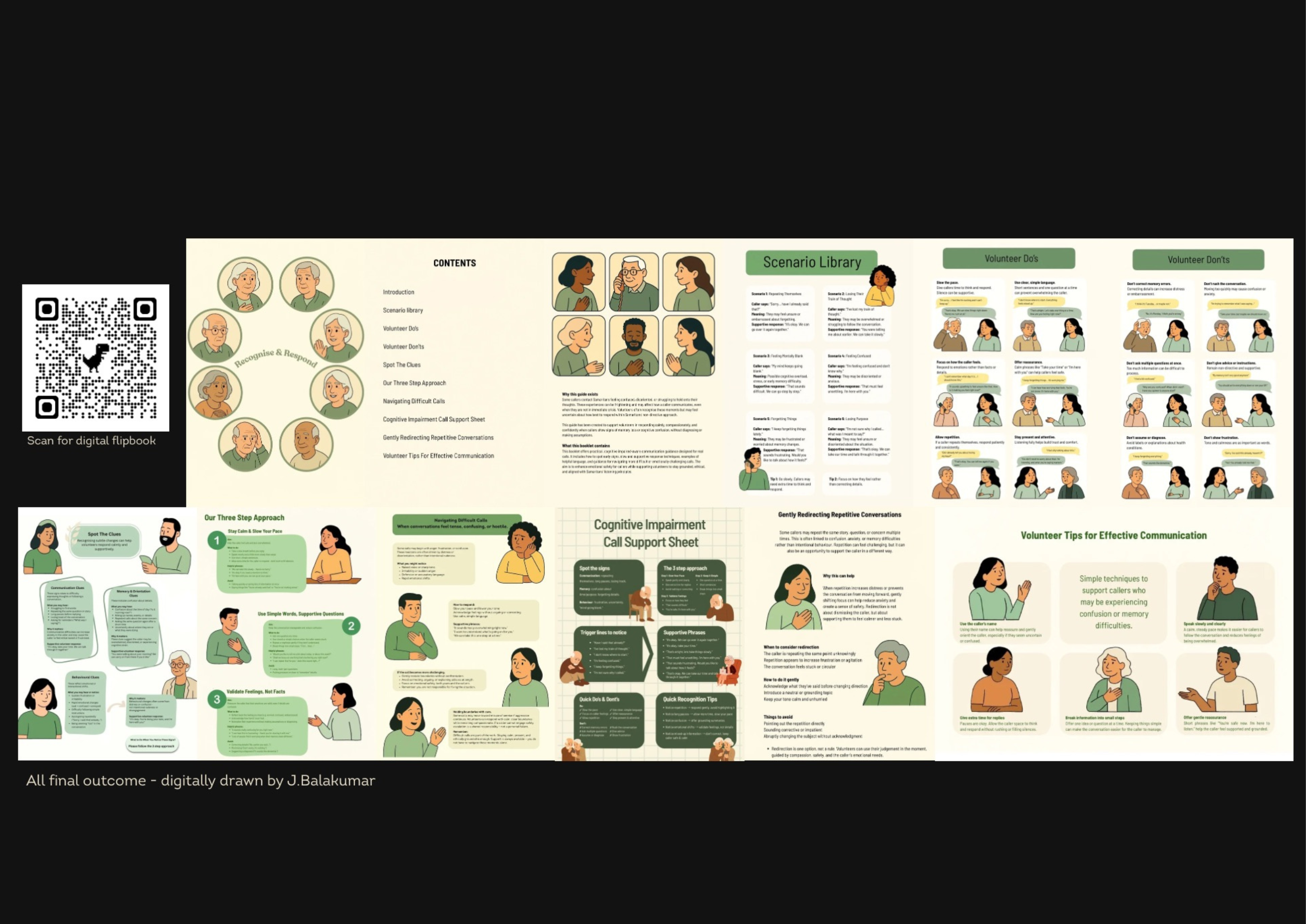
Recognise & Respond

Dementia-aware communication toolkit that equips helpline volunteers to confidently support callers experiencing confusion or memory difficulties through calm, ethical, and non-diagnostic conversations.

Define the problem/need you are solving or addressing with your project. How does it address the Open Call criteria, such as environmental impact, social engagement, circularity, user experience, resource efficiency, and community-driven solutions?

Older adults are increasingly contacting helplines experiencing confusion, memory lapses, and early cognitive changes. While volunteers are well trained in crisis support, there is limited guidance on how to respond to cognitive confusion in a way that is calm, ethical, and non-diagnostic. This gap can increase anxiety for callers and uncertainty for volunteers, affecting emotional safety and service quality. Recognise & Respond addresses this need through a dementia-aware communication toolkit co-developed with volunteers and healthcare professionals. It strengthens user experience by reducing distress and improving volunteer confidence during live calls. The project aligns with social engagement and community-driven solutions by supporting existing volunteer networks rather than replacing them. It is resource-efficient, requiring no new infrastructure or technology, and can be embedded within current training systems. By investing in people’s time and communication skills, the project enhances sustainable, human-centred support services without additional material or environmental impact.

Please describe your project, reflecting on the concept, inspiration, materials, technical aspects, methods and process(es).

Recognise & Respond is a dementia-aware communication toolkit designed to support helpline volunteers when speaking to callers experiencing confusion or memory difficulties. The concept was inspired by my experience as a Samaritans volunteer, where I noticed increasing calls involving repetition, disorientation, and anxiety linked to early cognitive changes. While crisis training is robust, there was little structured guidance for these moments. The project was developed through primary research including care home visits, community engagement, live call observations, and collaboration with senior volunteers and healthcare professionals who work daily with cognitive impairment. Secondary research into dementia communication and social innovation informed the framework. The toolkit consists of a structured call sheet, booklet, and digital module. It uses simple language, clear hierarchy, and low cognitive load design principles to ensure usability under pressure. Iterative prototyping and real-time testing during live calls shaped the final outcome.

What do you think makes your project innovative compared to the existing efforts and ideas in the field it addresses?

What makes Recognise & Respond innovative is its translation of dementia communication principles into a non-clinical, non-directive helpline context. While dementia guidance exists within healthcare and social care settings, there are currently no tools specifically designed for emotional support helplines, where volunteers must avoid diagnosing, advising, or correcting callers. The project bridges that gap by adapting professional communication techniques into a simple, real-time framework that aligns with Samaritans’ listening model. Rather than introducing new systems or technology, it innovates through integration — embedding structured, dementia-aware guidance within existing volunteer training. Its strength lies in co-design: developed alongside volunteers and informed by healthcare professionals, then tested during live calls. The innovation is therefore practical, ethical, and context-specific. By focusing on human interaction rather than technological intervention, the project offers a scalable, low-cost solution that strengthens emotional safety and volunteer confidence in everyday support settings.

Does it impact or reflect young people need(s) and how?

Although Recognise & Respond primarily addresses older callers experiencing cognitive confusion, it also reflects young people’s needs in several ways. Many young volunteers support helplines, and providing clear, structured guidance increases their confidence when handling complex or unfamiliar calls. This reduces anxiety, supports skill development, and strengthens volunteer retention among younger generations. In addition, young people are often informal carrers for grandparents or older relatives experiencing early cognitive changes. The communication principles within the toolkit — slowing down, validating feelings, and avoiding correction — can be applied beyond helplines, supporting intergenerational understanding and empathy. The project also promotes youth engagement in community-driven solutions by empowering young volunteers to contribute meaningfully within social support systems. By equipping them with practical, ethically grounded tools, the project enhances both their user experience as volunteers and their capacity to support vulnerable members of the community.

Seder – Self Service Denim Repair 

Give people the power to fix their jeans faster by using embroidery technology instead of buying a new pair.

Define the problem/need you are solving or addressing with your project. How does it address the Open Call criteria, such as environmental impact, social engagement, circularity, user experience, resource efficiency, and community-driven solutions?

Fast fashion has normalised immediate consumption while making clothing repair increasingly obsolete. Well-fitting but damaged jeans are often stored instead of repaired, due to a lack of repair knowledge, especially among younger generations, and limited access to tailors with unclear costs and long waiting times. This leads to unnecessary resource use, textile waste, and the gradual loss of repair craftsmanship.
SEDER addresses this gap by making repair accessible, understandable, and immediate. It supports circular practices by extending garment lifespans and reducing demand for new production. The system lowers barriers to participation through a guided, intuitive user experience and enables self-repair without prior skills. By decentralising repair into a self-service solution, it encourages community-based engagement with maintenance and care. This contributes to environmental responsibility, resource efficiency, and a cultural shift towards more sustainable and conscious consumption habits.

Please describe your project, reflecting on the concept, inspiration, materials, technical aspects, methods and process(es).

The Self-Service Denim Repair Station is a user-centred system that enables people to repair their jeans independently using embroidery technology. The concept is inspired by my own experience of repeatedly repairing my favourite jeans, and by observing how others store damaged garments with the intention to fix them later. However, many are hindered by the required craftsmanship, lack of knowledge, and limited access to tools.
As a trained seamstress, I believe repair can be made more accessible. SEDER is a physical terminal that guides users step by step through a simplified darning process. A built-in camera detects fabric damage and translates it into an embroidery pattern that reinforces the textile. The repair is executed automatically without prior sewing knowledge.
The system combines digital interface design, image recognition, and automated embroidery, transforming repair into an intuitive, time-efficient experience while reconnecting users with contemporary repair practices.

What do you think makes your project innovative compared to the existing efforts and ideas in the field it addresses?

SEDER introduces a new approach by combining self-service principles with textile repair, shifting the process from expert-based craftsmanship to accessible user interaction. Unlike traditional tailoring or DIY repair kits, it removes the need for prior knowledge while maintaining a high-quality outcome through automated embroidery.
The innovation lies not in a completely new technology, but in the meaningful integration of existing ones—camera-based damage detection, guided interfaces, and embroidery systems—into a coherent, user-friendly repair experience. This reinterpretation challenges the current repair paradigm, which is either inaccessible (tailors) or skill-dependent (DIY).
By making repair immediate, transparent, and approachable, SEDER repositions it as a viable alternative to consumption. It also contributes to preserving repair culture by translating craftsmanship into a contemporary, technology-mediated practice, rather than replacing it entirely.

Does it impact or reflect young people need(s) and how?

SEDER directly responds to the needs and behaviours of younger generations, who are strongly influenced by fast fashion systems but often lack the knowledge and access required to engage in repair practices.
Younger users are accustomed to intuitive, guided digital interfaces and expect fast, accessible solutions. SEDER adopts these interaction patterns, making repair feel familiar and achievable rather than complex or time-consuming. This lowers the threshold for engagement and encourages active participation in garment care.
At the same time, the project addresses a growing awareness among young people regarding sustainability and responsible consumption. By offering a practical, immediate alternative to buying new clothing, SEDER supports the translation of values into action.
It empowers users to take responsibility for their belongings, fosters skill-building through experience, and reconnects a generation with practices of care, longevity, and resource-conscious living.

Seeds of Curiosity 

Through material research and material-driven design using DIY biomaterial recipe from avocado seeds, this project creates participatory spaces where design becomes a collective act, rethinking material value, ecological responsibility, and shared futures.

Define the problem/need you are solving or addressing with your project. How does it address the Open Call criteria, such as environmental impact, social engagement, circularity, user experience, resource efficiency, and community-driven solutions?

This project addresses the disconnection between people materials and the environmental impact of everyday consumption especially the invisibility of food waste once it is discarded. Current systems frame waste as an endpoint reinforcing linear production models and passive consumption. By using avocado seeds to develop DIY biomaterial recipes through material driven design the project repositions waste as a starting point for learning making and collaboration. It creates participatory workshops and installations where users actively engage in transforming organic waste into tangible materials fostering awareness of resource cycles and ecological impact.

Please describe your project, reflecting on the concept, inspiration, materials, technical aspects, methods and process(es).

This project explores food waste as a starting point for material research and collective experimentation. Inspired by everyday practices of cooking and making, it focuses on the often overlooked avocado seed, transforming it into DIY biomaterials through accessible recipes. The concept is rooted in material driven design, where the behavior and qualities of the material guide the process. Technically, the project combines biofabrication methods using starch based binder and processed avocado seed powder. After forming and drying, the materials are further developed through laser engraving, integrating digital design tools with handcrafted processes. This combination highlights the value of craft while expanding its possibilities through precision and reproducibility. The process unfolds through participatory workshops and installations, where recipes are openly shared to support collective learning, positioning design as an evolving practice that connects material knowledge, digital tools, and community engagement.

What do you think makes your project innovative compared to the existing efforts and ideas in the field it addresses?

What makes this project innovative is its alignment with design as a tool for cultural shift, education, and collective agency rather than solely sustainable production. Responding to the call for more just, resilient, and humane futures, it reframes food waste through participatory, material driven processes that engage people directly in cycles of transformation. Instead of proposing a finalized product, the project creates spaces, workshops, and open recipes that function as platforms for collective action and learning. It connects food systems, waste reduction, and local material knowledge with hands on experimentation, supporting awareness and behavioral change in everyday practices. By combining craft based biofabrication with digital tools such as laser engraving, it highlights human centred making while encouraging accessible, shared knowledge. In this way, the project contributes to regenerative thinking, community engagement, and education, fostering more responsible relationships between people, materials, and ecological systems.

Does it impact or reflect young people need(s) and how?

This project responds to young people’s growing need for agency, participation, and meaningful engagement with ecological issues. Many young people are aware of environmental crises but lack accessible ways to act beyond consumption choices. This work creates hands on opportunities to experiment, learn, and co create, transforming passive awareness into active involvement. Through workshops and open recipes, it supports skill building, creative expression, and collective learning, aligning with DIY and maker cultures that resonate strongly with younger generations. It also reflects a desire for community, shared experiences, and alternative ways of living that move beyond individualism. By connecting food waste, material experimentation, and collaborative processes, the project empowers young people to rethink everyday practices and see themselves as contributors to change. It aims to open space for critical thinking, and a sense of belonging within more sustainable and regenerative futures.