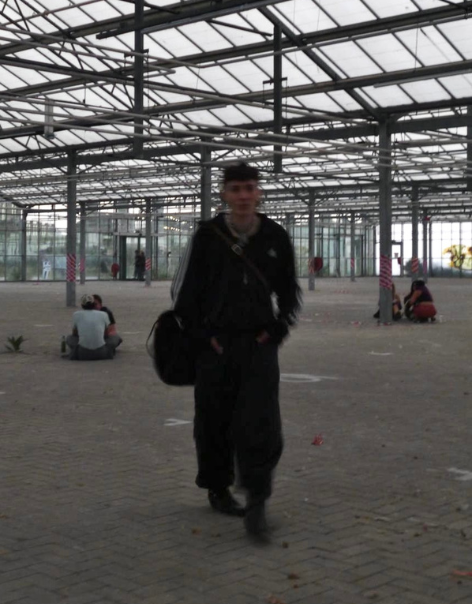
Bram de Vos

The common thread in my studio is providing answers to the pain points; that cities face. This involves a mix of complex questions about climate, growing population, equality in our society, energy, logistics, etc. Also known as transitions. Municipalities and governments have many questions about these issues. But the answers are still missing. That’s where my passion and strength lies. Bram de Vos studio is the bridge between the worlds of new abstract ideas; the questions lie;. Bram designs the overarching plan, where multiple disciplines collaborate on new possibilities. A master plan with answers for the future. Focused on the & quot; grey area; between the boundary of the city and the boundary of the surrounding landscape

Benjamin Onno Dikmans

I design possibilities for participation and perspective change. My practices aim at ecosystem restoration embedded in agricultural land management while opening spaces for exploration and critical theory. I believe we are part of a breathing organism that makes life on this planet possible. My work focuses on the relationship between humans and more-than-human entities, challenging the belief of separation. This holistic perspective on ecosystems and humanity’s place within them is expressed through both practical and artistic approaches. By drawing from permaculture design principles, my practice facilitates collaborative spaces for reconnection.

Angelique Tscherne

It all started with a love of detail in art lessons. So at the age of 14 I decided to attend a school called ‘HTLBVLA Ortweinschule’, which specialises in interior design and wood technology. This school not only taught me fundamental knowledge, but also showed me what is possible in the creative industry. To consolidate what I had learnt, I started an interior design course at the New Design University in St. Pölten. I also had the opportunity to complete an Erasmus+ semester abroad at the Academy of Fine Arts in Munich. Countless publications and project exhibitions followed over the years. I am currently in my final semester and my love of detail has become threefold over the years.

Borbala Kiszely

I’m Borbála Kiszely, an architecture student at TU Graz currently spending an exchange year at UTFSM in Chile. Growing up close to nature, I view it as an essential component of architecture—something to protect, integrate, and learn from. To me, architecture is a language that everyone experiences, whether through hearing, seeing, or feeling, which heightens our responsibility as designers. My designs focus on creating meaningful spaces that connect people with their environment. Through work experiences in Austria and Spain, I have explored how architecture shapes emotions and well-being. Passionate about future-oriented solutions, I strive to design spaces that are both human-centered and in harmony with nature.

Anabel Poh

Anabel Poh is a Singaporean designer, scientist, and entrepreneur based in the Netherlands. Her work bridges art, material science, sustainability, and storytelling, spanning carbon removal textiles to large-scale installations. She holds a Bachelor’s from Design Academy Eindhoven and a Master’s of Science in Innovative Textile Development from Saxion University. She co-founded Kantamanto Social Club, fostering circular fashion connections between the Global South and North, and UNCOLOUR Studios, a textile start-up developing bio-based silkscreen ink, nominated for the Earthshot Prize 2024. Previously, she led material innovations for automotive interiors and collaborated with Petit h, Hermès, on upcycling. Her work has been exhibited at Dutch Design Week, Milan Design Week, Palais de Tokyo, and Ghent Design Fest, amongst others.

URBAN MYCELIUM FARMS: Bio-mycorrhizal Development as Community Catalyst

The project explores Urban Mycelium Farms, utilizing fungi and mycelium to upcycle waste and foster urban symbiosis. By integrating sustainable farming into city centers, it promotes circular economies, healthier environments, and stronger, participative communities.

Define the problem/need you are solving or addressing with your project. How does it address the Open Call criteria, such as environmental impact, social engagement, circularity, user experience, resource efficiency, and community-driven solutions?

This project addresses the upcycling of city waste resources, the adaptation of urban voids, and the promotion of participative multi-stakeholder dynamics within neighborhoods through a biobased method: mycelium farming. The reuse of waste is essential; hence, an elaborate classification and management of resources becomes vital for success, tackling environmental issues while enhancing circularity within the production process. Importantly, the project involves local communities and diverse stakeholders, encouraging them to learn about the positive impacts this new initiative can bring and its potential for future development.

Please describe your project, reflecting on the concept, inspiration, materials, technical aspects, methods and process(es).

The project’s essence focuses on two main objectives: designing an educational urban mycelium farm suitable for an underutilized parking lot and establishing parameters for expanding and replicating these farms with various types and objectives. With the rise of bio-based innovations, mycelium emerges as a material with vast applications, including food sovereignty, medicine, construction materials, and packaging. Therefore, it is critical to identify and design suitable locations for its production. Despite being a relatively recent material, multiple companies and patents are already working with mycelium, showcasing its potential for large-scale production and the opportunities it creates for community development.

What do you think makes your project innovative compared to the existing efforts and ideas in the field it addresses?

Three key aspects distinguish our project from others. First, we aim to develop an evidence-based urban analysis system to determine optimal locations for mycelium urban farms. We will map urban voids, restaurants, and cafés for collecting organic waste necessary for cultivation, employing Space Syntax tools for pedestrian analysis to pinpoint potential hotspots. Second, we propose that these farms serve various applications based on their location, including food production, construction materials, and environmental education. Finally, repurposing urban voids is central to the project, revitalizing abandoned or underused spaces while reimagining public areas to benefit local communities.

Does it impact or reflect young people need(s) and how?

Engaging young people is vital since community development and social integration are central to the project. Involving younger populations through educational and employment opportunities is a key goal. Mycelium farms can catalyze local economic activity, creating new jobs while enhancing environmental awareness. Beyond fostering a bio-based economic impact, these farms aim to inspire a cultural shift, bringing individuals of all ages closer to sustainable practices that connect them with nature. Through job opportunities, workshops, guided tours, seasonal events, and awareness campaigns, urban mycelium farms offer a fresh approach to urban farming, enabling young people to actively participate in transforming their environments and instilling a sense of responsibility for the future of their communities.

Daan Sonnemans

Daan Sonnemans is the co-founder of Kantamanto Social Club, a community-driven upcycled fashion collective rooted in Ghana’s Kantamanto Market. Through this initiative, he works alongside makers and storytellers to amplify perspectives from the Global South, strengthen circular fashion ecosystems, and challenge extractive industry narratives. As a program manager at the Fab City Foundation, he has co-created the Fab City Challenge in Bali, Bhutan, and Mexico, contributed to the Fab City Awards, and coordinates the Master in Design for Distributed Innovation, where he co-leads Activating Communities. Daan also stewards the Decolonial Fashion Futures Lab, fostering reciprocal knowledge exchange between Ghanaian upcyclers and Dutch fashion institutions to advance regenerative, community-driven fashion futures.

Trustto V

We aim to design a storage, refrigeration, and transport device that maintains the temperature and humidity conditions required for medications and rapid tests in extreme weather conditions.

Define the problem/need you are solving or addressing with your project. How does it address the Open Call criteria, such as environmental impact, social engagement, circularity, user experience, resource efficiency, and community-driven solutions?

Our project was born in response to the humanitarian crisis affecting countries such as the Democratic Republic of the Congo, Panama, India, and South Sudan. Nowadays, thousands of essential medical products must be discarded due to extreme climatic conditions and lack of resources, which lead to the deterioration of their properties and prevent their proper use. The goal of the partnership between our engineering team and MSF is to develop a modular storage device that keeps essential medical products within a temperature range of 15°C to 25°C and a humidity of less than 60%, preventing their deterioration. Our solution reflects Open Call’s theme of aid-focused innovation because our product would be used in these scenarios where ONGs work. We have interviewed real users in each of the countries to cater directly to their needs.

Please describe your project, reflecting on the concept, inspiration, materials, technical aspects, methods and process(es).

Our solution consists of 4 essential components that work together to ensure optimal performance.

1. The cooling system is the core of the device, designed to maintain a stable temperature for as long as possible, optimizing energy consumption. It uses thermoelectric cooling and is powered by solar energy.

2. The outer case encloses and protects the cooling module, ensuring efficient thermal insulation, impact resistance, and a design adapted for easy transportation.

3. The interior architecture is designed to store up to 30 liters of medical products, maximizing thermal efficiency through the integration of phase change materials (PCM), which extend cooling duration and reduce energy demand.

4. Finally, the connection system is responsible for monitoring and precise temperature control, providing real-time data and alerts in case of fluctuations to ensure the safety and stability of stored medications.

What do you think makes your project innovative compared to the existing efforts and ideas in the field it addresses?

We, as Trustto team, develop this project for humanitarian emergency contexts, where the main goal is to improve people’s lives without any economic interest. Currently, medical-humanitarian organizations such as MSF don’t have solutions that maintain the temperature and humidity conditions in peripheral communities because there is no stable electrical source, and thus, the available products in the market, don’t meet their needs. We are focused on creating a solution that is tailored and solves every pain that the users have, by listening directly to their needs. Our product includes renewable energy, additive manufactoring and other innovative technologies. We will develop a high-performance product by combining design and engineering.**Does it impact or reflect young people’s need(s) and how (limit 150 words):** We want to share and give more visibility to the projects that ONGs are doing all over the world. Young people have shown that they are motivated to make an impact and improve the society in which we live in. Young people want to make a change and build more sustainable solutions, ensure that there are equal opportunities for everyone and everywhere.

Share-it! ♻

A sustainable, circular, and social urban initiative designed for residents within buildings. The main goal is to reduce consumption in the community, promoting a circular economy and fostering a more sustainable environment in cities.  

The project aims to reduce unnecessary consumption by promoting the sharing of infrequently used products, fostering a cooperative economy. In a world driven by consumerism, this alternative approach encourages resource efficiency and minimizes waste. By creating community hubs within buildings, the project strengthens social engagement, fostering interaction and cooperation among residents. It also supports circularity by extending the lifespan of products through shared use, reducing the need for constant production and consumption. The initiative directly addresses environmental impact by lowering waste and promoting sustainable consumption.  

Please describe your project, reflecting on the concept, inspiration, materials, technical aspects, methods and process(es).

Share-it! is a social and environmental platform designed as an automated vending machine, enabling residents to share essential tools and strengthen community ties in large residential buildings. The project encourages a circular economy by reducing unnecessary consumption and promoting sustainability. Users can borrow tools like drills, projectors, tents, and bicycle pumps for time periods ranging from one hour to three days. The process is seamless—items are returned to the machine, similar to a library borrowing system, but fully automated. The machine’s structure is constructed from durable aluminum and iron, with a facade made of recycled light birch wood, reflecting a commitment to sustainable materials. The system is managed via a dedicated app, which ensures smooth operation and technical support. Share-it! fosters a sense of community while reducing individual spending and waste, offering a practical, eco-friendly solution to everyday needs.  

What do you think makes your project innovative compared to the existing efforts and ideas in the field it addresses?

What makes Share-it! innovative is its focus on individual residents—those who occasionally need tools but don’t want to purchase them for one-time use. It offers a fully automated, easy-to-use system located within residential buildings, making access quick and convenient. This localized approach not only reduces personal consumption but also promotes a circular economy by encouraging shared use of seldom-needed products. Its unique design allows for seamless borrowing and returning of items, creating a simple yet effective solution for reducing waste. Currently, no other project combines this level of accessibility, automation, and sustainability in a residential context, making Share-it! a truly novel concept in the field.  

Does it impact or reflect young people need(s) and how?

Share-it! directly addresses the needs of young people, especially those who may not have the financial resources to purchase expensive tools or equipment. It offers an affordable alternative, enabling students or young renters to borrow essential items without the high upfront cost. For instance, placing the machine in student dormitories provides easy access to tools and equipment that are rarely needed, promoting savings and convenience. This model supports the values of resource sharing and sustainability, which resonate with younger generations who are often more conscious of environmental and economic challenges. By offering a cost-effective, community-driven solution, Share-it! helps young people access what they need without the burden of unnecessary purchases.