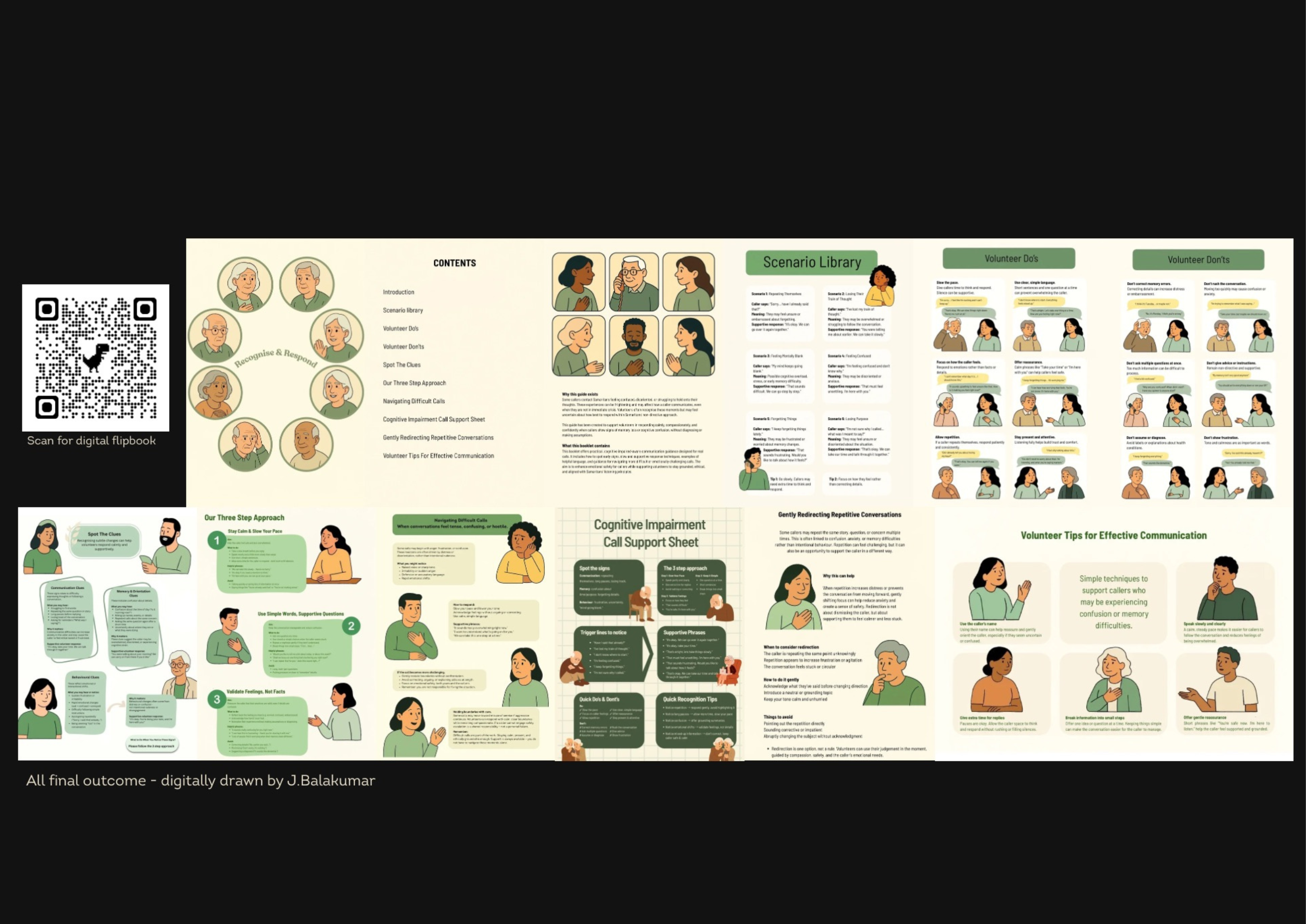
Dementia-aware communication toolkit that equips helpline volunteers to confidently support callers experiencing confusion or memory difficulties through calm, ethical, and non-diagnostic conversations.
Define the problem/need you are solving or addressing with your project. How does it address the Open Call criteria, such as environmental impact, social engagement, circularity, user experience, resource efficiency, and community-driven solutions?
Older adults are increasingly contacting helplines experiencing confusion, memory lapses, and early cognitive changes. While volunteers are well trained in crisis support, there is limited guidance on how to respond to cognitive confusion in a way that is calm, ethical, and non-diagnostic. This gap can increase anxiety for callers and uncertainty for volunteers, affecting emotional safety and service quality. Recognise & Respond addresses this need through a dementia-aware communication toolkit co-developed with volunteers and healthcare professionals. It strengthens user experience by reducing distress and improving volunteer confidence during live calls. The project aligns with social engagement and community-driven solutions by supporting existing volunteer networks rather than replacing them. It is resource-efficient, requiring no new infrastructure or technology, and can be embedded within current training systems. By investing in people’s time and communication skills, the project enhances sustainable, human-centred support services without additional material or environmental impact.
Please describe your project, reflecting on the concept, inspiration, materials, technical aspects, methods and process(es).
Recognise & Respond is a dementia-aware communication toolkit designed to support helpline volunteers when speaking to callers experiencing confusion or memory difficulties. The concept was inspired by my experience as a Samaritans volunteer, where I noticed increasing calls involving repetition, disorientation, and anxiety linked to early cognitive changes. While crisis training is robust, there was little structured guidance for these moments. The project was developed through primary research including care home visits, community engagement, live call observations, and collaboration with senior volunteers and healthcare professionals who work daily with cognitive impairment. Secondary research into dementia communication and social innovation informed the framework. The toolkit consists of a structured call sheet, booklet, and digital module. It uses simple language, clear hierarchy, and low cognitive load design principles to ensure usability under pressure. Iterative prototyping and real-time testing during live calls shaped the final outcome.
What do you think makes your project innovative compared to the existing efforts and ideas in the field it addresses?
What makes Recognise & Respond innovative is its translation of dementia communication principles into a non-clinical, non-directive helpline context. While dementia guidance exists within healthcare and social care settings, there are currently no tools specifically designed for emotional support helplines, where volunteers must avoid diagnosing, advising, or correcting callers. The project bridges that gap by adapting professional communication techniques into a simple, real-time framework that aligns with Samaritans’ listening model. Rather than introducing new systems or technology, it innovates through integration — embedding structured, dementia-aware guidance within existing volunteer training. Its strength lies in co-design: developed alongside volunteers and informed by healthcare professionals, then tested during live calls. The innovation is therefore practical, ethical, and context-specific. By focusing on human interaction rather than technological intervention, the project offers a scalable, low-cost solution that strengthens emotional safety and volunteer confidence in everyday support settings.
Does it impact or reflect young people need(s) and how?
Although Recognise & Respond primarily addresses older callers experiencing cognitive confusion, it also reflects young people’s needs in several ways. Many young volunteers support helplines, and providing clear, structured guidance increases their confidence when handling complex or unfamiliar calls. This reduces anxiety, supports skill development, and strengthens volunteer retention among younger generations. In addition, young people are often informal carrers for grandparents or older relatives experiencing early cognitive changes. The communication principles within the toolkit — slowing down, validating feelings, and avoiding correction — can be applied beyond helplines, supporting intergenerational understanding and empathy. The project also promotes youth engagement in community-driven solutions by empowering young volunteers to contribute meaningfully within social support systems. By equipping them with practical, ethically grounded tools, the project enhances both their user experience as volunteers and their capacity to support vulnerable members of the community.