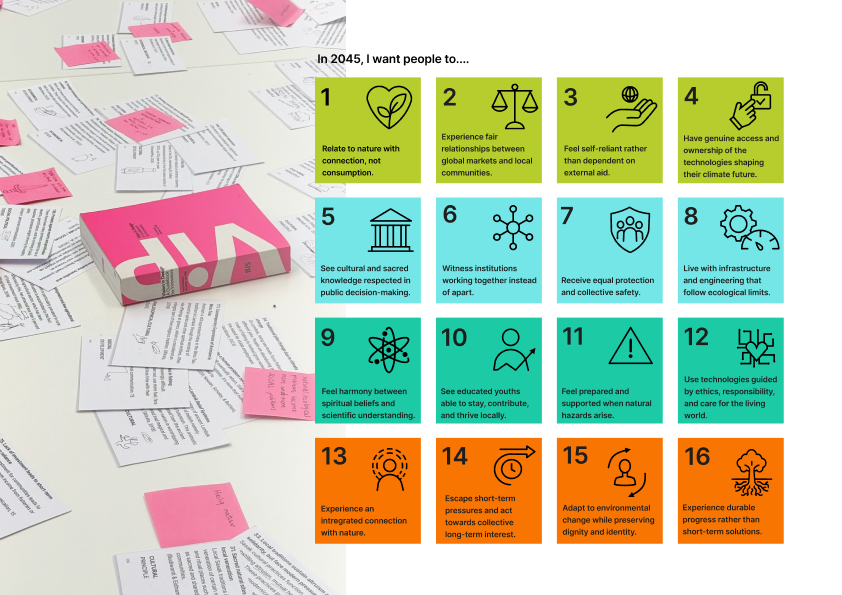
A future-oriented design project exploring sixteen plausible human–nature relations in Lombok toward 2045, translating societal goals into an educational program now active across ten primary schools, and continuing to grow beyond the graduation project itself.
Define the problem/need you are solving or addressing with your project. How does it address the Open Call criteria, such as environmental impact, social engagement, circularity, user experience, resource efficiency, and community-driven solutions?
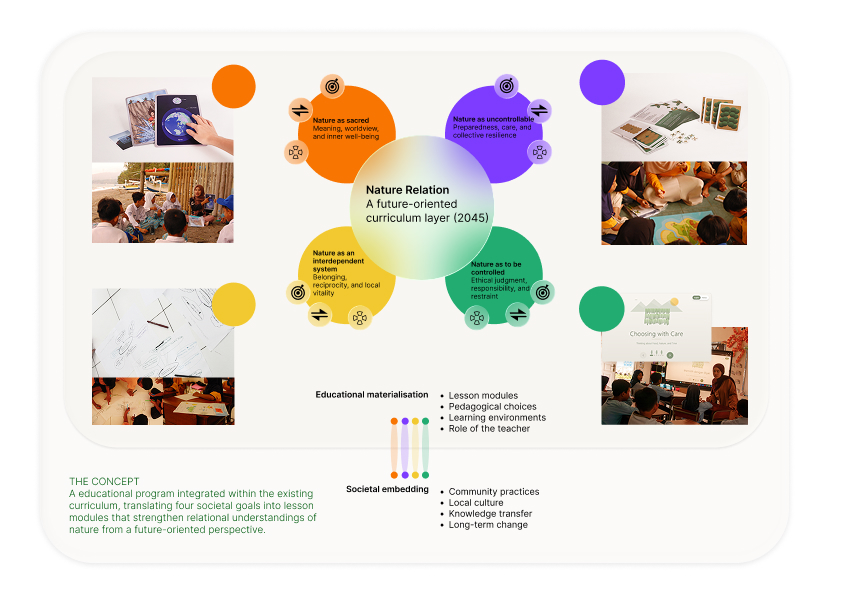
Across Lombok, human–nature relations are shifting, shaped by forces operating at different levels of agency: community life, knowledge systems, institutional governance, and global market pressures. The way people relate to nature varies fundamentally, from nature as sacred, to an interdependent system, uncontrollable, or something to be controlled. Existing systems struggle to navigate this plurality.
This project addresses this through a community-driven futures framework, developed with local stakeholders, NGOs, and policymakers, making it socially engaged and culturally grounded by design. By integrating the outcome into an existing curriculum rather than building parallel systems, it is resource-efficient and scalable. The educational approach builds long-term ecological awareness, contributing to environmental impact beyond the project itself. The workshop format and lesson modules prioritize accessibility and participation, ensuring the solution is usable and meaningful in its local context.
Please describe your project, reflecting on the concept, inspiration, materials, technical aspects, methods and process(es).
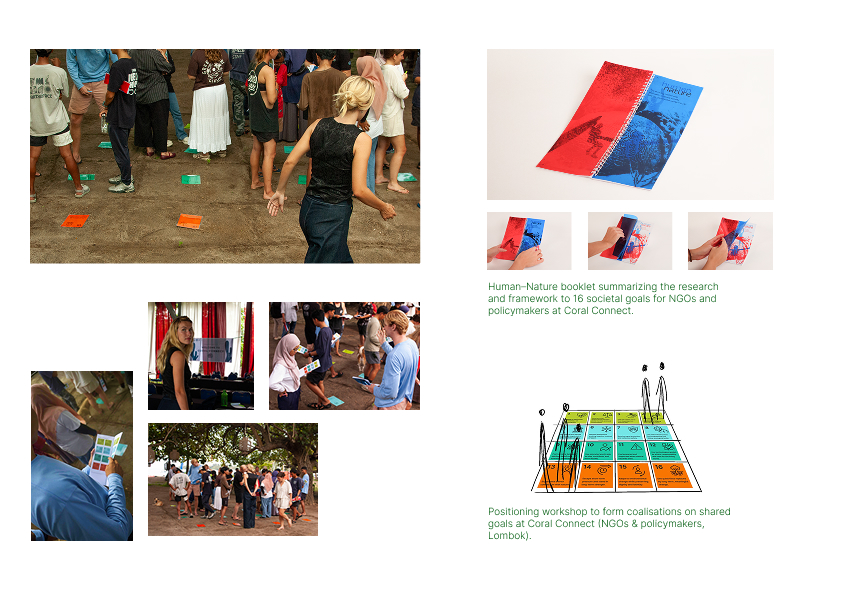
Human–Nature 2045 is a graduation project guided by the Vision in Design methodology, mapping sixteen plausible human–nature relations toward 2045 and translating these into societal goals. The resulting framework was applied at Coral Connect as a conversation and coalition-forming tool among NGOs, policymakers, and conservation actors.
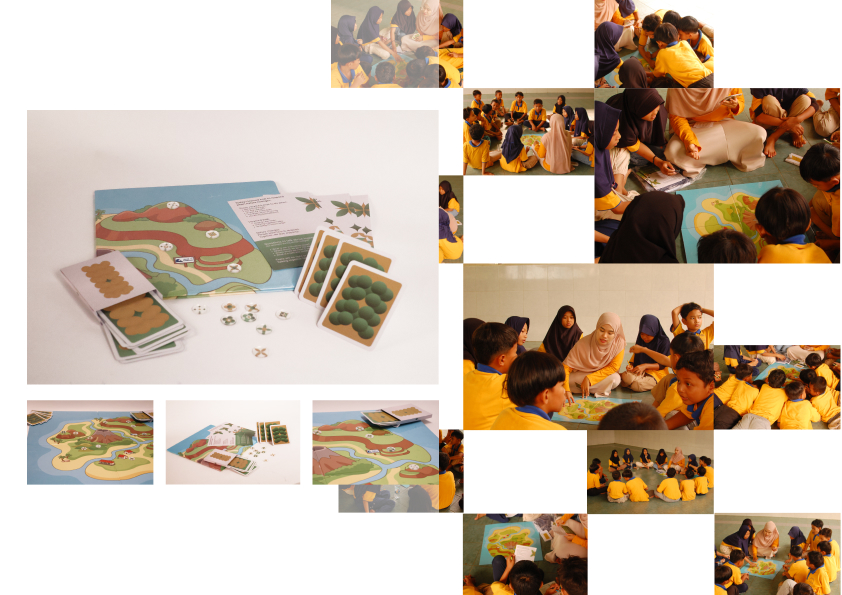
Four societal goals became the pillars of a modular educational concept, integrated within the existing curriculum in Lombok. Each pillar was materialised as a distinct lesson module with its own learning objectives rooted in the framework. One uses a map-based game with nature change cards, teaching children to navigate natural disasters through discussion-based learning. Others take the form of a website, storycards and a diary used in a natural context, and a design workshop addressing a local natural problem to foster agency.
Together they demonstrate how future-oriented societal goals can be translated into varied, contextually grounded learning experiences for the next generation.
What do you think makes your project innovative compared to the existing efforts and ideas in the field it addresses?
This project received a perfect 10 for its graduation assessment, a rare distinction within the MSc Design for Interaction program at TU Delft, reflecting the originality and rigor of its approach.
Its innovation lies in applying Vision in Design, a methodology built for structuring complexity and articulating long-term values, in a non-Western, cross-cultural context. It is widely acknowledged that the vast majority of design is made for the wealthiest ten percent of the world. This project deliberately works against that tendency, bringing futures thinking and design methodology to a context where it is rarely applied, yet urgently needed.
Rather than proposing a single solution, the project maps a plurality of futures and societal goals, acknowledging that there is no single right relationship with nature. This systemic, values-driven approach, translated into tangible tools tested in real schools, makes it both conceptually rigorous and practically grounded.
Does it impact or reflect young people need(s) and how?
This project is fundamentally oriented toward the next generation. The educational program is designed for primary school children in Lombok, directly addressing a gap in their curriculum: a relational, future-oriented understanding of nature that connects their daily lives to the world they will inherit by 2045.
Young people in Lombok are growing up in a context of accelerating ecological change, including increased natural disasters, shifting landscapes, and uncertain futures. Yet education rarely prepares them to navigate this complexity or to see themselves as agents within it. This project responds to that need by designing learning experiences that are contextually grounded, engaging, and empowering.
More broadly, the planet and how we live on it is the defining challenge for today’s youth globally. This project contributes to building the ecological literacy and relational understanding that the next generation will need to face it.