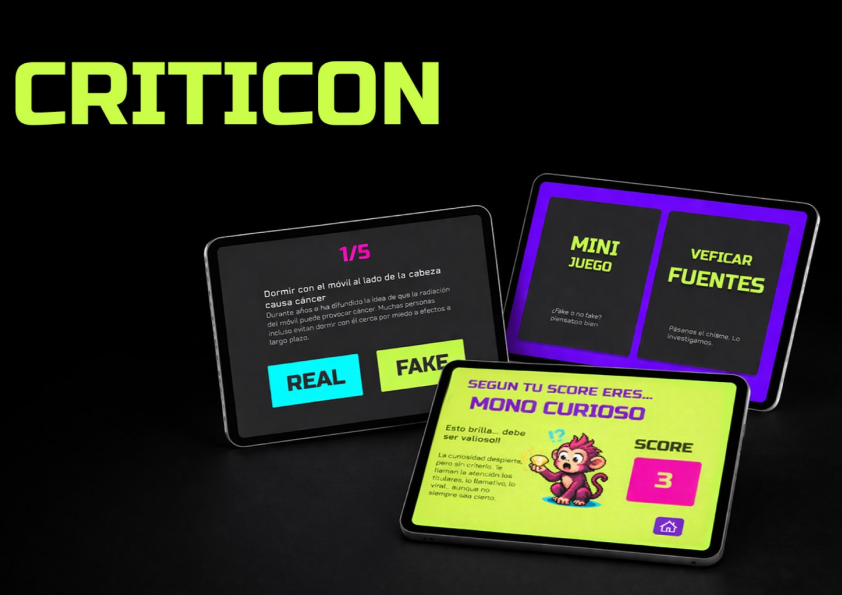
CriticON is a playful system that turns everyday exposure to information into moments of critical thinking, using humor, interaction, and AI to help young people question, verify, and resist misinformation in digital environments.
Define the problem/need you are solving or addressing with your project. How does it address the Open Call criteria, such as environmental impact, social engagement, circularity, user experience, resource efficiency, and community-driven solutions?
Young people navigate a digital environment where information is constant, fast, and emotionally charged. Platforms reward immediacy and engagement over accuracy, enabling misinformation to spread effortlessly. Despite being digitally native, many lack accessible ways to question what they consume in real time. Verifying information requires friction — switching platforms, investing time, and risking social tension — so doubt rarely leads to action.
CriticON addresses this behavioral gap by intervening at the exact moment misinformation spreads: when users decide to believe, share, or ignore content. It transforms this instant into an opportunity for critical thinking through playful, accessible interactions.
The project aligns with humane and ethical applications of technology by using AI to promote transparency, agency, and informed decision-making. It also functions as a design-led educational tool, fostering awareness, responsibility, and a cultural shift toward more critical and conscious digital behaviors.
Please describe your project, reflecting on the concept, inspiration, materials, technical aspects, methods and process(es).
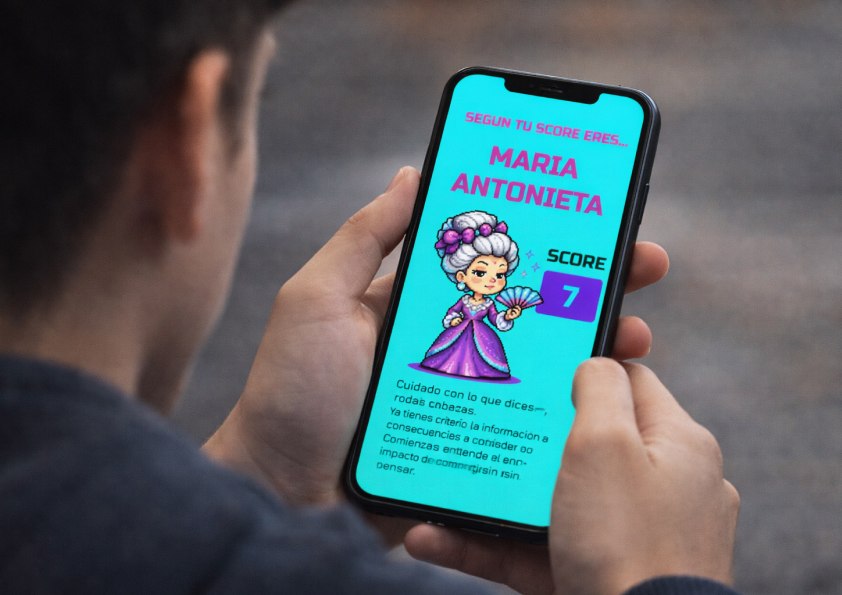
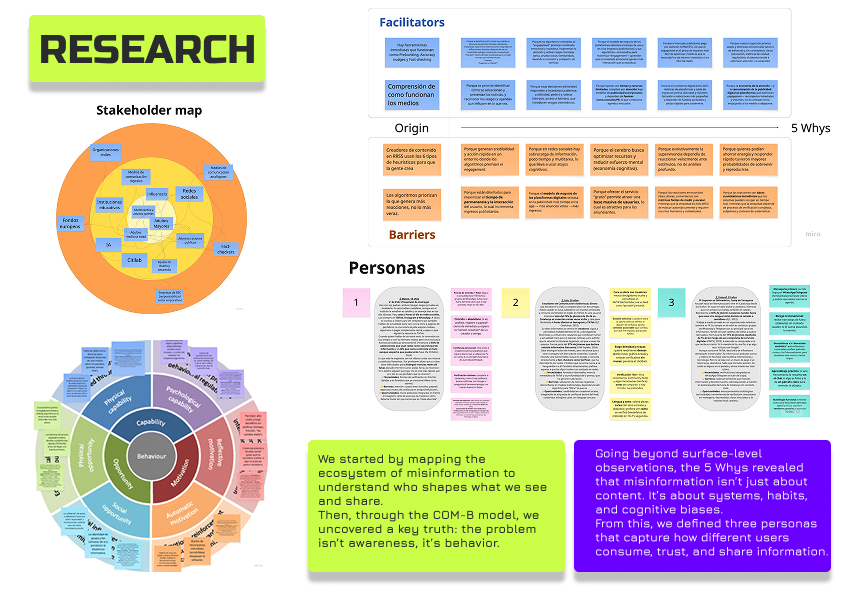
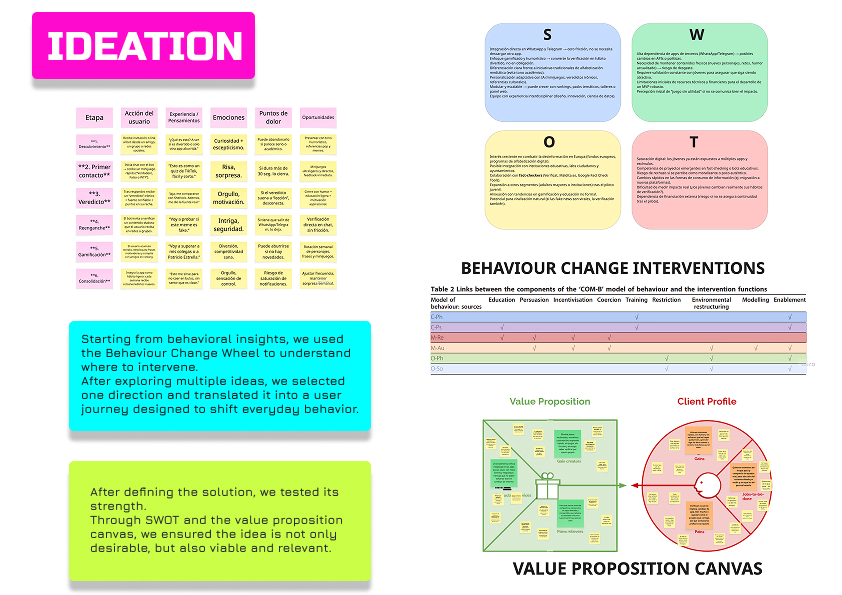
The project was developed following a Double Diamond approach, combining research, definition, and iterative design. We conducted initial research to identify key insights around misinformation behaviors, mapping stakeholders and analyzing barriers using frameworks such as COM-B and the Behavior Change Wheel. This led to the creation of user personas and the identification of a critical gap: the moment between doubt and action. From this, we ideated and evaluated multiple concepts, refining them through tools like value proposition canvases, user journeys, and strategic analysis. CriticON emerged as an experimental system that transforms verification into an interactive, lightweight, and repeatable experience. It operates through two core dynamics: a rapid “True or Fake” challenge that trains instinctive judgment, and a verification tool that analyzes shared content and returns contextualized feedback. By combining humor, cultural references, and AI-assisted responses, CriticON creates a conversational experience that encourages critical thinking as a habit, not an exception
What do you think makes your project innovative compared to the existing efforts and ideas in the field it addresses?
CriticON shifts the focus from information tools to behavior design. Rather than improving access to verified content, it intervenes in how people engage with information in real time, embedding critical thinking directly into everyday digital interactions and reducing the friction that prevents action.
The project approaches AI as a transparent, assistive layer that supports human judgment without replacing it, prioritizing agency, clarity, and interpretability over automation.
Its innovation also lies in reframing critical thinking as something social and desirable. By combining humor, gamification, and culturally familiar formats, CriticON makes verification visible and shareable.
Finally, its modular and platform-agnostic nature allows it to adapt across educational, civic, and digital contexts. As an evolving prototype, it continuously tests how design can shape more reflective, responsible, and conscious digital behaviors at scale.
Does it impact or reflect young people need(s) and how?
CriticON directly responds to the realities young people face in digital environments, where information is constant, fast, and often overwhelming. While they are highly connected, they lack tools that fit seamlessly into their habits and allow them to question information without interrupting their experience.
The project addresses this need by integrating critical thinking into familiar formats—short interactions, gamified dynamics, and conversational feedback—making it feel natural rather than effortful. It recognizes that for young users, behavior is shaped not only by knowledge but by context, speed, and social dynamics.
By making verification quick, accessible, and even shareable, CriticON supports young people in developing confidence, autonomy, and a more active role in how they engage with information. It transforms critical thinking from an abstract skill into a lived, everyday practice.