
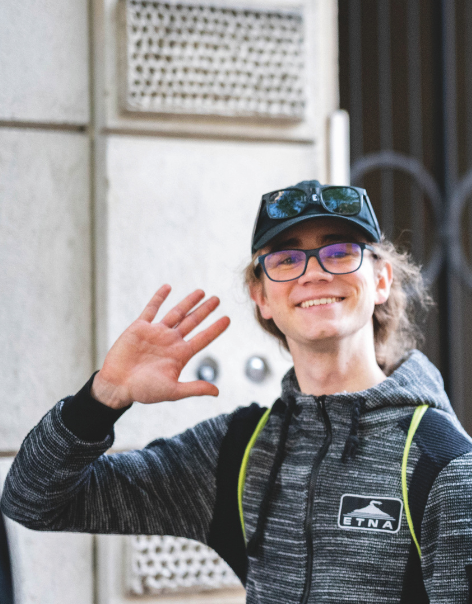
Industrial Designer currently pursuing his Master’s Degree in Eco-Innovative Design at the University of Applied Sciences in Graz, Austria. Alongside his work as a designer, he serves as a volunteer EMT and is an active member of the Scout movement. These commitments shape not just his values, but the way he works. His approach is grounded in a single question: Is this necessary? Trained to prioritize under pressure, to acieve more with less and to put others’ interests before his own, Niki brings a combination of pragmatism and precision to the design process, which enables him to find simple solutions for complex problems.
Month: May 2026
Care-ierr – foldable cardboard cat transporter
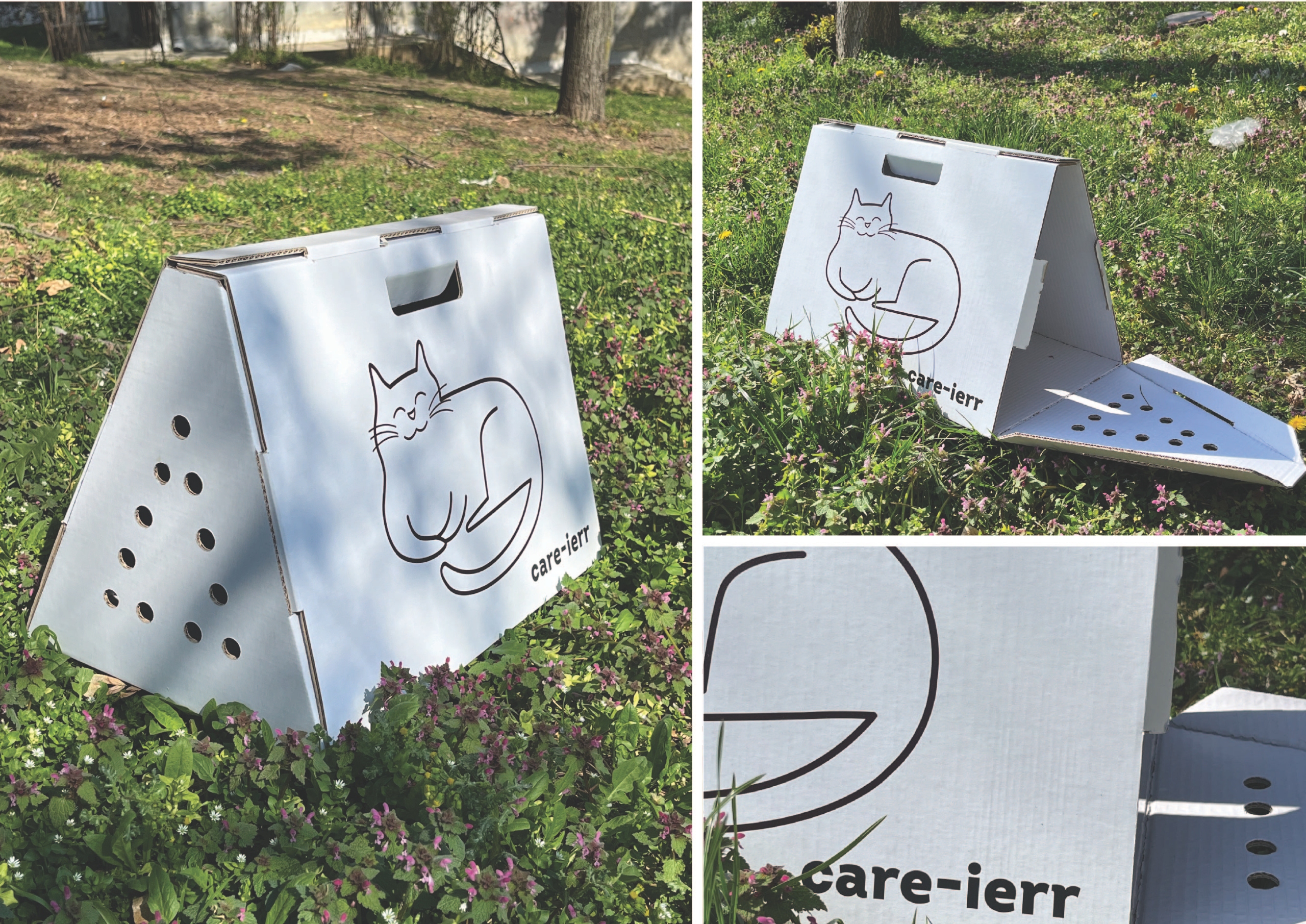
Making a environmentally friendly, low cost pet transporter that is easy to store away.
Define the problem/need you are solving or addressing with your project. How does it address the Open Call criteria, such as environmental impact, social engagement, circularity, user experience, resource efficiency, and community-driven solutions?
Standard cat carriers are mostly made of plastic and take up a lot of space, especially if we take into account that cats are vetted a couple of times a year. The idea was to apply a somewhat different approach and offer an alternative that takes into account the impact on the environment and the usability of the product itself. The project offers a solution through a foldable cardboard transporter, designed for short-term use that protects the environment. Plastic is replaced by a material that is recycled and supports more sustainable user behaviour. The structure of the material enables the product to be easily stored and disposed when not in use. Tactility and simple assembly improve the user experience, and cats’ affinity for boxes was also taken into account. It can be produced easily and locally, promotes good use of resources, circularity and a more responsible approach to products for pets.
Please describe your project, reflecting on the concept, inspiration, materials, technical aspects, methods and process(es).
The concept was designed by considering the daily habits, transport solutions of pet owners and material usage. It is made of cheap, recyclable material and can be easily produced by cutting on a CNC machine, with less than 10 minutes of work on each copy and the cutting layout is adapted to make the best use of the material. Multiple prototypes were developed in order to test structure, usability and assembly order. The design is optimized for folding and flat packing, and can also have an additional purpose as a cat house or toy. Air vents, safe and secure closing system as well as a reinforced handle for stable carrying are integrated into the product and taken into account. The project combines simple manufacturing methods and user-focused design.
What do you think makes your project innovative compared to the existing efforts and ideas in the field it addresses?
This solution simplifies the product, reduces the use of materials while keeping only the essence and utility value of the classic carrier. It looks at it from a new, more natural angle.
Does it impact or reflect young people need(s) and how?
This project caters to the everyday needs of younger people, especially those living in smaller spaces or moving frequently. Traditional pet carriers take up quiet a lot of space but are only used a few a times a year. The foldable design offers a more flexible and space-saving alternative that fits better into today’s lifestyle. It is also affordable and easy to produce, making it more accessible to students and younger pet owners. At the same time, many young people are becoming more and more aware of environmental issues and are trying to make more responsible choices. Using recyclable cardboard and reducing unnecessary material reflects that mindset. The carrier can also be used as a small shelter or object for the cat, extending its use beyond transportation. The project connects practical constraints with a more conscious and adaptable way of living.
Chaiterra

Chaiterra explores the potential of tea waste to create biobased materials, transforming discarded organic matter from local industry into functional products for a sustainable future.
Define the problem/need you are solving or addressing with your project. How does it address the Open Call criteria, such as environmental impact, social engagement, circularity, user experience, resource efficiency, and community-driven solutions?
The project addresses the dual crisis of plastic pollution and industrial organic waste. While the food and drink industry generates massive amounts of tea residues, traditional production still relies heavily on fossil-fuel-based plastics that pollute our ecosystems for centuries. Chaiterra identifies a specific opportunity within a local company to intercept their tea waste before it reaches landfills.
This initiative directly impacts young people, who are increasingly vocal about the plastic crisis and demand transparent, local production cycles. By transforming specific waste streams from the local food industry into functional objects, the project provides a tangible alternative to single-use plastics. It empowers the younger generation to transition from a “take-make-waste” mindset to one of environmental stewardship and localized resource management.
Please describe your project, reflecting on the concept, inspiration, materials, technical aspects, methods and process(es).
The concept focuses on creating a natural, fully biodegradable alternative to plastic, using tea waste sourced from a local company. Inspired by the principles of regenerative design, the process explores how organic leftovers can be stabilized without synthetic additives.
The technical method involves drying and processing the industrial tea residues, which are then combined with bio-based binders through a low-energy compression process. This “kitchen-to-studio” approach ensures that the material remains non-toxic and structurally sound for its intended use. By maintaining a simple, transparent production line, Chaiterra highlights the raw, sensory qualities of the tea. The resulting product is not just an object but a functional carrier of a circular story, designed to support natural cycles at every stage of its existence.
What do you think makes your project innovative compared to the existing efforts and ideas in the field it addresses?
Chaiterra’s innovation lies in its regenerative approach to material sourcing, turning a local industry’s byproduct into a high-value resource. It prioritizes circularity and resource efficiency over traditional, high-impact manufacturing. By replacing plastic with a biobased material, the project significantly reduces environmental footprints.
Socially, it engages the local community by closing the loop between a neighborhood company and the final consumer. The user experience is defined by the material’s honesty—its ability to eventually return to the earth as compost, supporting natural cycles. This makes Chaiterra a community-driven solution that proves how design can move beyond sustainability toward true regeneration, ensuring that the product’s end is simply a new beginning for the soil.
Does it impact or reflect young people need(s) and how?
Chaiterra addresses the urgent need of young people to combat plastic pollution through tangible, regenerative actions. By transforming local industrial tea waste into functional design, it offers a transparent alternative to fossil-fuel-based products. This empowers a generation facing ecological anxiety to integrate their ethical values into daily sustainable rituals.
Chick-Inn

Chick-Inn reimagines the chicken coop as an architectural space of dignity, shifting small-scale food infrastructure from productivity toward care, individuality, and respectful human–animal interaction through spatial design that reduces stress and fosters interspecies coexistence.
Define the problem/need you are solving or addressing with your project. How does it address the Open Call criteria, such as environmental impact, social engagement, circularity, user experience, resource efficiency, and community-driven solutions?
Small-scale animal housing is often treated as purely functional infrastructure, where productivity outweighs wellbeing. Even outside industrial farming, chickens are reduced to egg-producing units, and spatial design rarely considers stress, behavioural needs, or respectful human–animal interaction.
Chick-Inn addresses this by redefining the coop as a space of care rather than extraction. It shifts the focus from output to dignity, proposing a more humane model of small-scale food production. By encouraging decentralised, local practices, the project supports environmental responsibility and reduces reliance on industrial systems. Its compact, durable construction promotes resource efficiency and longevity. At a social level, it reframes everyday agriculture as an opportunity for conscious engagement, empathy, and shared responsibility. The project aligns with the call’s vision by demonstrating how design can reshape relationships, not only between people, but between species.
Please describe your project, reflecting on the concept, inspiration, materials, technical aspects, methods and process(es).
Chick-Inn emerged from questioning why even small-scale animal housing replicates industrial logic. The project reimagines the chicken coop as an architectural micro-environment shaped by care, observation, and respect for non-human individuality.
The design process began with studying chickens’ behavioural patterns, such as nesting habits, stress responses, and movement rhythms, and translating these insights into spatial decisions. The structure separates human access from nesting areas through an external egg-collection system, reducing disturbance while maintaining functionality. An interactive feeding element transforms routine maintenance into intentional engagement.
Constructed as a compact, durable timber structure, the coop prioritises longevity, clarity of assembly, and resource-conscious material use. The design balances practicality with ethical intention, demonstrating how even modest rural infrastructure can embody architectural thinking.
Chick-Inn proposes that care can be embedded in construction itself, turning an everyday agricultural typology into a spatial expression of interspecies responsibility.
What do you think makes your project innovative compared to the existing efforts and ideas in the field it addresses?
Chick-Inn is innovative because it transforms a mundane, utilitarian structure into a small-scale architectural experiment that prioritises animal wellbeing, human engagement, and ethical design. Unlike conventional coops, which focus solely on containment and productivity, it treats each hen as an individual with needs, personality, and space to express natural behaviours.
Spatially, the design integrates verticality, playful perches, and interactive elements that reframe routine tasks, such as feeding, egg collection and cleaning, as moments of mindful interaction rather than mechanical chores. Each nesting box is playfully labelled with charming names such as “Hen-Riette” or “Koko Chanel,” highlighting individuality and celebrating the hens as inhabitants rather than mere producers.
Does it impact or reflect young people need(s) and how?
Yes, it reflects young people’s needs by inviting them to reconsider relationships with the living world and everyday infrastructure. Chick-Inn demonstrates that even small, ordinary spaces, like a chicken coop, can embody care, observation, and ethical design. By prioritising the hens’ dignity and individuality, the project encourages empathy, reflection, and a sense of responsibility for non-human lives.
The interactive feeding station and external egg-collection system make daily engagement playful, intuitive, and rewarding, promoting active participation rather than passive management. It shows that design can be humanistic, socially aware, and fun, not just functional.
Through humour, charm, and architectural clarity, like nesting boxes labelled “Hen-Riette” or “Koko Chanel”, Chick-Inn inspires young audiences to question standardized systems, rethink their impact, and explore creative solutions that integrate care, ethics, and environmental awareness into everyday practices.
Cloud of Polyphony

An interactive audiovisual installation that reveals how data infrastructure reorganises ecology, territory, and memory in Guizhou, translating the hidden costs of digital expansion into a spatial experience of listening, sensing, and critical reflection.
Define the problem/need you are solving or addressing with your project. How does it address the Open Call criteria, such as environmental impact, social engagement, circularity, user experience, resource efficiency, and community-driven solutions?
Cloud of Polyphony addresses restrained public legibility around the environmental and social impact of digital infrastructure. Data centres, 5G networks, and platform expansion are framed through progress and economic growth, while their energy use, land transformation, and local consequences remain separated from everyday digital interfaces. The project focuses on Guizhou, where data-industrial policies has reshaped Karst landscapes, economic expectations, and public memory. Through an interactive sound installation with moving image, the work turns these hidden operations into a shared sensory encounter. Field recordings, oral histories, infrastructural imagery, reclaimed plywood, truss elements, and LiDAR-based interaction connect these impacts to listening, movement, and attention. The project formation with reused materials, restrained technical setup, and embodied social engagement that asks how design can mediate technology’s impacts on communities, territories and the planet.
Please describe your project, reflecting on the concept, inspiration, materials, technical aspects, methods and process(es).
Cloud of Polyphony is an interactive sound and moving-image installation focused on the data industry in Guizhou. The project takes 5G towers, abandoned Big Data Expo sites, data-centre architecture, Karst landscapes, and development signage as its visual and spatial language. Reclaimed construction elements form an antenna-like apparatus that holds power, speakers, and sensor. Field recordings, synthesized textures, oral histories, machine frequencies, and filmed landscape fragments are composed into a polyphonic audiovisual environment. LiDAR sensor register audience distance and movement, then shift the density, timing, and sequence of the sonic composition. The process combines filed research, archival montage, material reuse, custom-built interface, and spatial calibration. The installation turns a network receiver into a station for listening, so infrastructure can be access through sound, image, material, and bodily position.
What do you think makes your project innovative compared to the existing efforts and ideas in the field it addresses?
The project composed through low-tech formation that referral the material dependencies of data industry. It examines the large-scale systems that sustain the Cloud: data centres, network expansion, land transformation, and platform governance, and propaganda support its inevitable. These forces are condensed into an inverted antenna built from reclaimed construction elements. The apparatus changes a symbol of signal distribution into a civic listening station. LiDAR register audience position, then modulate sound through proximity, delay, density and rhythm. The audience encounters infrastructure as a bodily relation, sensing how digital dependency is tied to environmental pressure, industrial planning, and the uneven distribution of technological benefit.
Does it impact or reflect young people need(s) and how?
The project materialises the Cloud’s intangibility by treating digital technology as a material and political agent behind seamless service. For future generations, the work offers another way to access the systems they inherit: through land, water, sound, memory, and the images of progress they were promised. In Guizhou, the project follows the passage from Karst landscapes and hydrological change to data centres, abandoned expo sites, promotional signage, and infrastructural relics. These fragments are gathered through field recordings, oral histories, moving image, and an interactive listening apparatus. As visitors move through the installation, the Cloud appears a set of dependencies embedded in territory rather than an abstract service. The project opens a critical relation to digital futures by showing how technological dreams are planted in specific territories, and how their consequences remain after the development narrative moves on.
CriticON – Designing Critical Thinking in the Age of Missinformation
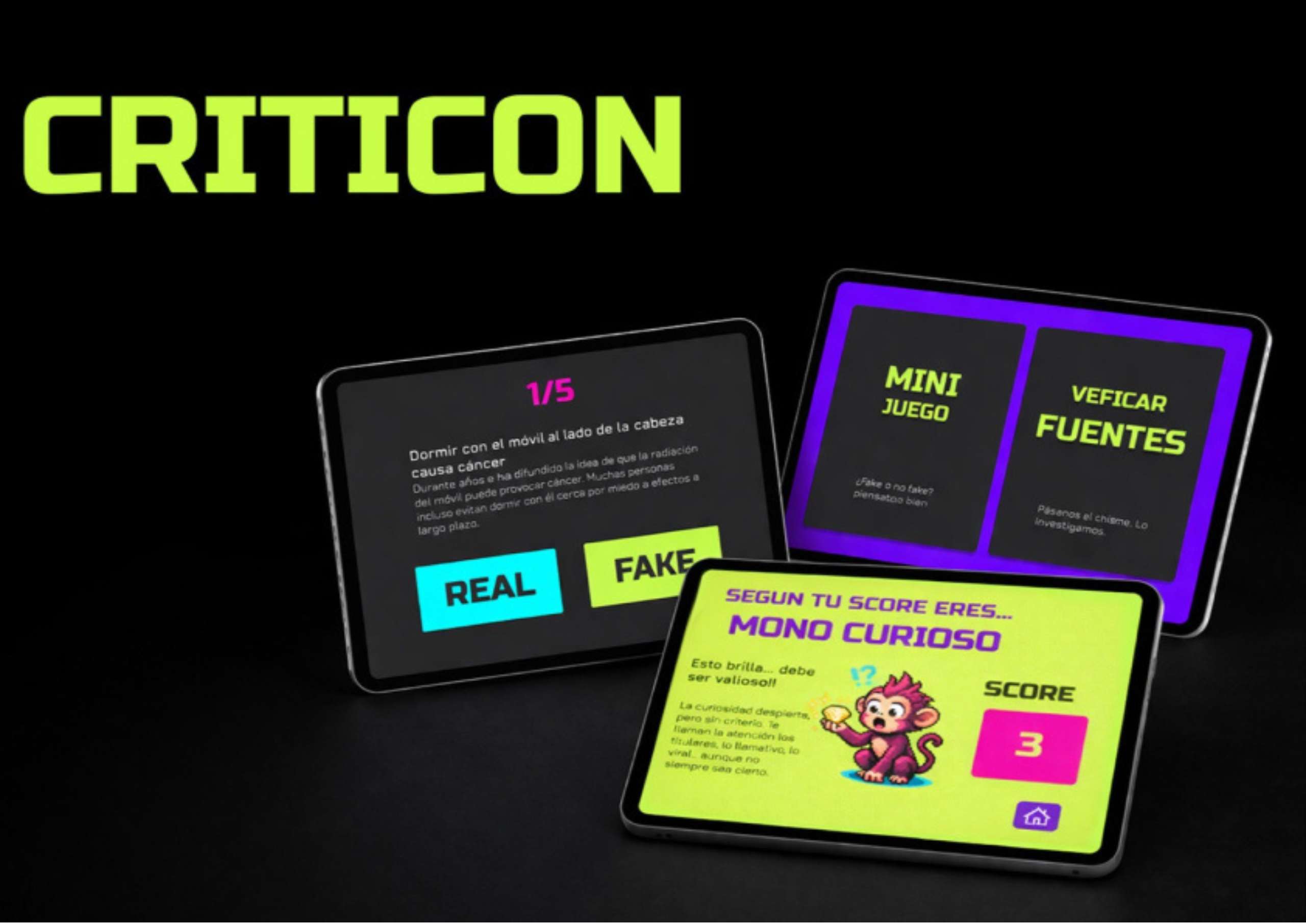
CriticON is a playful system that turns everyday exposure to information into moments of critical thinking, using humor, interaction, and AI to help young people question, verify, and resist misinformation in digital environments.
Define the problem/need you are solving or addressing with your project. How does it address the Open Call criteria, such as environmental impact, social engagement, circularity, user experience, resource efficiency, and community-driven solutions?
Young people navigate a digital environment where information is constant, fast, and emotionally charged. Platforms reward immediacy and engagement over accuracy, enabling misinformation to spread effortlessly. Despite being digitally native, many lack accessible ways to question what they consume in real time. Verifying information requires friction — switching platforms, investing time, and risking social tension — so doubt rarely leads to action.
CriticON addresses this behavioral gap by intervening at the exact moment misinformation spreads: when users decide to believe, share, or ignore content. It transforms this instant into an opportunity for critical thinking through playful, accessible interactions.
The project aligns with humane and ethical applications of technology by using AI to promote transparency, agency, and informed decision-making. It also functions as a design-led educational tool, fostering awareness, responsibility, and a cultural shift toward more critical and conscious digital behaviors.
Please describe your project, reflecting on the concept, inspiration, materials, technical aspects, methods and process(es).
The project was developed following a Double Diamond approach, combining research, definition, and iterative design. We conducted initial research to identify key insights around misinformation behaviors, mapping stakeholders and analyzing barriers using frameworks such as COM-B and the Behavior Change Wheel. This led to the creation of user personas and the identification of a critical gap: the moment between doubt and action. From this, we ideated and evaluated multiple concepts, refining them through tools like value proposition canvases, user journeys, and strategic analysis. CriticON emerged as an experimental system that transforms verification into an interactive, lightweight, and repeatable experience. It operates through two core dynamics: a rapid “True or Fake” challenge that trains instinctive judgment, and a verification tool that analyzes shared content and returns contextualized feedback. By combining humor, cultural references, and AI-assisted responses, CriticON creates a conversational experience that encourages critical thinking as a habit, not an exception
What do you think makes your project innovative compared to the existing efforts and ideas in the field it addresses?
CriticON shifts the focus from information tools to behavior design. Rather than improving access to verified content, it intervenes in how people engage with information in real time, embedding critical thinking directly into everyday digital interactions and reducing the friction that prevents action.
The project approaches AI as a transparent, assistive layer that supports human judgment without replacing it, prioritizing agency, clarity, and interpretability over automation.
Its innovation also lies in reframing critical thinking as something social and desirable. By combining humor, gamification, and culturally familiar formats, CriticON makes verification visible and shareable.
Finally, its modular and platform-agnostic nature allows it to adapt across educational, civic, and digital contexts. As an evolving prototype, it continuously tests how design can shape more reflective, responsible, and conscious digital behaviors at scale.
Does it impact or reflect young people need(s) and how?
CriticON directly responds to the realities young people face in digital environments, where information is constant, fast, and often overwhelming. While they are highly connected, they lack tools that fit seamlessly into their habits and allow them to question information without interrupting their experience.
The project addresses this need by integrating critical thinking into familiar formats—short interactions, gamified dynamics, and conversational feedback—making it feel natural rather than effortful. It recognizes that for young users, behavior is shaped not only by knowledge but by context, speed, and social dynamics.
By making verification quick, accessible, and even shareable, CriticON supports young people in developing confidence, autonomy, and a more active role in how they engage with information. It transforms critical thinking from an abstract skill into a lived, everyday practice.
Da Grigio A Verde. Campaigning for a greener and healthier city
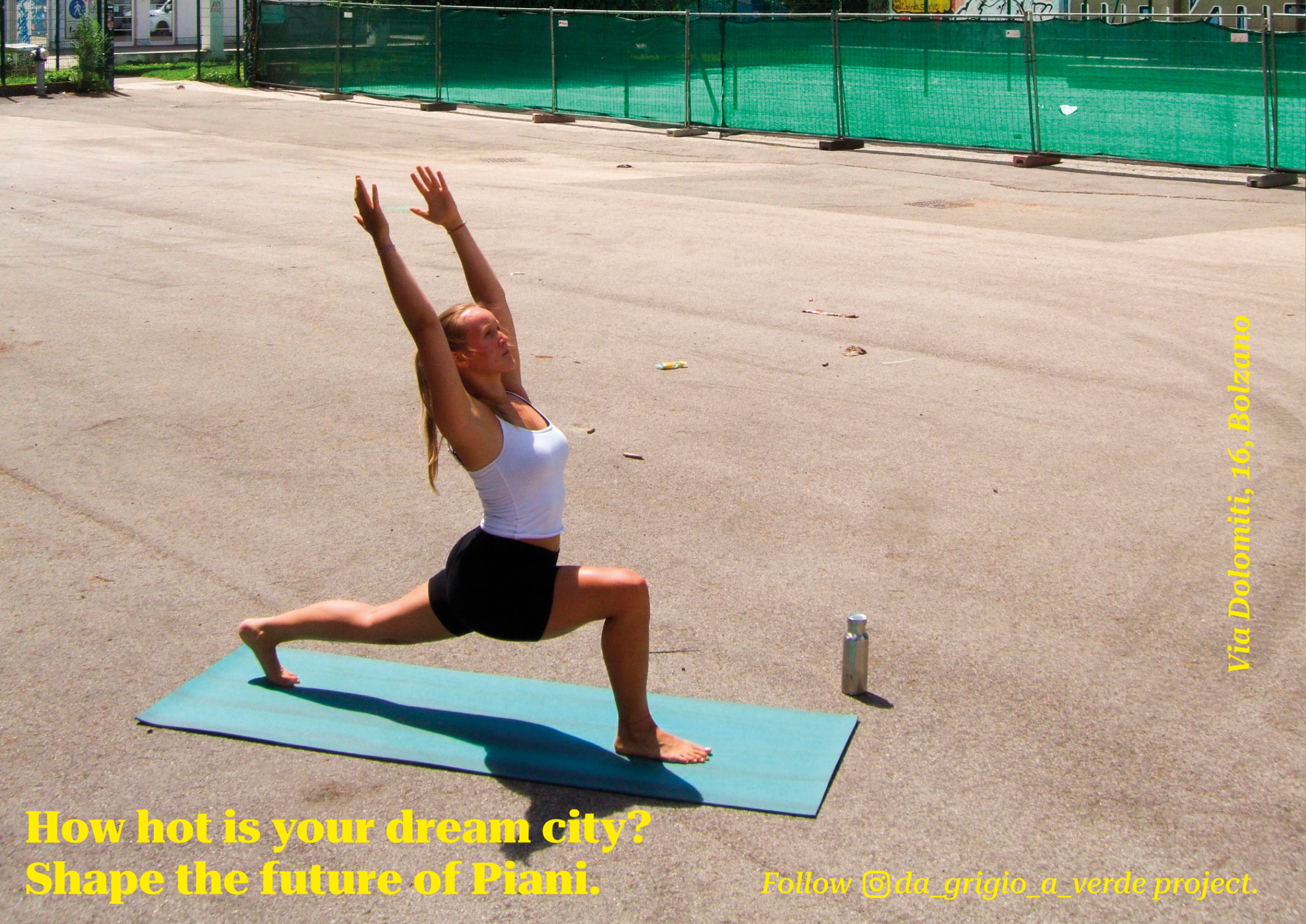
“Da Grigio A Verde” is a bold campaign promoting the green transformation of Bolzano’s Piani district, one of Italy’s hottest cities—a story of brave people fighting for a better future.
Define the problem/need you are solving or addressing with your project. How does it address the Open Call criteria, such as environmental impact, social engagement, circularity, user experience, resource efficiency, and community-driven solutions?
This project is a social and media campaign that fights for the implementation of a greening project in the Piani district in Bolzano, one of the hottest Italian cities, where only 1% of the total area is covered by public green spaces. Co-created with the association Ambiente e Salute, residents, students, professors, activists, and politicians. Together we fight for:
1. Creating green infrastructure.
2. Developing a water management and irrigation system.
3. Enhancing biodiversity.
4. Improving sports fields and playgrounds.
5. Upgrading accessibility, mobility, and safety.
My campaign promotes the project among local residents and focuses on showcasing its creators—residents concerned about the future. Even though the project was approved by the city council and we have secured 350,000 euros for its implementation, the municipality is delaying it and attempting to change its key objectives. That is why the project needs strong public recognition.
Please describe your project, reflecting on the concept, inspiration, materials, technical aspects, methods and process(es).
To make the campaign stand out, I used a bold fluorescent green and a brave visual style that immediately caught attention. Data visualizations—such as a project flag and graphs highlighting supporters and its long history—made the grassroots nature clear and accessible.
Ironic posters and artistic interventions exposed the absurdities of urban life, while an open exhibition at the project site brought the campaign closer to the public. Social media, a press conference, TV interviews, and a local newspaper article helped spread the message across the region.
Thanks to interventions in public space, the first points of the project were already marked and improved inhabitants’ safety. Ultimately, the campaign focused on a positive vision of the future, leaving people with hope and a compelling idea of a better city that truly serves its citizens.
What do you think makes your project innovative compared to the existing efforts and ideas in the field it addresses?
The campaign is bold, highly visible, and asserts a strong presence in public space. It creatively uses that space by identifying its problems and possibilities for improvement. It employs a variety of techniques—often unconventional for social campaigns—making it fresh and distinctive.
My role was to facilitate collaboration between visionary citizens and a rigid municipal structure, a connection often overlooked in similar initiatives.
The project shows that determination, commitment, and continuous effort can lead to real results. It proves that fighting for what we care about matters—because when we care deeply enough, others will join and support us.
Does it impact or reflect young people need(s) and how?
This project was largely created by young people. The initial vision for transforming the space came from the Ambiente e Salute association, which includes older members; however, thanks to the project’s partnership with the university and over two years of student work, it has reached this stage.
Young people live with growing fear about the future. The climate is changing, and predictions suggest the crisis will be far more severe than we can estimate. Climate anxiety is a daily reality. I know this because I carry it with me—sometimes sinking into gloomy visions of a meaningless future. That is why we must act: start locally, put pressure on authorities, and care for our cities. Young people understand this and are responding actively.
The bold, fluorescent campaign also has a modern, youthful character that appeals to younger audiences.
Das hier ist propaganda
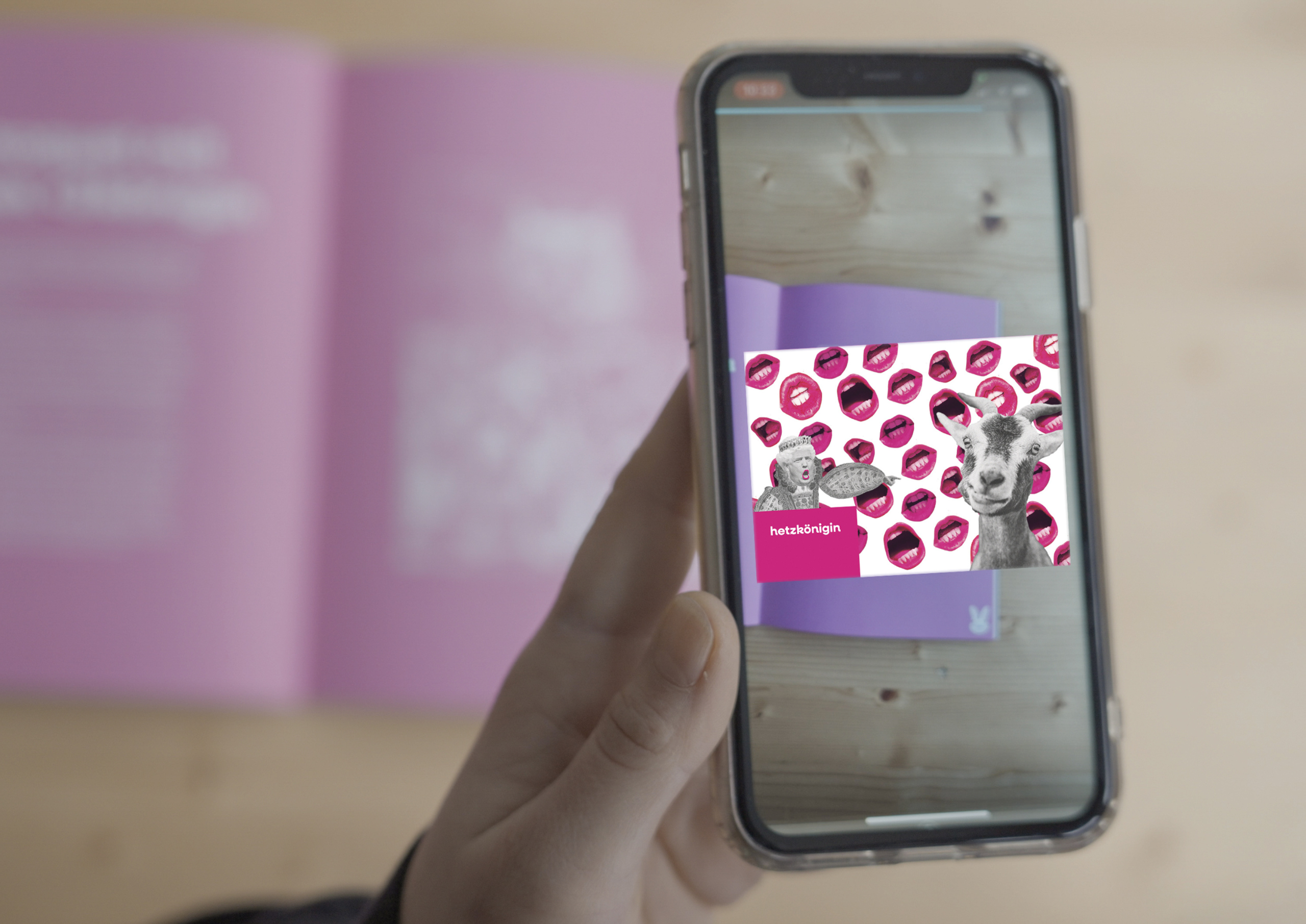
A field guide to Wonderland.
Or, in other words: A cross medial approach to build resilience & resistance against modern Propaganda on Social Media.
Define the problem/need you are solving or addressing with your project. How does it address the Open Call criteria, such as environmental impact, social engagement, circularity, user experience, resource efficiency, and community-driven solutions?
I‘m sure you can feel it too. Unsteadiness, discontent, distrust. We find ourselves in times of crisis. It comes at no surprise that we are now especially vulnerable to fall for “white rabbits“ which lure us into their rabbit holes by promising security, idyll and the one-and-only solution for all problems – ideologies too tempting to ignore. It is what many believe has perished with the Nazi Regime nearly a hundred years ago.
The reality is, propaganda is as existent as ever. All that has changed are its tonality, aesthetics, the media. Not that this change was by chance. It simply adapted to stay concealed. The Social Media Logic and recent developments of AI are contributing to spread manipulative content faster, more convincing and more gripping than ever before.
Please describe your project, reflecting on the concept, inspiration, materials, technical aspects, methods and process(es).
“Everybody knows enough about propaganda to dislike it, but few know enough to know what it is that propaganda actually does“, says Cory Wimberly.
To recognise the dangers early enough, we need to understand the mechanisms. That is why I designed a guide. It lifts the rosy veil of ideological promises. Inspired by the methology of “Prebunking“, readers learn about five common manipulation techniques and how to recognize them through a process of premonition, explanation and encountering examples. However, propaganda is not rational. It‘s toying with emotions. Thus, I approached the problem by making knowledge tangible through metaphors, namely the famous adventures of Alice in Wonderland but also popcultural references. The informative layer of the leaflet extends into the digital realm – just as propaganda did – by Augmented Reality.
What do you think makes your project innovative compared to the existing efforts and ideas in the field it addresses?
A common way to fight disinformation is by debunking the lies and factoids told by propagandists. However, various problems occur if we rely only on trying to redo the damage. Recent study suggests to expand the approach by including prevention: Prebunking. The goal is to preemptively build resilience and resistance against manipulative content. My main concern was how to translate the findings into a project, which would feel trustworthy and invites to properly engage with the topic, while also acknowledging today‘s accelerated consumption habits. The result is crossmedial: I translated the concept of a political pamphlet into a modern zine, combining analogue and digital by including AR-Elements. That way I could go beyond the expectations we have when consuming print products.
Does it impact or reflect young people need(s) and how?
One major aspect of developing the concept and visual language of the project was understanding where and how young people encounter propaganda. Studies suggest today‘s main touchpoint to be Instagram for my target group, which by it‘s design and logic seems to aggravate dynamics which allow manipulative rhethoric to flourish. Content floods us fast and unsorted. My project responds with the contrast of editorial clarity and structure, consciously enhanced by pop cultural references and memes, absurdity and humour. The AR contents add the possibility of working with motion and sound, to create more accurate links to what we encounter daily in “posts“ and “reels“. My goal is to craft an intuitive access, to empower young people. Because with the necessary tools, we can spot rabbit holes before the fall.
Eco Doka
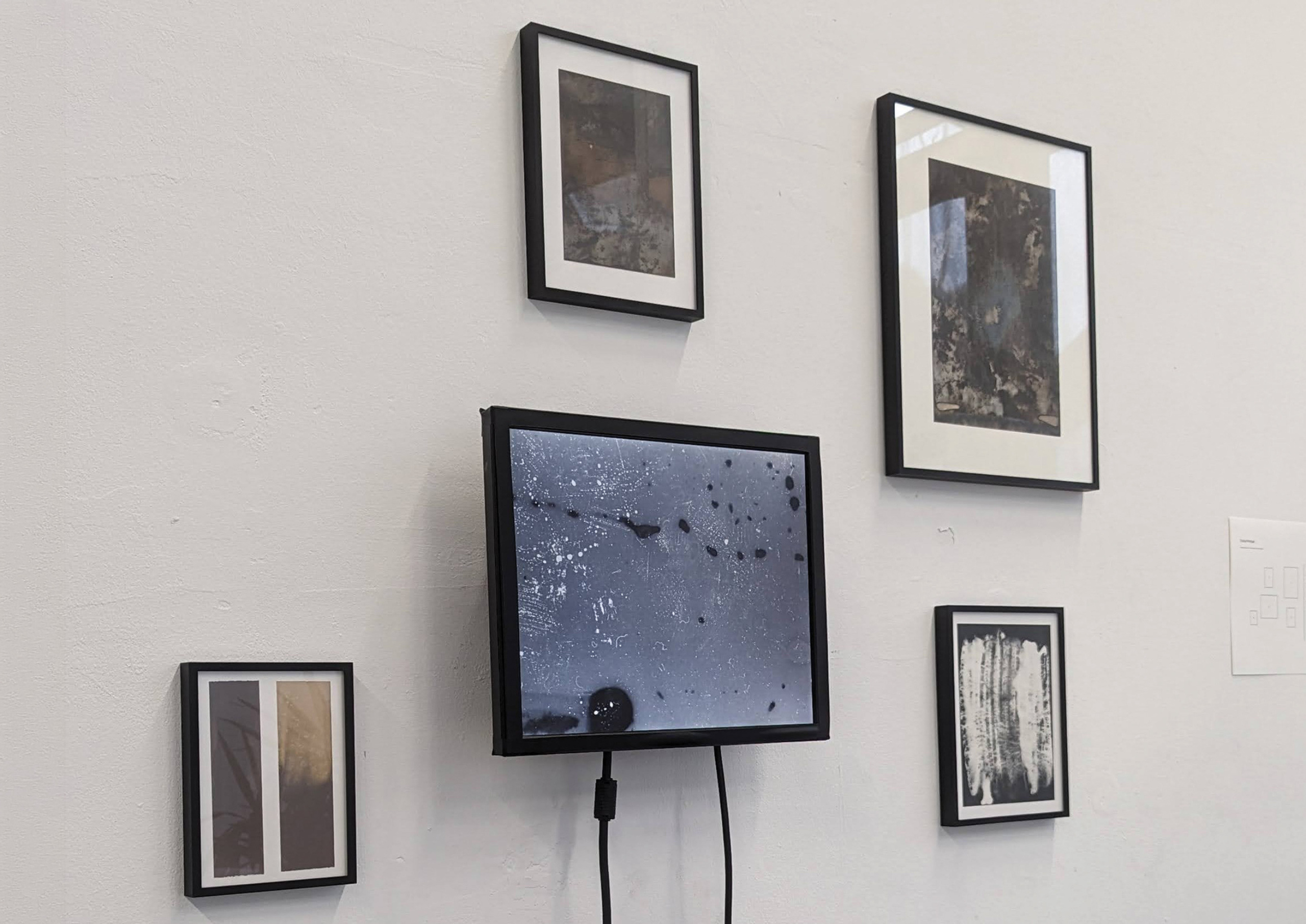
“Doka” is the Dutch word for the photographic darkroom, “donkere kamer”. This research project aims to provide sustainable alternatives to the harmful chemical process of darkroom photography.
Define the problem/need you are solving or addressing with your project. How does it address the Open Call criteria, such as environmental impact, social engagement, circularity, user experience, resource efficiency, and community-driven solutions?
Traditional developing and fixing processes in film photography rely on toxic chemicals like hydroquinone, metol and ammonium thiosulfate, and their disposal poses a major ecological risk. Growing up in Naples, where toxic waste dumping is a critical issue, I felt compelled to seek alternatives that wouldn’t contribute further to environmental harm. During my Tech Fellowship at Rijksakademie, I researched and developed new techniques that replace hazardous chemicals with natural and biodegradable substitutes. I identified ascorbic acid (vitamin C) as a safe developing agent and formulated an eco-friendly developer with sodium ascorbate and natural phenols from blueberries, coffee or cocoa powder, which allowed for effective film processing without traditional toxic developers. Similarly, I substituted the stop bath with a simple solution of rainwater and vinegar and experimented with a salt-based fixer, using sustainable accelerants like sulfenic acid from onions and MSM (methylsulfonylmethane) to speed up the process.
Please describe your project, reflecting on the concept, inspiration, materials, technical aspects, methods and process(es).
An estimated 11.6 million tonnes of toxic waste is buried or burned beneath vegetable fields, in quarries or on open land in the area around Naples, Italy, my hometown. Highly toxic industrial waste such as dioxin, arsenic, and even radioactive material can be found in the area. It is important to be aware of what these chemicals do to the environment over time, and be eco-smart about the best method of disposal. Most municipalities do not allow the disposal of any photographic waste into septic systems because it can adversely affect sources of underground drinking water and aquatic life. Yet most photographers dispose of their chemicals down the drain. I am developing recipes and guidelines to share with a wider community, hoping to inspire others to pursue environmentally conscious approaches to art and chemical-based processes, while also laying the groundwork for sustainable practices in creative industries.
What do you think makes your project innovative compared to the existing efforts and ideas in the field it addresses?
While most coffee-based developers are film-specific, my research focuses on a universal recipe compatible with any black-and-white brand and a massive sensitivity range (ISO 12–3200). I am currently refining this formula to offer a cheap, accessible alternative that I plan to both commercialize and share freely online. The analogue revival is undeniable; over the last decade, Kodak resumed production and ILFORD’s revenues doubled. However, many “eco-friendly” chemicals currently on the market are merely greenwashed products that remain environmentally harmful. My goal is to provide a truly sustainable solution that honours the craft. I hope this movement eventually inspires other chemical-heavy industries, like ceramics and painting, to adopt authentic, sustainable alternatives at a commercial level.
Does it impact or reflect young people need(s) and how?
This project taps directly into the “Analog Renaissance” led by Gen Z and Millennials, who are increasingly seeking tactile, slow processes to counter their digital-heavy life. Young people are highly sensitive to greenwashing. My recipe offers a transparent, DIY alternative to “eco-labeled” industrial toxins, aligning with their environmental values. Additionally, by keeping the recipe cheap and open-source, I lower the financial barrier to entry, making high-quality film development inclusive rather than elitist.
The project transforms a high-tech hobby into a grounding, kitchen-based ritual, turning a “black box” chemical process into something tangible and safe, satisfying a deep-seated need to reconnect with natural, non-digital cycles.