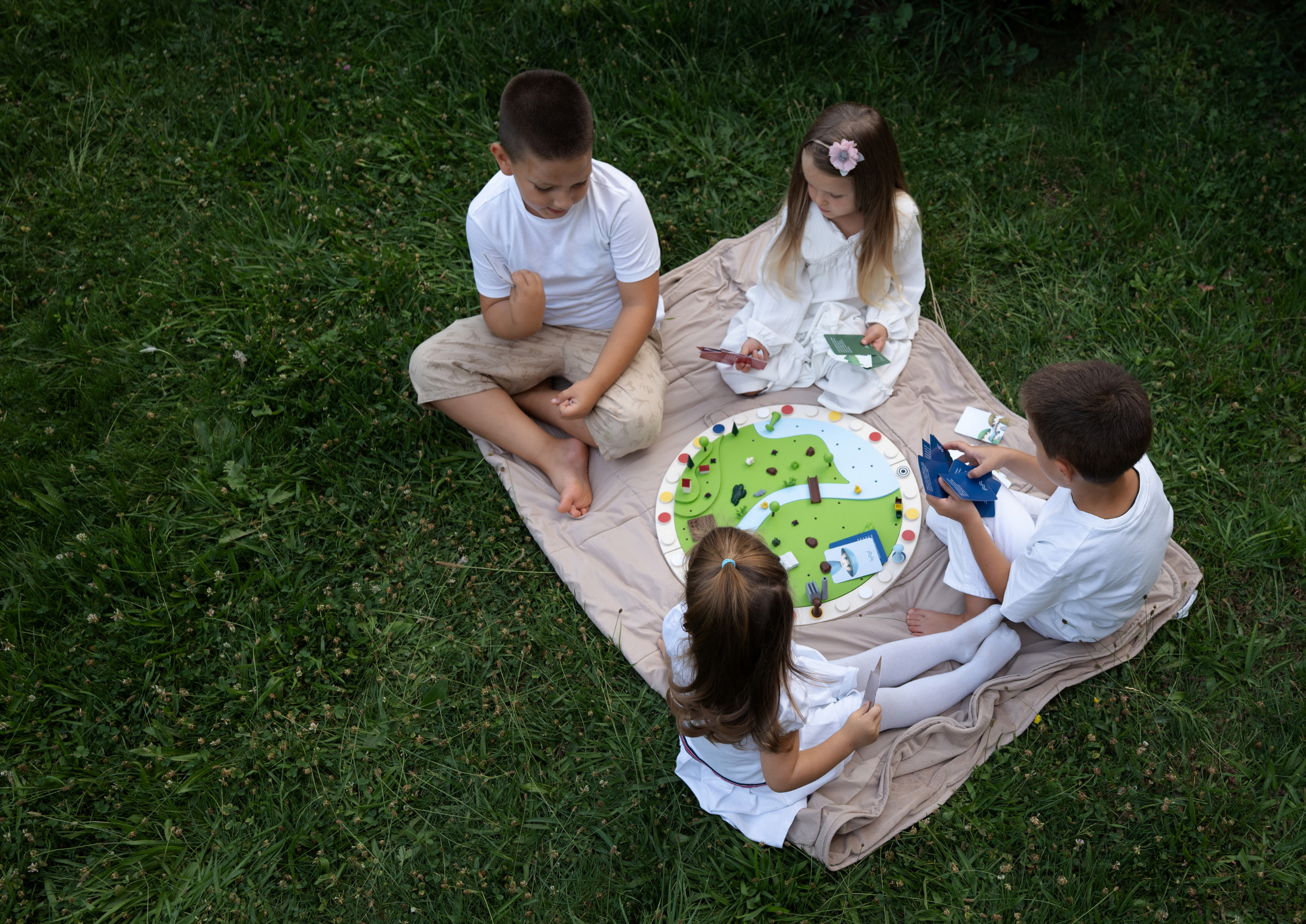
EcoRush – Design of a Didactic Game for Developing Ecological Awareness in Children

EcoRush is a cooperative didactic game designed to build environmental awareness in children through play, showing them how everyday actions affect nature while developing cognitive, social, and creative skills.

Define the problem/need you are solving or addressing with your project. How does it address the Open Call criteria, such as environmental impact, social engagement, circularity, user experience, resource efficiency, and community-driven solutions?

EcoRush addresses the growing disconnect between children and environmental responsibility. As ecological crises intensify, early education must embed ecological thinking, yet most tools rely on passive instruction rather than playful, embodied learning.
The game responds directly to the Open Call criteria. It delivers environmental impact through mechanics where rewards and penalties are tied to ecological actions, helping children understand consequences through experience. Social engagement is fostered through cooperative play requiring teamwork to restore a shared natural landscape. The user experience is innovative: children do not just learn about nature, they actively protect it, making decisions with immediate, visible effects on their shared world. Resource efficiency is achieved through thoughtful design that reduces material use while preserving educational value. Community-driven solutions are central: no one wins alone. Players must collaborate as the Guardians of soil, air, forest, and river to restore balance together.

Please describe your project, reflecting on the concept, inspiration, materials, technical aspects, methods and process(es).

EcoRush centers on a circular board symbolizing the planet and the interconnection of all ecosystems, populated with modular elements including trees, factories, recycling stations, solar panels, and oil spills. The landscape visually reflects the state of the world, shifting as players make decisions. Four Guardian characters represent soil, air, forest, and river, each carrying a distinct ecological role.
The game was developed through direct testing with children across multiple prototype iterations, with cardboard and foam models used to refine scale, element proportions, and gameplay mechanics before moving to digital 3D modeling. Material choices were guided by durability, tactile quality, and ecological responsibility. The final system combines structural components with smaller detailed pieces, creating a rich sensory experience. Rewards and penalties are tied directly to ecological actions, making cause and effect immediately legible to young players.

What do you think makes your project innovative compared to the existing efforts and ideas in the field it addresses?

Most eco-educational toys are either passive or competitive, framing environmental protection as individual achievement. EcoRush differs in three meaningful ways.
First, it is structurally collective: the game ends only when all four Guardians complete their tasks together, modeling real ecological interdependence rather than simplifying it.
Second, its world-building system is dynamic. Polluted factories sit alongside solar panels, oil spills alongside recycling stations, creating a landscape that visibly degrades or recovers based on player choices, making environmental consequences tangible for young children.
Third, the Guardian characters foster identification over competition: each child embodies a specific ecological role, grounding abstract concepts in personal responsibility. This combination of collective mechanics, visual storytelling, and role embodiment, validated through multiple rounds of child user testing, has no direct equivalent in the current market.

Does it impact or reflect young people need(s) and how?

EcoRush is designed around the developmental needs of children aged 6 and above, drawing on Piaget’s cognitive stages, fine motor skill research, and socio-emotional growth theory.
At this age, children are transitioning from egocentric toward cooperative reasoning. Gameplay supports this directly: it requires turn-taking, communication, strategic thinking, and emotional regulation when outcomes are negative. Tactile miniature elements strengthen fine motor skills; illustrated character cards support language development and narrative thinking; the ecological task system builds environmental literacy through lived experience.
Young people are the generation that will bear the full weight of today’s environmental decisions. EcoRush meets them at their developmental level with honest, age-appropriate content, not fear, but agency. Children learn that small actions carry weight and that real change happens through cooperation. These are not abstract lessons. They are practiced through play.
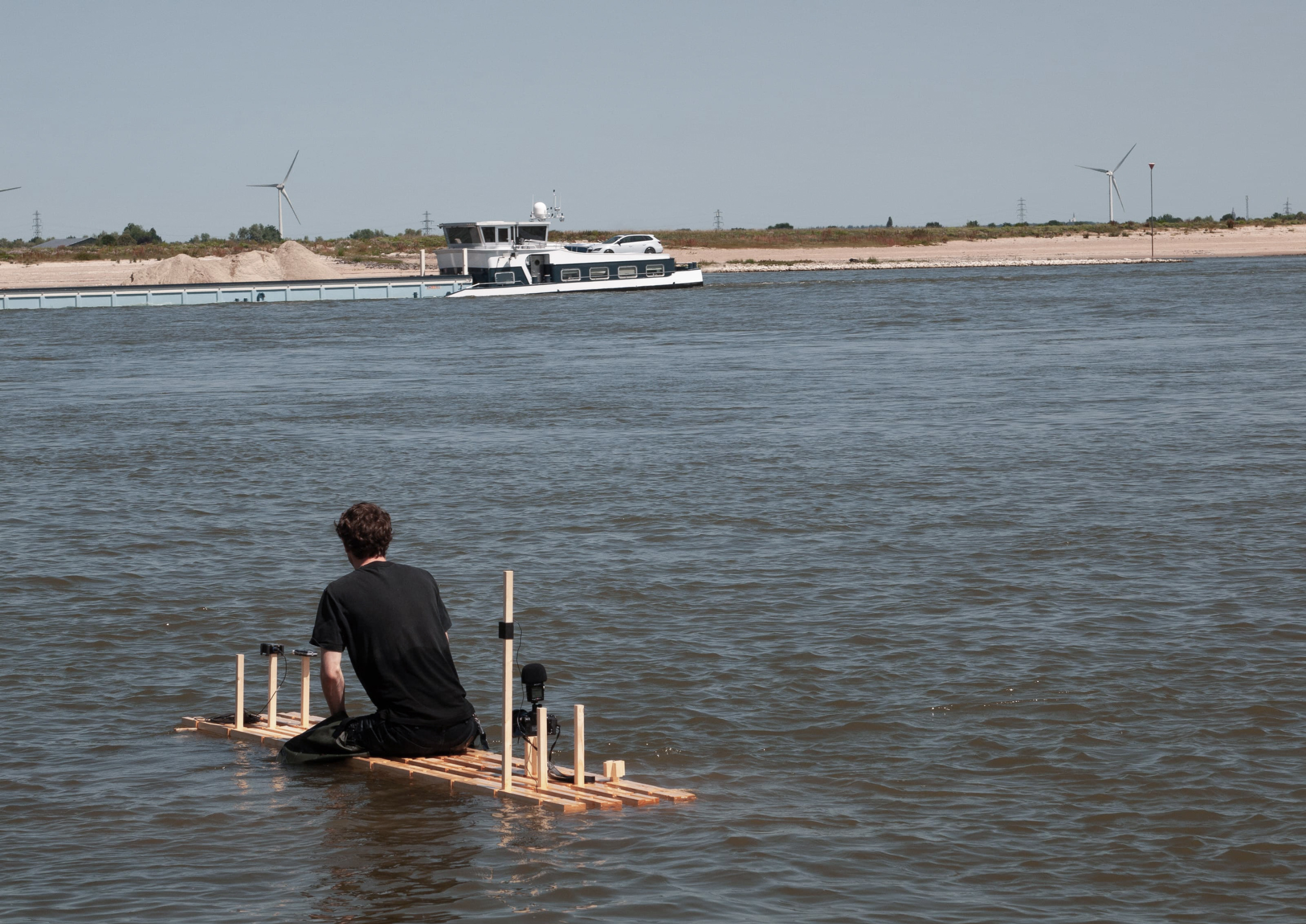
Flössern – in fluent

A handmade raft navigates along the Rhine-River, transforming river travel into a platform for shared knowledge, dialogue and alternative measurement.

Define the problem/need you are solving or addressing with your project. How does it address the Open Call criteria, such as environmental impact, social engagement, circularity, user experience, resource efficiency, and community-driven solutions?

Decisions about rivers are often made by distant institutions that manage them through technical standards, data platforms, and clearly defined borders of responsibility. Environmental protection, engineering, and energy production operate in parallel systems, rarely sharing knowledge or perspectives.
At the same time, crucial information about water flows remains inaccessible. For example, hydropower operators in upstream regions do not publish reservoir levels or flow data, which leaves downstream regions in a state of uncertainty regarding future water availability.
Historically, rivers were interpreted differently. Timber rafters had to understand currents, landscapes and seasonal changes through direct observation and exchange. This situational knowledge has largely disappeared.
Today, the Rhine-River is largely used as an industrial material, but is rarely understood as a shared ecosystem that can also be depleted. There is a need to bridge this gap by creating opportunities for institutions and communities to exchange knowledge and rethink collective responsibility across landscapes.

Please describe your project, reflecting on the concept, inspiration, materials, technical aspects, methods and process(es).

A handmade raft becomes a mobile measuring station that floats on the Rhine as an unconventional research instrument. This structure encourages direct engagement with the river landscapes and with the people, ecologies and institutions that form around the river. Rooted in pre-industrial rafting, the project reflects on how industrial standards have shaped our relationship with rivers. At each station, conversations with scientists, ethnologists and engineers will provide site-specific insights into missing parameters, which will later be translated into visual and spatial interventions. Instead of transporting goods, the raft carries stories, knowledge and alternative ways of knowing. Each documentary episode addresses gaps in recorded history, while archival publications compare standards and values along the Rhine, bringing knowledge back to institutions and crossing rigid borders of responsibility. The evolving design process transforms the raft into a platform for exchange, turning the river into a shared space of connection.

What do you think makes your project innovative compared to the existing efforts and ideas in the field it addresses?

Research is often conducted from a top view—identifying problems and attempting to intervene from the outside. Much like the sequence of your questions: Problem > Project > Innovation > Impact. For me, it was important to become an actor within the system, standing alongside the institutions and stakeholders along the Rhine.
Every conversation, research step, journey, and intervention happens through the object. The timber history and the building of a raft become the entry point for exchange.
Historically, rafts were highly adapted to each river course and current. In a similar way, the object—and myself as its navigator—remain adaptable in form and language, translating internal or specialised knowledge into accessible entry points.
The project challenges how we enter a river system: where access begins, through which tools, and who is allowed to participate in understanding it.

Does it impact or reflect young people need(s) and how?

Young people will face the ecological consequences of river systems, yet they are rarely part of current discussions. Flößern challenges this “not yet.” It shows that one does not need to be a scientist or engineer to begin engaging with rivers, and how a simple object can become a tool for community building and interdisciplinary exchange.
As more young people move to cities, they become consumers of distant landscapes without perceiving the infrastructures that sustain them. Rivers reveal these hidden connections. Timber once travelled from Alpine forests to Dutch cities, enabling urban growth. Today, these relationships persist but remain invisible.
By retracing these routes and translating them into publications, conversations, and spatial encounters, the project reconnects urban generations with the landscapes, communities, and infrastructures they depend on. It highlights how decisions in one region—such as climate change in the Alps or restricted environmental data—directly affect ecosystems and communities downstream.