
I am an industrial designer from Belgrade, currently working in a printing company, where I am involved in design and production processes. I hold a Bachelor’s degree in design, and my work is shaped by a hands-on approach that connects concept development with real-world fabrication.
Month: May 2026
Can Crea — Intergenerational Cultural Center
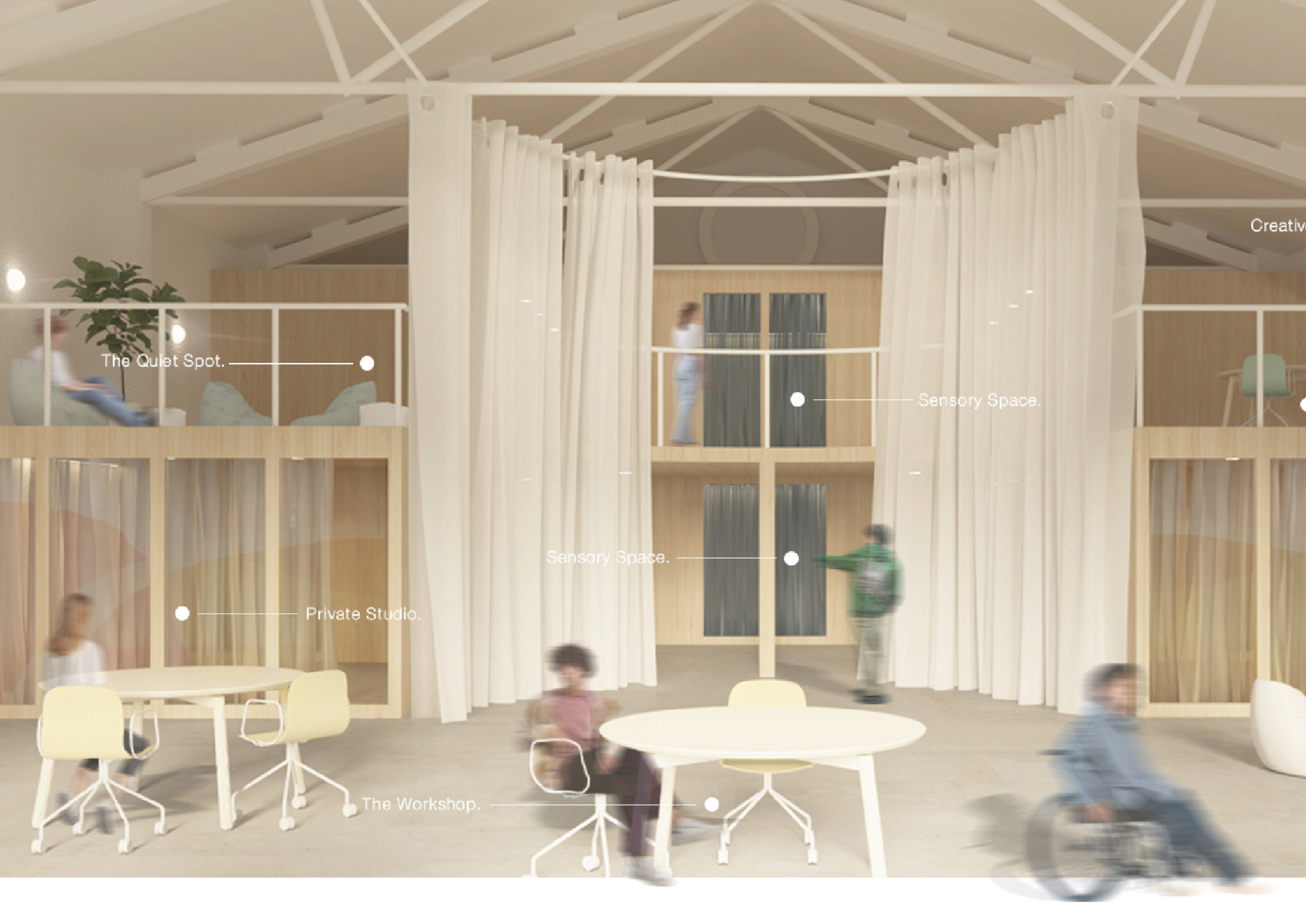
An intergenerational meeting point where design, light, and space work together so that people with intellectual disabilities can choose, create, and actively participate in cultural life.
Define the problem/need you are solving or addressing with your project. How does it address the Open Call criteria, such as environmental impact, social engagement, circularity, user experience, resource efficiency, and community-driven solutions?
In Spain, 74% of young people with intellectual disabilities were unemployed in 2022, reflecting a systematic exclusion from social, cultural, and community life. This group lacks spaces that recognize their active and creative role in society. Can Crea responds to this gap as a flexible and stimulating cultural center for people with intellectual disabilities over 18, where participation, creativity, and learning coexist in an open and welcoming environment. Organized around two complementary services: one focused on labor insertion and the other on occupational therapy and creative expression, the center is conceived as a living experience that goes beyond the physical. It is a space that adapts to changing emotions and needs, allowing each user to find their own rhythm, combining focus, play, and learning according to the needs of each moment.
Please describe your project, reflecting on the concept, inspiration, materials, technical aspects, methods and process(es).
Everything in Can Crea starts from a clear concept: the person is at the center. From there, every design decision develops as a living system that responds to changing emotions and needs.The project transforms two industrial warehouses of the Can Ricart heritage complex, in Poblenou, Barcelona, into a flexible cultural center. The duality of the space itself allows us to read and develop the atmospheres: understanding where light enters more and where less, which zones invite encounter and which invite introspection.From this reading, color is applied according to the function of each space: warm tones activate and stimulate creativity while cool ones invite calm and emotional regulation. Strategic volumes of CLT panels, a renewable and sustainable material, connect and organize both warehouses, respecting the natural gradation of light and generating fluid routes between workshops, therapy rooms and rest areas. A space that listens, welcomes and transforms.
What do you think makes your project innovative compared to the existing efforts and ideas in the field it addresses?
Can Crea is born from a constant dialogue between the space and the people who inhabit it. A cultural center that not only welcomes but listens, that not only functions but feels. It innovates by conceiving inclusive design as a living experience: flexible and multifunctional spaces, stimulating environments, therapy rooms, outdoor areas and interaction zones that adapt to the needs of each moment. CLT panels are not just structure; they bring warmth, enable sustainability, and allow reversibility, an intervention that respects heritage while building the future. Aligned with SDGs 10 and 11 and the Spanish Disability Strategy 2022–2030, the project promotes the integral development of people with intellectual disabilities by combining learning, artistic creation and community participation in cultural spaces. It connects families, caregivers, young people and local institutions, building a reference for inclusion where each person can explore their potential and be valued for their contributions.
Does it impact or reflect young people need(s) and how?
Can Crea directly impacts young people with intellectual disabilities over 18, a group that is especially vulnerable during the transition to adult life. In Spain, 74% of this group were unemployed in 2022, reflecting an exclusion that extends beyond employment to a lack of spaces for growth, expression, and participation in society. Can Crea responds to this need by creating an environment free of physical, sensory and cognitive barriers, where each individual can explore their potential and be valued for their skills and contributions. Light, color and materials work together to generate atmospheres that accompany changing emotions and needs, allowing each young person to find their own rhythm. More than a space, Can Crea is a living experience that adapts and gives each person their own way of inhabiting it.
Alessandro Pantoja Esna
I am an Interior Designer graduated from LCI Barcelona in 2025, with a background in scenic and performance lighting; disciplines that shape my understanding of space as an experience rather than an object. My starting point is always analysis and drawing: every line is a way of thinking, exploring and testing each decision before materializing it. I seek to create living, authentic and deeply memorable spaces, transforming every space into a sensory experience with purpose and intention.
Natalia Valverde Garrido

Spanish designer specialized in product and furniture design. She studied Industrial Design Engineering and Product Development in Seville and later specialized in Furniture Design at the Politecnico di Milano. Her goal as a designer is to create pieces that tell a story and establish a connection with the user, without compromising on functional purpose. Her projects are distinguished by a strong use of color and organic forms. Her creative process draws inspiration from Spanish culture, integrating tradition and innovation, both in form and in the choice of materials. In this journey, research and observation are fundamental elements in the design of objects that to have a strong identity and a deep emotional connection.
Ibrahim Beqiri
Kosovo-based architect, designer, and founder of the award-winning multidisciplinary studio SHAPE & SHADE. His work bridges architecture, product design, and urban thinking, translating local memory and cultural heritage into contemporary forms. With his debut product, the BOLD Shkam chair, he gained international recognition through multiple global awards and exhibitions, positioning Kosovo-rooted design on the international stage. Ibrahim’s projects range from urban masterplans and housing concepts to experimental objects and installations. Alongside his practice, he teaches design, mentors young creatives, and actively builds platforms that strengthen the regional design ecosystem. His approach is guided by one belief: local identity is not limitation, but future potential.
Jakša Bogdan
Born in 2005, Jakša is an industrial design student on the School of design program at Faculty of architecture Zagreb, blending technology, art and sustainability. With a media background, he indulges in projects like the open-source “Bojan” inkjet printer alongside visual communications and typography works. His designs have been showcased at DA! Festival and KOMBO Festival.
Jana Valdé Cusachs
I’m Jana Valdé Cusachs, a graphic designer and emerging artist based in Barcelona. I graduated from ELISAVA Faculty of Design and Engineering, where I developed a practice that moves between graphic design, art direction, and sensory design. My work explores the relationship between the body, perception, and communication through experimental formats that combine visual language, materials, and physical experience. I’m especially interested in how design can engage with social realities while remaining playful, poetic, and emotionally resonant. My latest project, Bleh! Ode to the Tongue, investigates oral perception, macroglossia, and childhood therapy through food design and graphic identity, transforming therapeutic exercises into joyful sensory interactions. Through my practice, I aim to create projects that connect care, expression, and design.
Juana John

Designer currently based in Berlin, Germany, with a focus on experience design, data-driven design and visual narratives. Recently graduated with a Master’s in Visual & Experience Design at the University of Europe for Applied Sciences, working on projects that create experiences that are intentional and impactful addressing issues from echo chambers in media consumption to the climate crisis. With a background in graphic design, I’m now transitioning into the UX and product design field, with a deep interest in designing products and experiences that drive social good and cultivate well-being.
Aakriti Singh

Architect and founder of Aakriti Atelier, working at the intersection of architecture, ecology, and digital design. Trained at IAAC in Barcelona, her work explores how urban systems can integrate biodiversity through scalable, technology-driven interventions. Her projects move beyond static buildings toward adaptive ecological frameworks, combining spatial design with simulation tools. Through BEASTIE, she develops a platform that enables users to design, visualize, and evaluate biodiversity interventions within existing urban environments. Her approach focuses on transforming everyday spaces into active ecological infrastructures that support multispecies coexistence.