

Giulia is a Neapolitan transdisciplinary artist currently based in Amsterdam. Her practice explores perception as an unstable interface between the self, technology, and the environment. Mapping a deliberate conceptual arc of moving from the outer environments we observe to the internal environments that observe us. She works on mixed media installations and material research on sustainable darkroom practice, first developed during Covid-19 and later supported by Rijksakademie van Beeldende Kunsten via tech fellowship (2022). Her work has been exhibited throughout the Netherlands, India, Japan and NYC. Her photographic research won the Art and Science Prize at Crqlr Awards (JP) in 2024. In 2023 she co-founded Doka 107, a photographic darkroom studio in the centre of Amsterdam.
Month: May 2026
Bold Collection
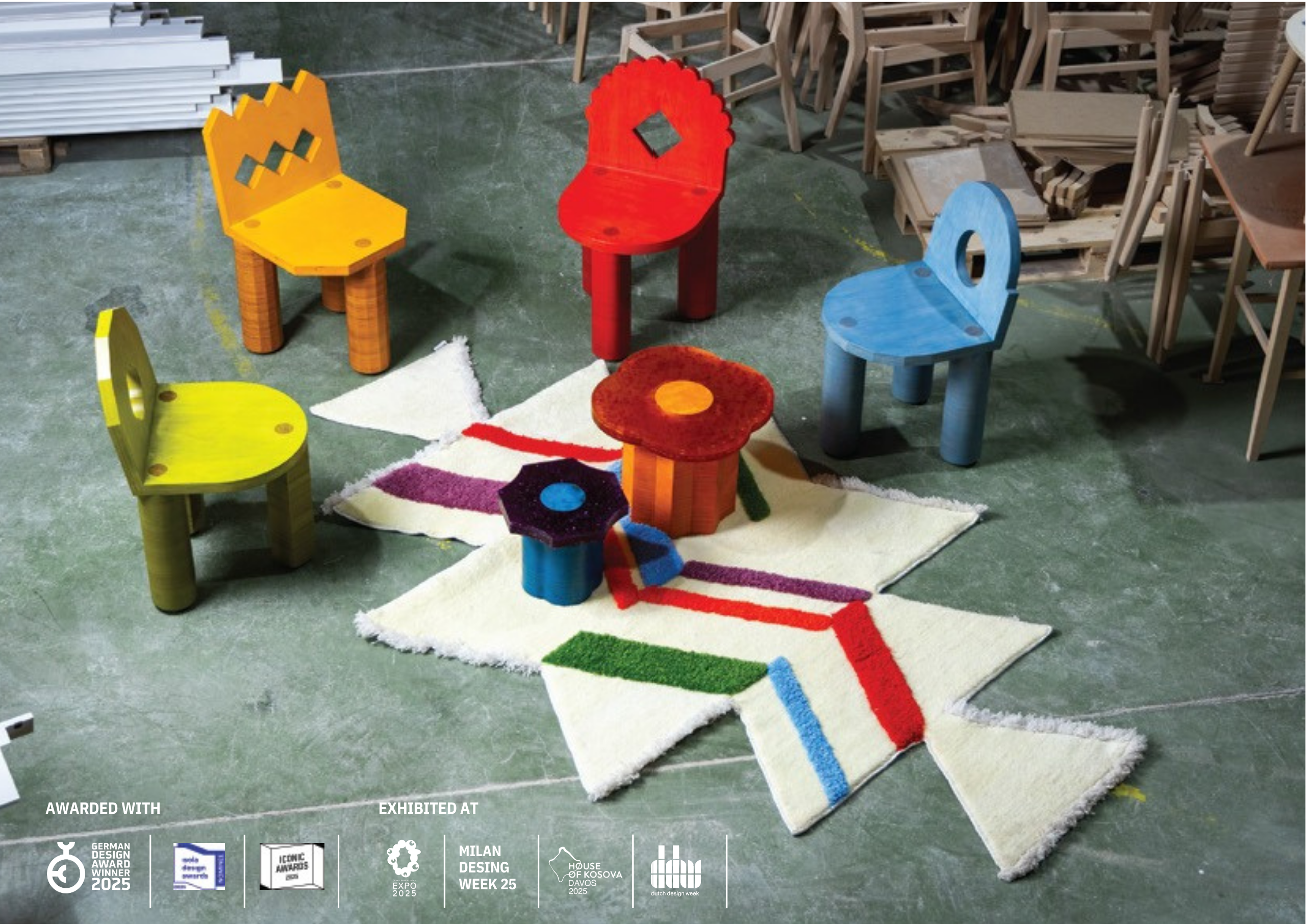
BOLD Collection reinterprets a traditional Albanian stool into a modular, sculptural and personalizable system translating cultural memory into contemporary, adaptable, and internationally relevant objects.
Define the problem/need you are solving or addressing with your project. How does it address the Open Call criteria, such as environmental impact, social engagement, circularity, user experience, resource efficiency, and community-driven solutions?
The BOLD Collection addresses the growing disconnection between contemporary design and local cultural identity. In many emerging regions, traditional crafts are disappearing while mass-produced furniture dominates markets with little emotional or environmental value.BOLD reinterprets a vernacular wooden stool into a modular, adaptable system designed for longevity, repairability, and reinterpretation. Produced locally with small-scale manufacturers, it supports regional craftsmanship and reduces transport impact. Its modular logic allows parts to be replaced, reconfigured, or expanded, encouraging circular use rather than disposal.Beyond function, the project creates social engagement by repositioning heritage as a contemporary asset. It strengthens community-driven production networks and empowers local makers to compete in international markets.By combining cultural continuity, local production, modular adaptability, and durable materials, BOLD proposes a sustainable model where identity, economy, and environmental awareness coexist.
Please describe your project, reflecting on the concept, inspiration, materials, technical aspects, methods and process(es).
BOLD Collection originates from the reinterpretation of a traditional Kosovo wooden stool used for generations in rural homes. Rather than preserving it as a nostalgic artifact, the project transforms it into a modular, scalable design system adaptable to contemporary living.The collection is crafted from solid wood sourced and produced locally in collaboration with small manufacturers. Its structure is based on a clear geometric logic that allows stacking, reconfiguration, and expansion into tables, benches, and spatial installations. The joinery is simplified for durability, repairability, and efficient production.The process combines digital modeling with hands-on prototyping, ensuring both precision and craftsmanship. By maintaining minimal components and structural clarity, BOLD reduces material waste while increasing longevity. The project is not only a product, but a method: translating vernacular memory into a flexible, contemporary system rooted in culture and built for the future.
What do you think makes your project innovative compared to the existing efforts and ideas in the field it addresses?
BOLD is innovative because it does not treat heritage as decoration, but as infrastructure. Instead of applying traditional motifs superficially, it extracts structural intelligence from a vernacular object and transforms it into a modular design system.Its innovation lies in combining cultural reinterpretation with scalability. The same structural DNA generates multiple typologies, allowing adaptability without redesigning from zero. This reduces production complexity and material waste. Unlike many contemporary furniture brands that prioritize aesthetics over context, BOLD positions identity as a driver of sustainability. By strengthening local production networks and enabling international distribution of regionally rooted design, it proposes a new economic model for emerging creative ecosystems. The project demonstrates that innovation can emerge from reinterpretation rather than technological excess; merging craft knowledge, modular logic, and circular thinking into a globally relevant design language.
Does it impact or reflect young people need(s) and how?
BOLD impacts young people by reframing cultural identity as a source of confidence and opportunity. In regions where creative industries are still developing, many young designers feel disconnected from both global markets and local traditions. The project demonstrates that heritage can become contemporary and internationally competitive without losing authenticity. Through workshops, lectures, and exhibitions, BOLD has been shared with students and emerging designers as a case study of how local narratives can become global platforms. Its modular and adaptable logic also reflects how younger generations live today: flexible, mobile, and multifunctional. The collection encourages reinterpretation rather than fixed use, aligning with evolving lifestyles.By proving that a locally rooted idea can win international awards and travel globally, BOLD offers a tangible example that innovation does not require leaving your context; it requires redefining it.
Botijo, the furniture that breathes cool air
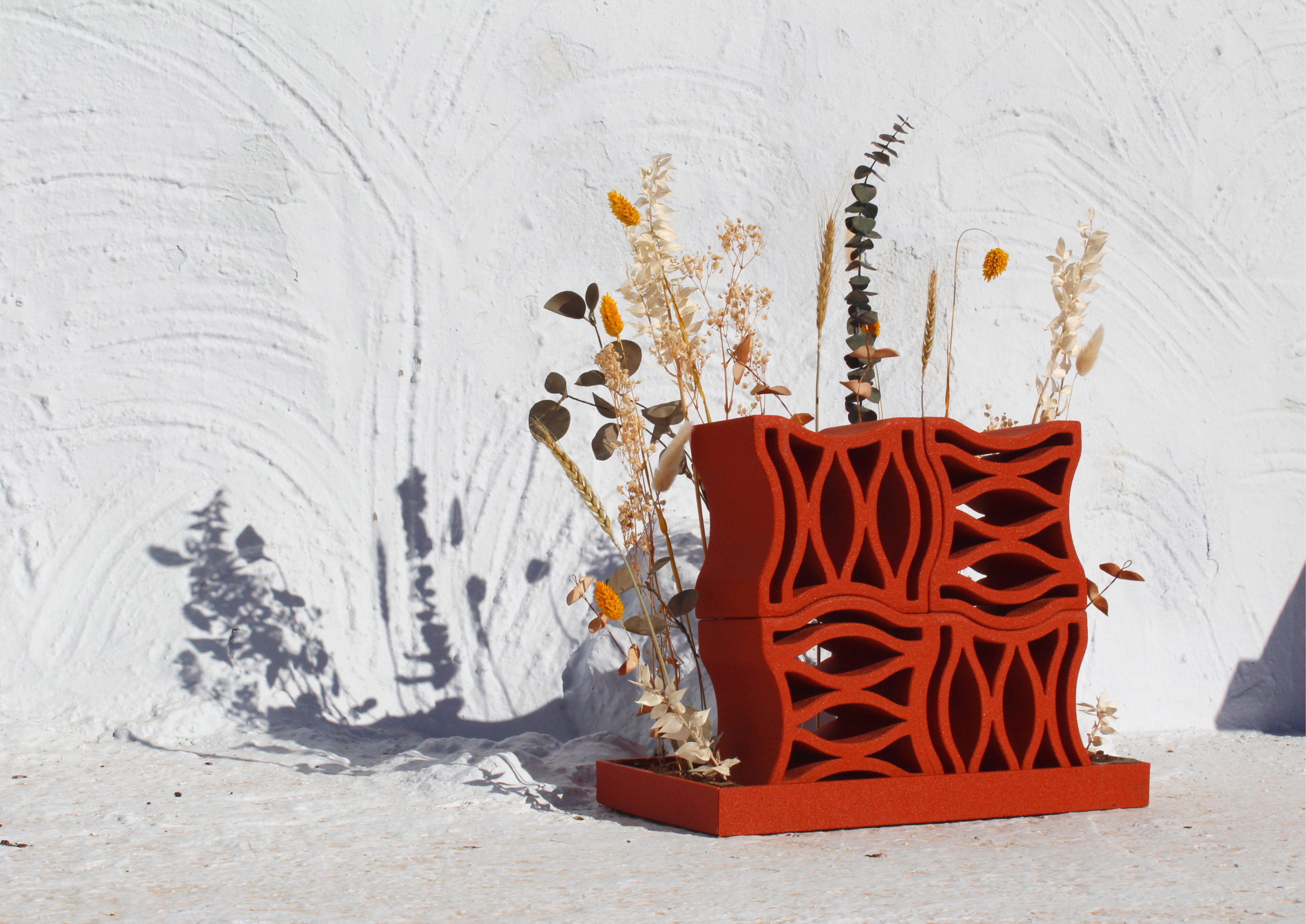
Botijo is a modular furniture system made of terracota that cools spaces through natural evaporation, reinventing tradition to create a versatile climate control solution that merges southern Spanish heritage with function and contemporary design.
Define the problem/need you are solving or addressing with your project. How does it address the Open Call criteria, such as environmental impact, social engagement, circularity, user experience, resource efficiency, and community-driven solutions?
Due to pollution and frequent heatwaves, rising global temperatures are making life in hot climates increasingly difficult. Although evaporative air conditioners exist to alleviate this discomfort, their manufacture and installation are often complex. Botijo solves this problem by creating a simple, modular terracotta piece that can be easily used to make versatile furniture, such as tables, benches and room dividers, which also function as evaporative coolers. This type of cooling reduces environmental impact, as it simply involves wetting the piece with water — which is reused to water plants — and allowing it to evaporate. Circularity is guaranteed thanks to the material used, terracotta, which is natural, durable and recyclable, and can also be reused as raw material if a piece breaks. These accessible modules allow people to build bespoke pieces, thereby enhancing the user experience and enabling endless configurations to suit any space.
Please describe your project, reflecting on the concept, inspiration, materials, technical aspects, methods and process(es).
The project aims to transform the concept of the traditional Spanish water jug into a functional piece of furniture. The decision to choose terracotta as the primary material draws inspiration from both the jug and traditional architecture, as it is a durable and resistant material, yet porous enough to absorb water and allow it to evaporate. The shape was chosen following extensive research into sustainable cooling methods, during which I discovered adiabatic coolers and how they use curved cellulose pads to absorb as much water as possible. This specific geometry increases the surface-to-volume ratio and forces the air to change direction, maximising contact time with the wet clay to achieve optimal evaporative cooling. At the same time, the pieces are designed to be stacked in any orientation and joined with mortar, allowing users to create endless configurations. The dimensions also allow for heights that are ergonomically suitable for any type.
What do you think makes your project innovative compared to the existing efforts and ideas in the field it addresses?
Botijo is innovative because it transforms the concept of furniture, shifting from a passive object for use and decoration to becoming an active part of the space, which benefits both the environment and users. Furthermore, it changes the paradigm of climate control, since, rather than viewing a cooling device as a machine that needs to be hidden away, it integrates it directly into domestic life as an aesthetically pleasing piece of furniture. It solves two problems at once: furnishing a space and cooling it. Unlike traditional cooling devices, which can only be installed in specific areas of a room, Botijo’s modularity and versatility allow for endless configurations and customisations, demonstrating that climate control technology can be sculptural, customisable and seamlessly integrated into interior design. On top of all this, the simplicity of its construction, compared to other furniture, makes it much more affordable than most.
Does it impact or reflect young people need(s) and how?
Young people require solutions that match both their ecological awareness and their dynamic lifestyle. Botijo directly addresses their needs offering an affordable, simple and energy saving solution to combat extreme heat, in line with the shared concern for the future of the planet. Furthermore, its modularity speaks to their need for adaptable living, since the system can be scaled up or down, functioning as a small stool or a large room divider, depending on the user’s available space and budget. It encourages young people to take sustainable climate action in their own homes, whilst continuing to create aesthetically pleasing spaces where nature takes centre stage. This project aims to create iconic pieces that can also spark conversation and help mitigate the effects of climate change, either through their function or by changing people’s way of thinking.
Janine Kerscher
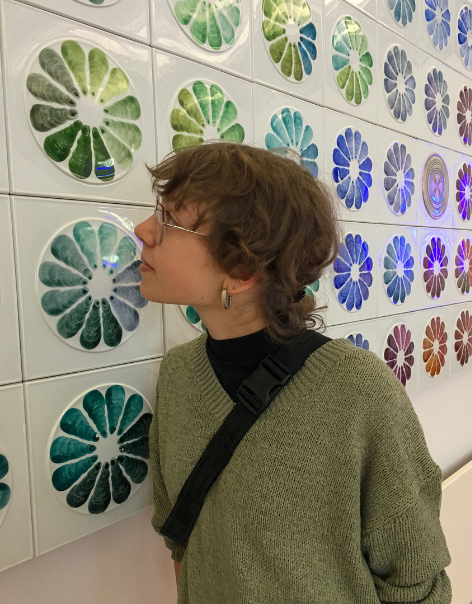
Writing this, I‘m freelancing as a sustainable communication designer, in my early twenties, situated in Germany. Last year, I graduated, leaving uni as “Bachelor of Fine Arts“. But more important than any title, I left with my own expression as a creative person and the goal to craft connection through design. I know it‘s actually complex, but to put it simple: I want to do good.
To me, good design is so much more than “make it pretty”. It means acknowledging the power to change views, to guide, to shape – essentially to map the future. And most importantly “good” includes treating this power with responsibility & care, asking why before what.
Barbara Koniecka

My name is Barbara Koniecka, I am a transformation designer, artist and maker. In my work I focus on addressing ecological and social issues, promoting equality and access to green spaces. I am fascinated by the city, its unique structure, and the challenges and potential it holds. In my work, I focus on analysing this subject and seeking out opportunities for change. Thanks to my background in design (Bachelor’s degree in Product and Graphic Design, Warsaw) and art (Bachelor’s degree in Art Education, Warsaw), my work combines the need for pragmatic problem-solving and the search for a form that best serves a function, with the need for artistic creation that is free and bold.
Sebastian Melenge Valladares

Designer who is constantly questioning how and why things work the way they do. His approach is grounded in curiosity, research, and a need to understand what sits behind people’s decisions, especially in digital environments. Originally from Colombia and now based in Barcelona, his experience as a migrant has shaped how he sees culture, context, and the way people relate to information. He is not particularly interested in polishing solutions, but in uncovering tensions, contradictions, and behaviors that often go unnoticed. Through his work, he explores how design can shift perspectives, challenge assumptions, and create more conscious ways of interacting with the world, rather than just making things smoother or faster.
Hanchen Zhang

Research-based designer and artist based in the Netherlands. His practice works across sound, moving image, objects, and installation to examine how infrastructural systems shape ecological, territorial, and social relations. Through field recordings, sensing devices, reclaimed materials, and audiovisual composition, he builds spatial narratives that make large-scale systems perceptible without reducing them to illustration. His work has been shown at Nieuwe Instituut, Temporary Art Centre, OSCAM, De Bouwput, and international screening platforms. Trained in Geo-Design at Design Academy Eindhoven and originally rooted in ceramics, he approaches design as a situated form of inquiry into extraction, mediation, and more-than-human coexistence.
Borbála Kiszely

I’m Borbála Kiszely, a Master’s architecture student at TU Graz. I completed my Bachelor’s in architecture at TU Graz and UTFSM in Chile, after studying interior architecture at the Ortweinschule in Graz.
Growing up close to nature, I see it as an essential part of architecture: Something to protect, integrate, and learn from. I view architecture as a language everyone experiences, shaping how we feel and interact with space.
My work focuses on creating meaningful, human-centered environments that connect people with their surroundings. Through experiences in Austria and Spain, I’ve explored how design influences emotions and well-being, aiming to create spaces in harmony with nature.
Leja Rebolj

Industrial designer from Slovenia, currently studying at the Academy of Fine Arts and Design in Ljubljana. Her creative approach seamlessly merges product and service design with a deep commitment to sustainability and material innovation. She is creating her personal brand ELERE, through which she explores the potential of biobased materials, such as her notable project Pomter—a biodegradable material derived from waste potato peels.
Her work has gained international recognition, including the Perspectives Award for Industrial Design. Driven by nature and a circular economy mindset, she aims to bridge the gap between waste and functional design, creating solutions that connect people with more sustainable living.