

Growing up in Vilobí del Penedès, surrounded by the vineyards and landscapes of Barcelona, I developed an early obsession with how natural light transforms a space. Now, at 23, that fascination has evolved into a professional focus on lighting design — balancing the technical side of brightness with the warmth of a lived-in home. I’ve always been someone who prefers getting my hands dirty. Whether it’s woodworking or exploring traditional Mediterranean crafts, I believe design should feel tactile and grounded. For me, the “Next Gen” of design isn’t just about new tech; it’s about bringing soul back into our environments by honoring raw materials and heritage.
Month: May 2026
Stefan Aleksandar Jovanovski

Is a curator, art director and concept-driven cultural practitioner based in Skopje, with more than 10 years of experience in contemporary art, community-based practice and multidisciplinary cultural production. He is the founder of KomshiLOOK, a platform that transforms overlooked public spaces into stages for collective cultural experience. His work combines site-specific art, performance, light and media art, dramaturgy and community engagement. He is also the founder of Skopje Light Art District and The Smallest, and one of the initiators behind LUNA. As a concept thinker, he develops new artistic formats that use art as a tool for visibility, participation and social connection exploring how culture can create dignity, reshape everyday space and open new ways for connection.
Valdís Steinarsdóttir

Is an Icelandic designer and researcher, exploring material innovation and speculative narratives through experimental design. She graduated from the Iceland Academy of the Arts with a BA in Product Design in 2017 and from the Design Academy Eindhoven in 2025 with a Master’s in Social Design with cum laude and nomination for the Gjise Bakker Award. Valdís has received numerous awards for her design, including Formex Nova-Nordic Designer of the Year.
Michael Pfandl

I’m Michael Pfandl, a 24-year-old industrial design student at FH Joanneum in Graz, Austria. My work moves between product design, toolmaking, and material research, focusing on how design can build better relationships between people and nature. Design has given me the freedom to follow creative impulses, connect different fields, and think beyond familiar patterns. Through hands-on experimentation with biomaterials, digital fabrication, and low-tech making, I explore practical ways of bringing new technologies and local resources together. I’m drawn to projects that link ecology with everyday life and create value through collaboration across regions and disciplines. For me, design is a tangible way to test ideas and make change visible.
Iza van der Klauw

Dutch designer with a background in Industrial Design Engineering and a Master’s in Design for Interaction from TU Delft, graduated cum laude with a GPA of 8.95. With around seven years of design experience spanning product, UX/UI, branding, and strategic design, she works at the intersection of complex social challenges and future-oriented thinking. Her graduation project explored human–nature relations in Lombok toward 2045, resulting in an educational program now distributed across ten primary schools. She has contributed to projects shown at the World Expo Osaka and the UNESCO International Year of Quantum Science, and currently works as a freelance designer and event architect for international ocean governance initiatives.
Kelly Azevedo Galvão

I’m a 25-year-old graphic designer from Luxembourg. I finished my Bachelor’s degree in Communication Design at the Trier University of Applied Sciences in February 2026. I’m passionate about exploring different styles and techniques, and I’m always eager to learn and grow in my craft. My main interests lie in typography, branding and editorial design.
Bojan – DIY inkjet printer
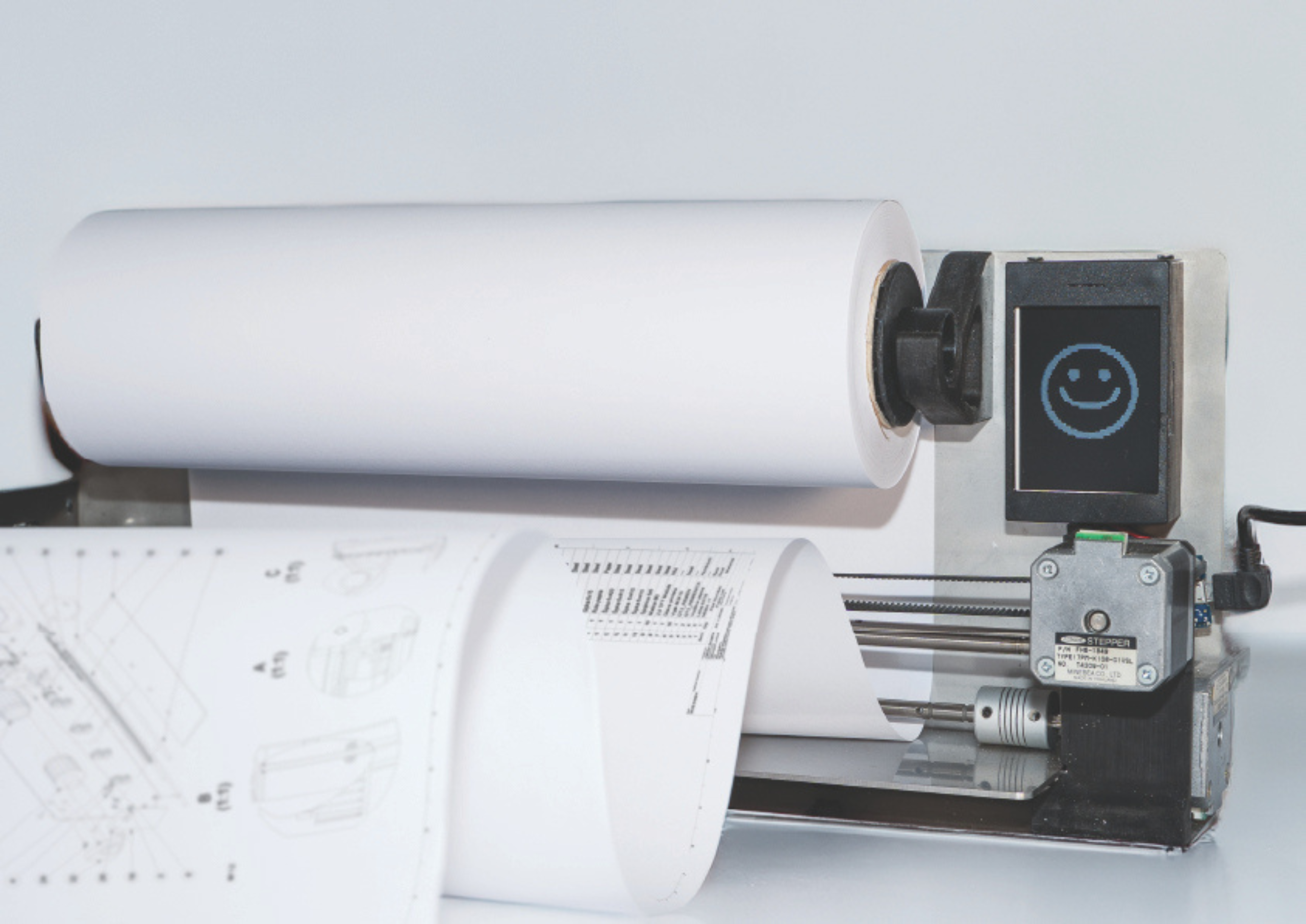
Bojan [pron. Boy-yan] is an open DIY inkjet printer that students can build, understand, and modify themselves, offering a low-cost, repairable and educational alternative to closed commercial printers in student spaces.
Define the problem/need you are solving or addressing with your project. How does it address the Open Call criteria, such as environmental impact, social engagement, circularity, user experience, resource efficiency, and community-driven solutions?
Commercial printers burden students with high ink costs, e-waste from unrepairable “black boxes,” and dependency on proprietary parts, creating financial stress and environmental waste in shared student spaces. Bojan addresses this by being a fully open-source DIY inkjet printer: students assemble it from affordable, off-the-shelf components like NEMA17 motors, ESP32, and 3D-printable parts, understanding every mechanism, from printhead movement to paper feed. Environmental impact through repairability (no proprietary cartridges, refillable HP302) and reduced e-waste; circularity via modular, upgradable design; social engagement and community-driven solutions by inviting hacks and workshops; user experience with customizable print widths and intuitive touchscreen control; resource efficiency using standard parts (~€150 total) for low ongoing costs. Bojan empowers student makers to experiment, collaborate, and sustain their own printing ecosystem.
Please describe your project, reflecting on the concept, inspiration, materials, technical aspects, methods and process(es).
The name Bojan comes from the common Croatian name which sounds similar to the word “to color” [cro. bojati]. Bojan is an open-source DIY inkjet printer inspired by RepRap 3D printers and cartridge hacks found on sites like Hackaday, aiming to democratize color printing in student spaces. The concept: a modular platform students build themselves, using off-the-shelf parts. Technical aspects include microstepping, PDF rasterization on ESP32, and 1.5mm printhead gap to avoid crashes. The process: source parts (~€150), 3D print holders (customizable width via rod length), assemble mechanics like a 2D plotter and flash Arduino firmware for G-code like printing. This hands-on method fosters tinkering, with inspiration from Hackaday projects, emphasizing repairability over disposability.
What do you think makes your project innovative compared to the existing efforts and ideas in the field it addresses?
Bojan stands out from existing DIY inkjet efforts like Open Printer or Magic Paintbrush by targeting student ecosystems with extreme simplicity and affordability (~€150 BOM using ubiquitous parts like NEMA17 stepper motors, ESP32 microcontroler and HP302 cartridge). Unlike niche hacker projects requiring custom PCBs or STM32, Bojan prioritizes 3D-printable modularity—print width set by rod length, no exotic tooling and ESP32-only control for accessible Arduino programming, enabling workshops without advanced skills. Its innovation lies in educational transparency: every subsystem (motors, cartridge pulses, rasterization) is exposed for understanding, fostering community forks for UV inks, roll paper, or multi-color upgrades. While others focus on performance, Bojan emphasizes circularity: refillable cartridges, zero e-waste design and social scalability via plug-and-play assembly, bridging RepRap’s self-replication ethos to 2D printing for non-experts in shared spaces.
Does it impact or reflect young people need(s) and how?
Bojan directly impacts young people’s needs in student environments where printing is essential yet costly and unreliable: ink expenses (€0.05/page), frequent breakdowns, and e-waste from unrepairable printers create barriers to education and creativity. As a DIY open-source inkjet printer, Bojan slashes ongoing costs to near-zero (refillable HP302 cartridges at €2/fill) while empowering students to self-repair and customize—addressing frustration with “throwaway” tech. It reflects youth needs for hands-on learning and maker culture: high school/university students (like me, studying industrial design) gain skills in electronics (ESP32), mechanics (stepper timing), and coding (PDF rasterization), turning printing into a collaborative workshop activity. In shared dorms/clubs, it fosters community-driven sustainability, reducing waste and building resilience against vendor lock-in—key for Gen Z’s values of repairability, affordability, and digital-physical empowerment.
Laurin Böhm

Designer and trained carpenter from the Alpine region, where local questions between material origin and landscape conditions shape everyday life. This background informs his research-driven practice, which investigates water systems and the ways human behavior affects environments and the other way around. At the Design Academy Eindhoven, he developed a methodology that combines handcrafted objects with engagement of communities. Recent work includes the exhibition Studio Technogeographies (Z33, Hasselt, 2024), where he presented research on water behavior, materiality, and handmade fieldwork objects. The investigation into Austria’s infrastructure and dependence on artificial snow was shown at Atlas of Distances (Faber, Timisoara, 2023).
Emina Murtezic

Is a product and visual designer, researcher, and advocate exploring the intersection of design, inclusion, and ecological responsibility. Combining social engagement with systems thinking, she develops design solutions that challenge existing structures and center human needs. She studied Product Design in Sarajevo, where she is currently completing her Master’s degree.
Emina’s work explores how design can drive meaningful societal transformation. She collaborates with foundations and international organizations, which informs her impact-driven approach. Her award-winning work has been exhibited across Europe and beyond. She deeply believes that design should not adapt people to the system, but reshape the system to fit people.