

Nina booked a one way flight to Asia after finishing her masters in Interior Architect, and ended up traveling for over a year. Somehow she ended up in San Francisco, designing NotAMouse. She’s in love with Cats, Tea and Ux design.
Month: May 2025
Bacterial Brickbats
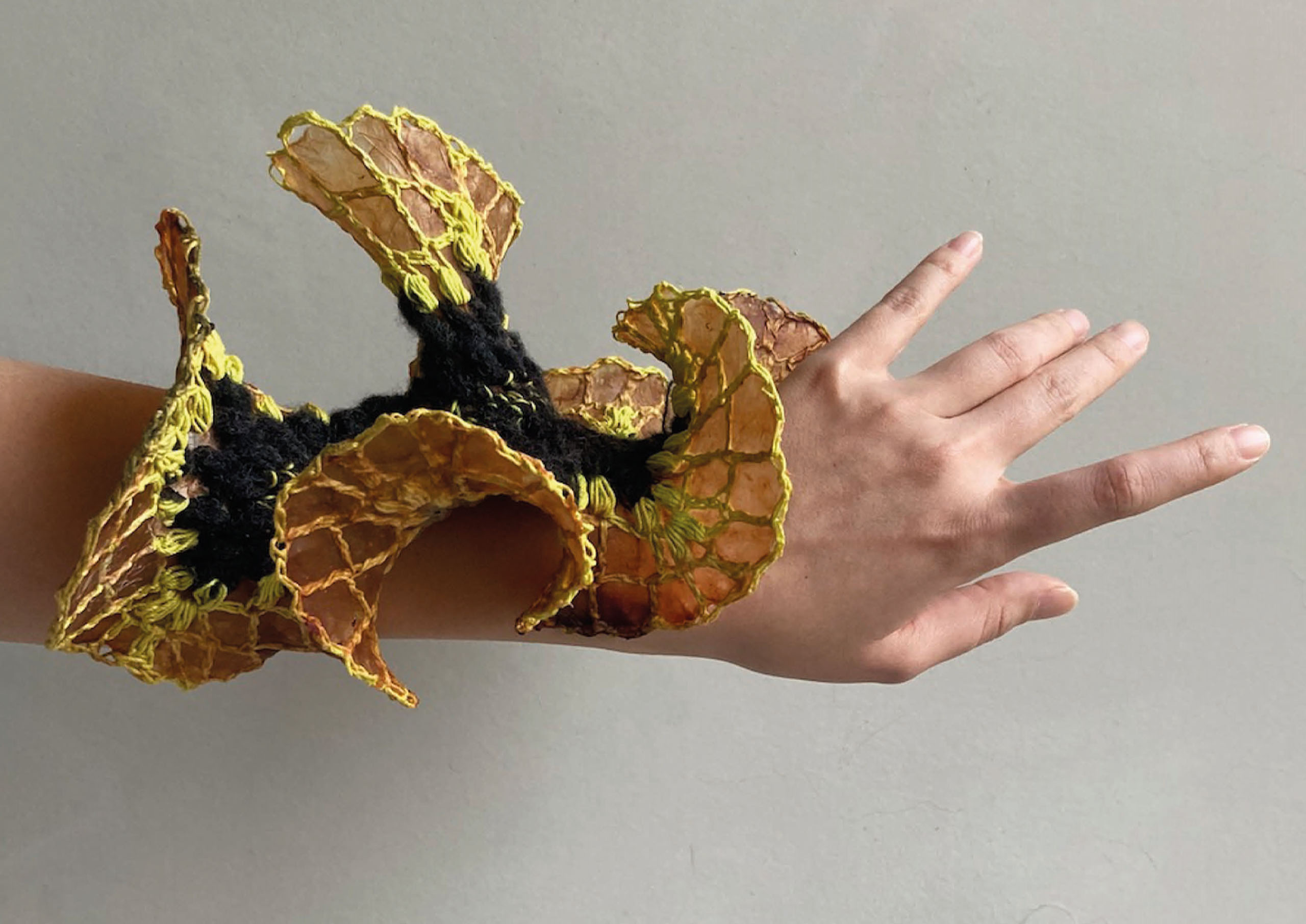
A foray into the aesthetic expressions of bacterial cellulose-knit textile composites challenging anthropocentric agency through human/non-human design collaboration
Define the problem/need you are solving or addressing with your project. How does it address the Open Call criteria, such as environmental impact, social engagement, circularity, user experience, resource efficiency, and community-driven solutions?
Bacterial Brickbats proposes self-assembling properties of bacterial cellulose (BC) delivering textiles for fashion applications BC is organic, compostable, and being treated only with beeswax, poses little environmental detriment. Scaffolds were manufactured from cotton yarn to maintain the library monomaterial, as this facilitated recycling and appeared to be BC’s preferred basal material. Making processes rely on bacterial organic growth processes, significantly reducing manufacturing costs, resource consumption, and chemical and water impact. Bacterial brickbats negotiates the systemic leap towards regenerative design by placing its main contribution in knowledge and its proposed method. It exemplifies what can be accomplished with available techniques and materials, but encourages investigative openness and iterations with different materials to better understand the interaction between living materials and textiles. This enhances localised design, as available materials will vary regionally and produce different results from the same methodology, and suggest a comparatively greater attachment formed between designer, artefact and non-human.
Please describe your project, reflecting on the concept, inspiration, materials, technical aspects, methods and process(es).
‘Bacterial Brickbats’ explores reassembly as a subsidiary property of bacterial-cellulose’s (BC) natural growth and self-assembling potential through a comprehensive material library. This consolidates the understanding of BC as a living textile and acknowledges BC’s organic intelligence as capable of designerly agency by rooting its design method in biological growth patterns and BC’s behaviour towards knitted textile scaffolds. From human perspectives, the proposed textiles probe for colour, texture and form studies exploring the optics of textile translation into artefact. Later stages speculate around situated artefact creation and body applications, emphasising transparency and light interaction as unique properties to BC-based composites. Proferring concurrence between bacterial processes and human design conventions, this multi-species approach heeds human and non-human roles in the design process by progressively and gradually shifting agency between them, affording the human the chance to observe, understand and design in synchrony with BC’s morphology and behaviour.
What do you think makes your project innovative compared to the existing efforts and ideas in the field it addresses?
Bacterial Brickbats takes a more-than-human approach to textile design-make potential by acknowledging the agency of non-human stakeholders collaboratively with the human designer. From technical perspectives, it relies on bacteria’s organic growth to assemble textiles and explores possible fashion future applications ; the artistry involved regales the human with the designerly expression of the non-human, and how to achieve this through collaboration. Artefact, partner, confidant,… the single-minded nature of living materials casts a unique light on design, as the nascent material itself dictates the final outcome. Deciphering what bacteria communicate in their own language illustrates the meticulousness of biodesign, a process that spills beyond textile making; from nurturing the bacteria to caring for them once the design flow concludes and the artefact moves on from the human designer’s hands. Through this approach, Bacterial Brickbats surpasses circular design, reaching for regenerative ways of designing and making textiles and fashion.
Does it impact or reflect young people need(s) and how?
By advocating for the inclusion of the non-human in textile and fashion design cycles, Bacterial Brickbats proposes novel pathways for design expression and development with a solid grounding in scientific investigation, facilitating the shift towards circular and regenerative economies crucial to our ecosystems’ wellbeing now and in future generations. Its roots in slow manufacturing encourages taking time to make and understand these textiles, as well as highlighting the importance of craft in the making of fashion and adapting its methods, visuals and ways of wearing/using to contemporary contexts, merging past with future, and illustrating how human needs are connected to nature and other species cohabiting these spaces.
Jacqueline Yu

Jacqueline’s interest in architecture was ignited during a high school trip to Mai Châu, Vietnam, where she helped build a home for a disadvantaged family, fostering her passion for socially responsive design. At The Bartlett School of Architecture, she explored innovative methodologies—from wearable spatial tools to adaptive floating infrastructures—demonstrating her commitment to creative experimentation and environmental resilience. Her postgraduate project, The Flooding School for Amphibious Living, exemplified this ethos. Currently at Broadway Malyan, Jacqueline has gained insights into the business of architecture and leadership within an Employee-Owned Trust. She is developing robust business acumen alongside her design skills, aiming to bridge commercial and socially driven practices, addressing pressing societal challenges through architecture while navigating the complexities of a capitalist system.
Ilse Kremer

Ilse Kremer is a textile innovator and founder of Fabulous Fungi, a pioneering initiative transforming textile dyeing with fungi-based pigments. With a background in sustainable fashion from the Willem de Kooning Academy, Ilse specializes in bio-based color solutions that eliminate toxic chemicals and water waste. Fabulous Fungi bridges biotechnology and craftsmanship, offering a circular, biodegradable alternative to synthetic dyes. Collaborating with scientists, designers, and sustainable brands, Ilse drives systemic change in the fashion industry. Through research, workshops, and industry partnerships, she empowers a new generation to embrace regenerative design. Her mission is to make sustainable dyeing accessible and scalable, proving that nature-inspired innovation can redefine fashion’s relationship with color.
Gerald Geier

Gerald is a designer, strategist, and filmmaker exploring hopeful futures. Combining research with art and systems thinking, he develops new narratives for tomorrow. He studied Design in Vienna, Copenhagen, and London, specializing in communication, ideation, and speculative design. Gerald’s practice explores how design can drive societal transformation. He has previously worked for think tanks, world-class architects, and the European Commission, which informs his impact-driven approach. Gerald holds foresight workshops, speaks at design and climate conferences, and his award-winning works have been showcased globally. He deeply believes in the power of design to shape our collective futures, inspiring us to imagine a tomorrow we desire.
Florian Steidl

My name is Florian Steidl and I was born in Innsbruck (Austria). After a middle school with a creative focus, I attended the Higher Technical College in Imst, specializing in wood and interior design. My community service I served at AufBauWerk Innsbruck, where young people with special needs are prepared for the job market. Then I moved to Linz to study Industrial Design at the University of Art and Design. As part of this study program, I completed a four-month internship at the design studio “Fillip Studios” (Netherlands). In the summer semester 2025 I will graduate with a Bachelor’s degree. Alongside this, I became engaged in the cultural scene and was involved in various productions.
Federica Breedveld Bortolozzo

Federica is an industrial designer with a strong focus on sustainability and social impact. With Italian and Dutch roots and a deep passion for cultures and languages, she creates designs that foster awareness, inclusion, and change. Her work has been exhibited at the London Design Fair (2023), ‘SaloneSatellite’ during Milan Design Week (2023, 2024), and in various London galleries. She holds a BA from IUAV University of Venice and an MA in Industrial Design from Central Saint Martins, London, where she graduated with distinction. Federica has received multiple awards, including the ‘Nuovo Grand Tour’ grant (2023) and ‘Premio Barcellona’ (2024), recognizing her as an emerging Italian designer specializing in sustainable design.
Emina Murtezic

Born in 2002 in Novi Pazar, Serbia, I completed my primary and medical secondary education there. Currently, I am a fourth-year student at the Academy of Fine Arts in Sarajevo, specializing in Product Design. Alongside my studies, I actively engage in various visual communication media, particularly photography. I have exhibited my work in Bosnia and Herzegovina, Serbia, Croatia, and Montenegro. My strong passion for interdisciplinary collaboration drives my interest in projects that merge educational approaches with research-based methods in creative practice.
Emily Klein

Emily Klein is a curious design student based in Graz, with an art background and a love for exploring new ideas. While working in creative environments, she became fascinated by how design can shape our lives and influence behavior in positive, sustainable ways. Open minded and with a hands-on approach, she is driven by the question of how products and experiences can do more than just function – how they can connect, inspire, and make everyday life a little better.