

A 24-year-old originally from Lloret de Mar, I graduated in Design and Innovation with a focus on Product from Escola Elisava in Barcelona. Currently in my second year of the Consecutive Studies Program in Industrial Design Engineering at Elisava, I believe that design can serve a meaningful purpose in improving lives. My passion lies in social design, particularly in creating products related to medicine, as I aim to bring innovative, functional solutions that enhance people’s quality of life.
Month: May 2025
Paolina Kuhr

Paolina-Luna Orsa is a Paris-born material designer and researcher exploring the intersection of biology and design. She studied biology in Berlin and Milan, where an internship on bacterial-cellulose leather sparked her passion for bio-based materials. She later earned a Master’s in Design through New Materials at Elisava in Barcelona and founded Orsa Studio to rethink materiality as a collaboration with nature. Her research focuses on microalgae’s role in carbon regulation, particularly its potential for glass production. Working with scientists and artisans, she envisions a future where material design fosters ecological balance, reshaping industry toward carbon-negative solutions that respect and regenerate ecosystems while expanding creative and scientific possibilities across disciplines.
Looop Can

A frugal cleaning kit for reusable menstrual pads washed with 500-700 ml of water through buoyancy force. The complete set, made with polypropylene plastic and bamboo fabric pads, costs around £3-5.
Define the problem/need you are solving or addressing with your project. How does it address the Open Call criteria, such as environmental impact, social engagement, circularity, user experience, resource efficiency, and community-driven solutions?
Menstruation is costly, with individuals spending around €20,000 on menstrual products over a lifetime, contributing to period poverty, which affects over 500 million people globally. Refugees face heightened challenges; 60% prioritize food and diapers over menstrual products due to limited resources, including water, soap, and private spaces. The Looop Can addresses period poverty in water-scarce regions by serving as a portable cleaning kit for reusable menstrual pads, empowering individuals to manage their periods confidently despite financial constraints and cultural taboos. By utilizing buoyancy force, it effectively cleans with only 500-700 ml of water. The kit, produced using injection molding with polypropylene plastic washing parts and bamboo fabric pads, costs around £3-5 and is designed to last up to five years, catering to refugees awaiting identity approval in camps.
Please describe your project, reflecting on the concept, inspiration, materials, technical aspects, methods and process(es).
To use Looop Can, users insert a used menstrual pad into the container, add baking soda for stain removal, and fill with water to the indicated level. The contained baking soda naturally removes blood stains. After securing the cap, users can immerse and spin the container using a gyroscopic mechanism that minimizes effort—ideal for those experiencing period cramps. After 30 minutes, the blood disintegrates. The user scrubs, rinses three times, and the pad is clean using only 500 ml of water. The wastewater produced is safe for disposal since both blood and baking soda are compostable. The Looop Pad consists of an antibacterial graphene fabric layer for skin contact, a moisture-wicking bamboo fleece absorbent layer, and a waterproof PUL layer that prevents bacterial growth and odors. Quick-drying within half a day, its discreet rectangular shape minimizes fabric waste and helps reduce stigma around menstruation in refugee camps.
What do you think makes your project innovative compared to the existing efforts and ideas in the field it addresses?
Looop Can stands out by utilizing recycled steel cans to reduce costs and promote recycling without energy-intensive processes. Collaborating with local manufacturers, it establishes localized recycling systems, ensuring sustainability and thereby minimizing transportation fees. While hermetic plastic coatings extend the lifespan of food cans, Looop Can recommends replacing them every nine months to maintain health and safety standards. The design effectively prevents water spillage and can accommodate both reclaimed tin cans and a purpose-made plastic container. Furthermore, the Looop Pad’s rectangular shape minimizes fabric waste and reduces visibility, addressing gender stigma, especially in refugee camps where access to menstrual products can be limited. Looop Pad not only provides menstrual hygiene solutions but also empowers women by creating potential financial opportunities through pad manufacturing. Collaborations with NGOs like Phoenicia Finesse (California) and iDE Global (Cambodia) enhance the project’s reach, ensuring equitable access to sustainable menstrual solutions.
Does it impact or reflect young people need(s) and how?
Looop Can seeks to improve menstrual health for marginalized communities by distributing 10,000 units in refugee camps by 2025. Through partnerships with NGOs and local governments, the project ensures equitable access while gathering feedback to measure impact effectively. The initiative promotes menstrual hygiene education and empowers marginalized groups, particularly women and girls. By prioritizing sustainability through the use of recycled steel cans, Looop Can reduces costs and encourages recycling. Strategic collaborations with organizations such as Phoenicia Finesse (California), iDE Global (Cambodia), Give through Giving (Cape Town), and The Pachamama Project (UK) enhance outreach and drive impact. The diverse team partnering in this effort, including industrial designer Cheuk Laam Wong and activist Margaret Wu, as well as Gravity Light co-founder Jim Reeves and iDE Global Design Strategist Fatima Shahata, ensures expert guidance in material selection and product development. Together, they strive to provide affordable, sustainable menstrual products while upholding dignity and hygiene for those in need.
Kantamanto Social Club

Kantamanto Social Club is an upcycled fashion collective reclaiming space for marginalised communities, amplifying their voices, and showcasing the Global South’s leadership in sustainability through storytelling, research, and circular fashion innovation at Ghana’s Kantamanto Market.
Define the problem/need you are solving or addressing with your project. How does it address the Open Call criteria, such as environmental impact, social engagement, circularity, user experience, resource efficiency, and community-driven solutions?
Kantamanto Social Club tackles waste colonialism and systemic injustice in the fashion industry by amplifying the voices of communities burdened with global textile waste. The industry profits while externalising its waste, leaving historically marginalised communities to manage the consequences without representation or benefit. Our project aligns with the Open Call criteria by fostering environmental impact through upcycling and circular fashion, promoting social engagement by centring on affected communities, and advancing resource efficiency by regenerating discarded textiles. We create community-driven solutions through co-creation and skill-sharing, ensuring that those most affected lead the conversation. Our approach enhances user experience by shifting perceptions of waste and demonstrating the value of localised, circular economies. By challenging dominant narratives and showcasing the innovation within Kantamanto Market, we advocate for systemic change, proving that sustainability solutions already exist within the Global South.
Please describe your project, reflecting on the concept, inspiration, materials, technical aspects, methods and process(es).
Kantamanto Social Club is an upcycled fashion collective reclaiming space for marginalised communities while challenging waste colonialism. Inspired by the inherent sustainability of Kantamanto Market in Accra, Ghana, our project supports the transformation of discarded garments into new fashion, proving that sustainability is already embedded in Global South practices. We work with local communities that repurpose the Global North’s unwanted textiles, emphasising circularity and resource efficiency. Our process includes co-creation with Kantamanto upcyclers, storytelling, and research-driven advocacy. Through exhibitions, workshops, and collaborations, we create space for these artisans’ voices, shifting the narrative around sustainable fashion. By connecting local expertise with global platforms, we foster systemic change in fashion education, policy, and industry practices.
What do you think makes your project innovative compared to the existing efforts and ideas in the field it addresses?
Our project shifts the sustainable fashion narrative from a Global North-centric perspective to one that recognises the Global South’s leadership, particularly the Kantamanto community. Unlike efforts that treat waste management as a problem to be solved externally, we highlight Kantamanto’s ingenuity, resilience, and circular economy practices. By centering community-driven upcycling, reclaiming space for marginalised voices, and fostering global-local collaborations, we challenge waste colonialism and redefine sustainable fashion as a decolonial movement. Global climate solutions must support collaboration between formal and informal economies. Often dismissed, the informal sector is vital to sustainability and circular economies. By legitimising and elevating these systems, we reimagine sustainable fashion as co-creation rather than unilateral intervention. Kantamanto Social Club is just the beginning—a prototype for future initiatives worldwide, each adapting to local contexts while promoting circularity, equity, and decolonisation.
Does it impact or reflect young people need(s) and how?
This project directly addresses the needs of young people, particularly those in the Kantamanto community and global youth engaged in sustainable fashion. Many young designers and upcyclers in Kantamanto depend on second-hand clothing for their livelihoods but often lack recognition, resources, and opportunities to scale their work. By fostering knowledge-sharing, international collaboration, and policy advocacy, the project empowers young creatives to shape the future of sustainable fashion. Through exhibitions, storytelling, and partnerships with institutions like Saxion and BlueCrest Fashion School, the project connects young people across the Global North and South, driving cross-cultural exchange and systemic change. By challenging industry norms and promoting community-led sustainability, it inspires young creatives to take ownership of their futures while addressing environmental and economic injustices. As young designers, we are learning to engage meaningfully with communities—designing ‘with’ rather than ‘for.’ Kantamanto Social Club serves as a model, redefining designers as facilitators of systemic change.
Diana Galindo

Diana holds a BSc in Creative Computing and has prior experience as a junior digital product designer, specialising in web design, UX principles, front-end development, and project management. Her work is usually associated with sustainability practices, ethical use of technology and data, digital green skills, and the application of technology to address current environmental issues.
More recently, with the rise of mainstream Machine Learning and Artificial Intelligence, Diana’s research has focused on how the wider public can use these technologies to support critical citizen science projects. Bridging her design knowledge with her coding skills, Diana experiments with different coding frameworks and tools to bring products to life, and empower people through technology.
Carolina De Lara

I am a Spanish bio-designer specialised in bacterial-cellulose in fashion applications, with a background in knitting and footwear. Making use of new technologies intertwined with traditional design approaches, my work investigates the potential of more-than-human design and living materials through multidisciplinary, speculative fashion and textile proposals. I recently completed my Master’s at the Swedish School of Textiles, where I investigated the possibilities of shared human/non-human agency towards textile outcomes, and am now working towards my PhD at Kyoto Institute of Technology. Although I come from and maintain an artistic design focus, my practice has led me to deepen my understanding of microbiology and organic chemistry through classes and workshops in order to support my design research explorations.
Debris Lore
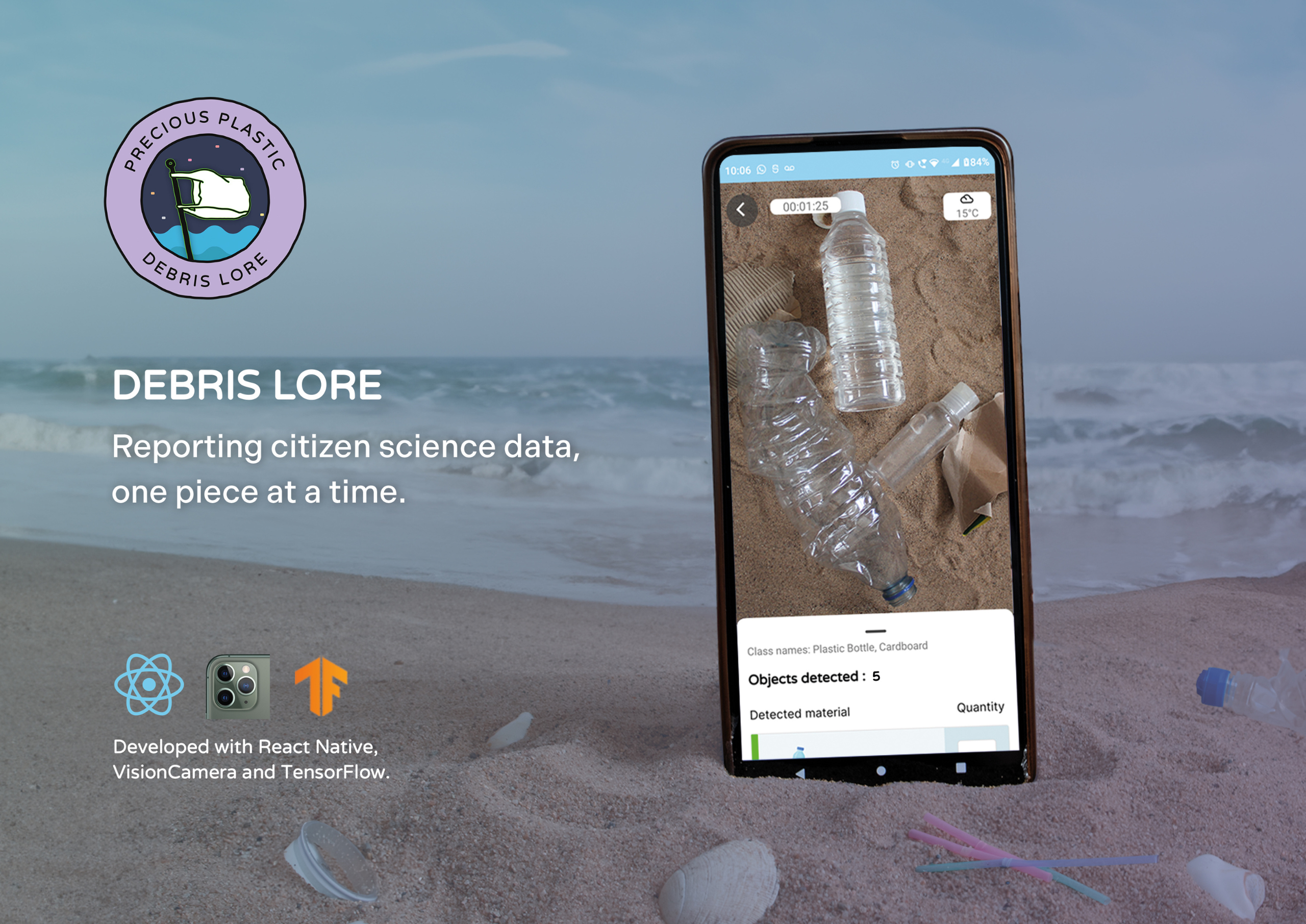
Fostering collective action against marine pollution through Debris Lore, an app that uses machine learning technologies to help citizen volunteers document the quantity and types of waste found during beach cleanup campaigns.
Define the problem/need you are solving or addressing with your project. How does it address the Open Call criteria, such as environmental impact, social engagement, circularity, user experience, resource efficiency, and community-driven solutions?
Despite various government commitments, an estimated 53 million metric tonnes of waste are expected to enter aquatic ecosystems by 2030. This growing crisis highlights the urgent need to understand the threats pollution poses, not only to marine and coastal ecosystems, but also to human health.
Debris Lore addresses this challenge by enhancing the efficiency and accuracy of waste data collection through citizen-science initiatives. Using machine learning, the app empowers volunteers to document and classify marine debris more effectively, identifying materials such as plastic, cardboard, and metal with greater speed and precision.
By augmenting volunteer efforts, Debris Lore improves data accuracy, scalability, and classification speed, enabling broader and more effective environmental monitoring. This data-driven approach supports the development of evidence-based policies, legislation, and sustainability action plans at local and regional levels. Additionally, the platform fosters social engagement by increasing community awareness, education, and participation in tackling marine pollution.
Please describe your project, reflecting on the concept, inspiration, materials, technical aspects, methods and process(es).
Debris Lore was born from my firsthand experience participating in a beach cleanup organised by Plástico Precioso Uramba, a citizen-science initiative in Colombia. This project brings together volunteers, both locals and visitors, to clean beaches, learn about plastic pollution, and transform collected materials into new resources. Witnessing their community-driven approach to engagement and education inspired me to create a tool that empowers volunteers through accessible technology.
The app activates the phone’s camera and uses a pre-trained machine-learning model to identify, classify, and count waste items within the field of view.
Key features include:
• Survey Details Form: volunteers input key location data before beginning cleanup efforts, ensuring valuable contextual information.
• Automated Object Recognition: the app scans and categorises waste (plastic, cardboard, metal, etc.), increasing data accuracy and efficiency.
• User Profile & Achievements: volunteers can track their contributions, visualise their impact, and stay motivated through engagement-driven features.
What do you think makes your project innovative compared to the existing efforts and ideas in the field it addresses?
The differentiation factor of Debris Lore is its usage of computer vision to classify waste more quickly and accurately. This technology reduces the manual effort required for data collection, allowing volunteers to maximise their time and therefore collect more high-quality data and evidence on the types of waste polluting specific areas.
While other apps exist to replace traditional paper-based surveys, also known as data cards, they still rely on input boxes, dropdowns with pre-defined options, and count boxes to collect and record data. Users are often presented with these interfaces, which are time-consuming and often lead to volunteer fatigue during the classification process.
Debris Lore reinvents and enhances this current process with the integration of computer vision for waste tracking. The app aims to expand the scale and quality of environmental monitoring efforts, enabling better-informed policies, and engaging new and existing audiences in cleanup efforts.
Does it impact or reflect young people need(s) and how?
This project reflects on the need and the rights of young generations to learn and take action on the current climate crisis. Citizen science projects are powerful in their use of collaboration, sense of belonging, and group support, from which young people could benefit. Additionally, the use of new technologies, such as AI has an extra engagement element with young audiences, unlocking big potential to inspire career paths in technology, environmental sciences, or sustainability-focused industries.
Debris Lore is a project that seeks to fulfil different needs, starting with the need for the physical well-being of communities and nature achieved through the demand for better waste management, to the need for learning, participating, and contributing to finding feasible solutions for a sustainable future. This project was born from creativity and personal experiences, and in telling the story, this project hopes to inspire creatives and creators to ideate integral and ethical technologies.
Robyn Brown-Burke

I am a Final Year Textiles student from Ireland in the National College of Art and Design, specialising in weaving. I am passionate about sustainability and sourcing locally. I create fabrics for homeware. I advocate for “slow” making as it’s important to be more mindful while living in a fast paced world. The fabrics I make are environmentally conscious, that holds meaning & my fabrics will eventually return back to the earth. I am passionate about circular design, this underpins my making process. I aspire to keep creating regenerative textiles so I can be a part of this growing movement.
Sara Cherry

Sara Cherry is a Lisbon-based designer specializing in both Industrial and Graphic Design, currently seeking professional experience. She began her studies at António Arroio Art School and completed a Bachelor’s degree in Design at Lisbon’s School of Architecture. Her experience includes designing for cinema at Oedipus Films, interning as a guide at MAAT, and currently working at MUDE—Lisbon’s Design Museum. Sara actively explores biomaterials as a volunteer at Biolab Lisbon and collaborated on a basketry lamp collection at MADE IN Platform’s Summer School. In 2024, she won first prize at the Interfer Universities Award, was shortlisted for the Global Creative Graduate Showcase, and received a Bronze Award at the ADCE Student Awards.