BEASTIE: Biodiversity Enhancement and Support Tool for Individuals and Ecosystems

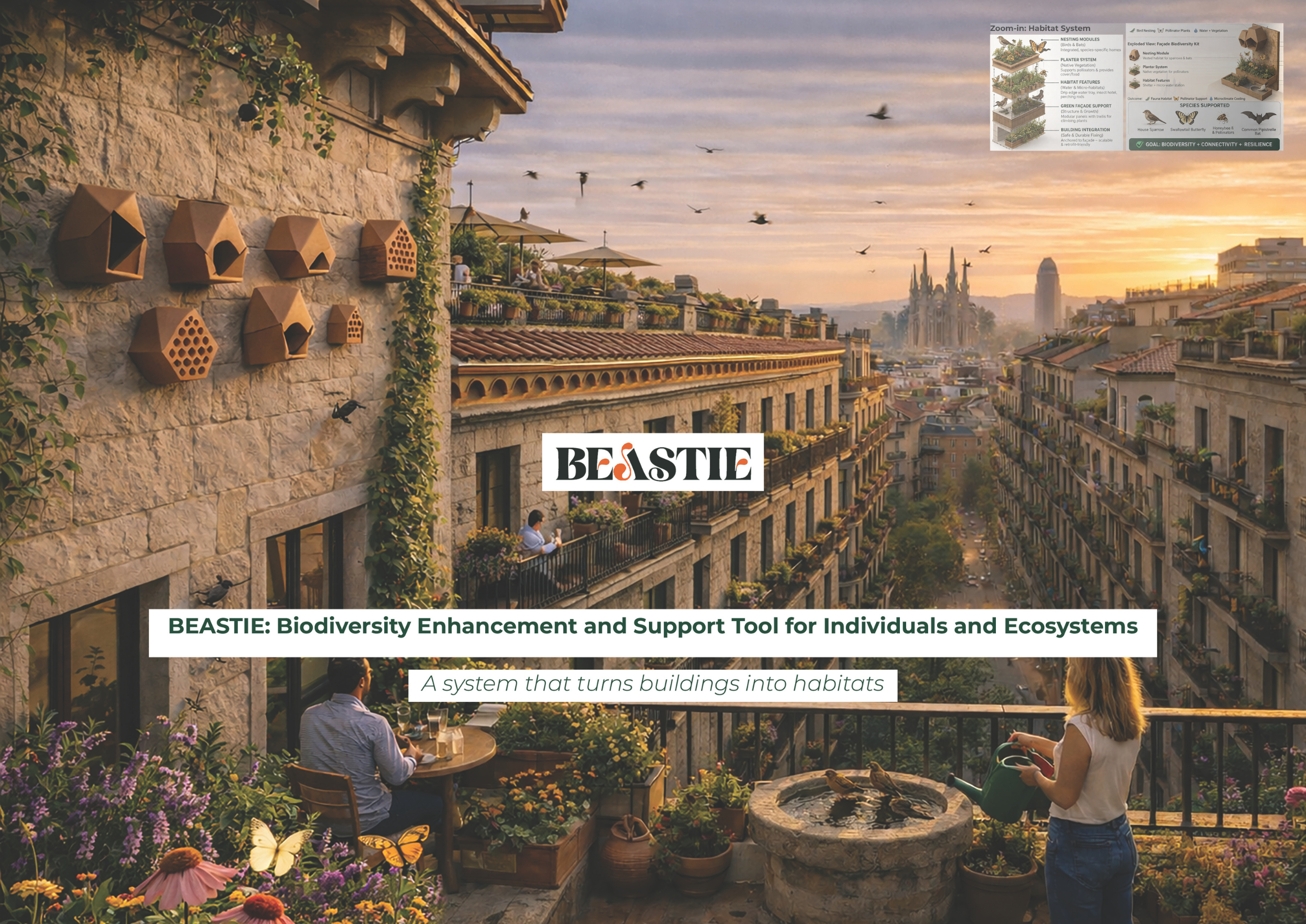
A digital-architectural system that transforms buildings into habitats by enabling users to design, simulate, and implement biodiversity interventions within existing urban spaces.

Define the problem/need you are solving or addressing with your project. How does it address the Open Call criteria, such as environmental impact, social engagement, circularity, user experience, resource efficiency, and community-driven solutions?

Cities are expanding while biodiversity is rapidly declining, largely due to fragmented habitats and underutilized urban surfaces. Existing approaches often remain either large-scale ecological planning or isolated architectural gestures, lacking tools that connect users to actionable, small-scale interventions. BEASTIE addresses this gap by enabling individuals, communities, and stakeholders to actively participate in biodiversity enhancement. The platform integrates environmental data, species requirements, and spatial conditions to generate targeted interventions, improving ecological connectivity, environmental quality, and microclimate. It promotes resource-efficient strategies by retrofitting existing structures rather than replacing them, supporting circular and low-impact urban transformation. By making biodiversity design accessible and interactive, BEASTIE fosters community-driven ecological engagement and empowers users to contribute to resilient urban ecosystems.

Please describe your project, reflecting on the concept, inspiration, materials, technical aspects, methods and process(es).

BEASTIE is a biodiversity design tool that translates ecological data into architectural interventions. The system operates through a structured workflow: mapping biodiversity hotspots, identifying species-specific requirements, generating spatial solutions, and simulating their impact. Users select a species and an available urban space, after which the platform proposes modular interventions such as nesting units, planter systems, and water features. These solutions are evaluated using a Habitat Suitability Index (HSI), measuring their impact on biodiversity, environmental quality, and microclimate. The platform visualizes transformations directly onto user-provided images, enabling informed decision-making. Designed as a scalable and adaptable system, BEASTIE bridges ecological science and architectural practice, transforming buildings into distributed habitat networks across the city.

What do you think makes your project innovative compared to the existing efforts and ideas in the field it addresses?

BEASTIE shifts architecture from designing isolated objects to creating an ecological operating system. Unlike conventional approaches that treat biodiversity as an afterthought, it integrates species-specific data, environmental metrics, and spatial design into a unified, interactive platform. Its key innovation lies in combining simulation with architectural application—allowing users to test, visualize, and evaluate interventions before implementation. The use of a Habitat Suitability Index (HSI) introduces measurable performance into biodiversity design, bridging the gap between ecological science and design practice. Additionally, BEASTIE operates at the scale of everyday urban elements—balconies, facades, courtyards—making it scalable and accessible. By transforming users into active participants, it redefines architecture as a participatory and data-informed ecological system.

Does it impact or reflect young people need(s) and how?

BEASTIE directly addresses the growing demand among young people for tools that enable meaningful environmental action. It transforms passive awareness into active participation by allowing users to design and visualize biodiversity interventions within their own spaces. The platform is intuitive, accessible, and adaptable, making it relevant for students, young designers, and communities seeking to engage with climate and ecological challenges. By combining digital tools with real-world impact, BEASTIE aligns with the way younger generations interact with technology—interactive, visual, and data-driven. It also promotes collaborative decision-making, enabling communities to collectively improve their environments. In doing so, it empowers young people to become active contributors to urban resilience and ecological restoration.

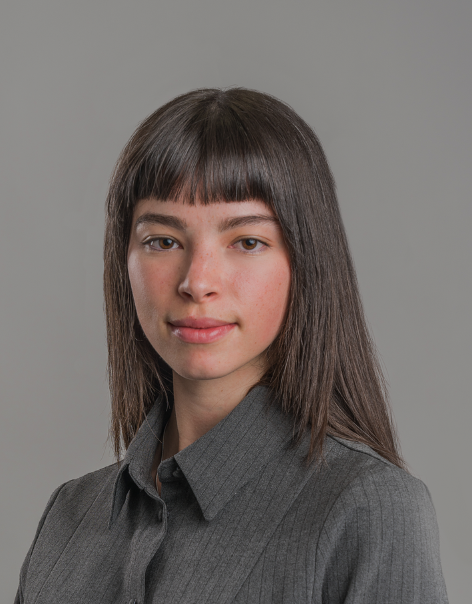
Abril Poblet Baringo 

I am an Industrial Design Engineer who is passionate about combining technological accuracy with environmental sensitivity. My professional work includes 3D modeling, structural analysis and fluid analysis all aimed at providing solutions that not only work accurately but also work for the environment. So far, I have used multiple softwares for the analysis of complex systems, such as artificial reefs for the prevention of coastal erosion. The sea has always fascinated me, not only for its beauty, as has been the case for many, but also for its power, complexity, and the role that it plays in the world we live in. This fascination has grown into an ideology that seeks to work with nature, not against it.

Ekim Güney Öztürk  

I am an industrial designer educated at Istanbul Technical University and Politecnico di Milano, where I completed a Master’s in Integrated Product Design alongside a business degree at Alta Scuola Politecnica. My work spans appliances, furniture, and packaging, including experience at De’Longhi. I have received eight international design awards and was recently selected as a finalist in the emerging design category of Design Doha Biennale. I focus on material exploration, usability, and building ideas that extend beyond single products. Recently, I have been developing custom furniture and independent concepts around circularity and modularity. By the end of this year, I will continue my studies in Rome with a specialized Master’s in Designing for Children.

Anna Kudrjavceva  

My name is Anna Kudrjavceva. I am currently a third-year student at the Beogradska Politechnika pursuing a bachelor’s degree in Industrial design. In addition, I have been learning and practicing 3D animation and visualization for over five years.
I have participated in annual student exhibitions in Belgrade, as well as in an exhibition dedicated to industrial design at the ULUS Gallery in 2024.
I am interested in both following new trends and directions in design and exploring its history in greater depth. I draw inspiration from everyday life and natural forms, creating my designs through experimentation with shape and materials.

Marko Skrbic

Graduated graphic designer, born on November 23, 1999, in Banja Luka. Completed undergraduate studies at the Academy of Arts, University of Banja Luka (2018–2022). Currently a final-year master’s student in Industrial Design at the Academy of Fine Arts and Design, University of Ljubljana. During his studies, he participated in an international exchange at NABA – Nuova Accademia di Belle Arti (2024–2025), specializing in Product and Service Design. Currently working as a product designer for GMP Company and the brand Volumen, focusing on furniture development. As part of his master’s thesis, he explores design opportunities for products and services aimed at supporting children with autism and sensory processing challenges, with the goal of improving their everyday quality of life.

Katrina Deicmane

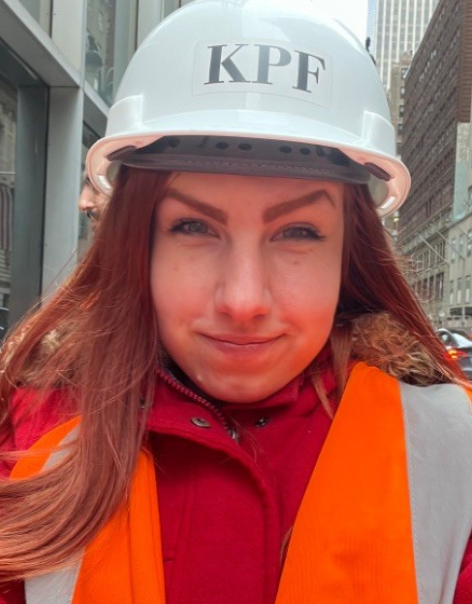
I’m a fifth-year architecture student at the New York Institute of Technology, originally from Latvia. My interest in architecture is tied to my own experience growing up with arthritis, spending time in medical environments from a young age. I became aware early on of how much space can affect how you feel—whether it adds stress or creates a sense of calm and control. That experience continues to shape my work today. Alongside my studies and my role at Kohn Pedersen Fox (KPF), I’ve developed an interest in healthcare and socially driven design, focusing on how spatial systems can support dignity, autonomy, and emotional wellbeing.

Krish Raheja

Hello! My name is Krish Raheja. Growing up in India in a family of entrepreneurs, topics of conversation at the dining table often circled around startups. The intersection between business, economics, science, and creativity is what ultimately drove me to design. I love studying messy, entangled problems. By understanding the emotions and experiences of individuals, I’m able to identify the context in which complex problems disrupt society. As a designer, I observe patterns, translate research into action, and dissolve problems. Collaborating with interdisciplinary teams of ethnographers, psychologists, technologists, executives, and creatives allows me to break boundaries and unlock hidden opportunities to create intentional change.

Biome

A digital platform that personalizes climate crisis communication using adaptive data-driven visuals. Biome is designed to foster an emotional connection and response among individuals through narratives that resonate across numerous audience profiles.

Define the problem/need you are solving or addressing with your project. How does it address the Open Call criteria, such as environmental impact, social engagement, circularity, user experience, resource efficiency, and community-driven solutions?

The rapidly unfolding anthropogenic climate change has led to witnessing drastic and widespread impacts on both human and non-human existence, making it one of the most imperative crises to address; however, there remains a lack of urgency and commitment to take meaningful action. One of the crucial reasons for this is the psychological distance one has from the crisis — perceiving it as far, not relevant to them or their region. To address this distance, climate communication needs curation with consideration of the audience and their individual biases, experiences and interests. This project explores how data communicated and personalized through a psychological rather than just a geographical lens can support a personal & meaningful relationship to the crisis.

Please describe your project, reflecting on the concept, inspiration, materials, technical aspects, methods and process(es).

The process of conceptualizing Biome started with the question, “How can creating a personalized experience for consuming crisis-related information support a more emotional engagement?”. The objective was to understand the complexities of both climate crisis communication and human psychology to create a deeper connection between them, driving more empathy. Through a brief survey to understand how people perceive the severity of the crisis, I found that the majority were aware of the ongoing crisis but still felt distant from the growing urgency and intensity of it.

The overarching intention with this concept is to support more empathetic engagement; however, when individuals are emotionally disconnected from the crisis itself, the first step is to create that connection through personal resonance. Biome communicates climate crisis data in a way that is relevant and personal to the individual and visually aligns with their diverse emotional and cognitive needs.

What do you think makes your project innovative compared to the existing efforts and ideas in the field it addresses?

What makes Biome stand out is the ability to learn and connect, both about the individual and the world around them. Employing a two-layered personalization, gaining insights into personal life experiences and personality traits, the platform first learns more about the individual and identifies relevant links between them and the climate crisis to help them connect with the world. The personalization feature extends beyond the curation of climate content and also influences the visual language of the data-driven experience, leveraging Generative AI to cater to various personality clusters through research-driven design. This is crucial when communicating because each of us perceives the crisis differently, our level of knowledge differs and most importantly, we process emotions in our own ways. These differences are also seen in the way we engage with visualizations, influenced by our diverse personality traits, making it pertinent to the personalization of the Biome experience.

Does it impact or reflect young people need(s) and how?

Biome creates a space to foster empathy towards all life around. There are two ways that this impacts the needs of young people. Firstly, it provides an opportunity to learn deeply about the world we live in, the growing degradation of it caused by human activity, the ways in which our lives are altering without realization, and the ways we can nurture and take action towards ending the exploitation, in a way that is personal and human. This leads to the second point — enabling a community driven by empathy. Through personalized learning and connecting, individuals are encouraged to find a sense of community and empowerment, reflecting on their actions and adopting meaningful habits towards building a sustainable future. The personalization that Biome offers enables the impact of the experience to be amplified across diverse audiences, allowing for a deeper connection to the world and to each other.