A digital-architectural system that transforms buildings into habitats by enabling users to design, simulate, and implement biodiversity interventions within existing urban spaces.
Define the problem/need you are solving or addressing with your project. How does it address the Open Call criteria, such as environmental impact, social engagement, circularity, user experience, resource efficiency, and community-driven solutions?
Cities are expanding while biodiversity is rapidly declining, largely due to fragmented habitats and underutilized urban surfaces. Existing approaches often remain either large-scale ecological planning or isolated architectural gestures, lacking tools that connect users to actionable, small-scale interventions. BEASTIE addresses this gap by enabling individuals, communities, and stakeholders to actively participate in biodiversity enhancement. The platform integrates environmental data, species requirements, and spatial conditions to generate targeted interventions, improving ecological connectivity, environmental quality, and microclimate. It promotes resource-efficient strategies by retrofitting existing structures rather than replacing them, supporting circular and low-impact urban transformation. By making biodiversity design accessible and interactive, BEASTIE fosters community-driven ecological engagement and empowers users to contribute to resilient urban ecosystems.
Please describe your project, reflecting on the concept, inspiration, materials, technical aspects, methods and process(es).
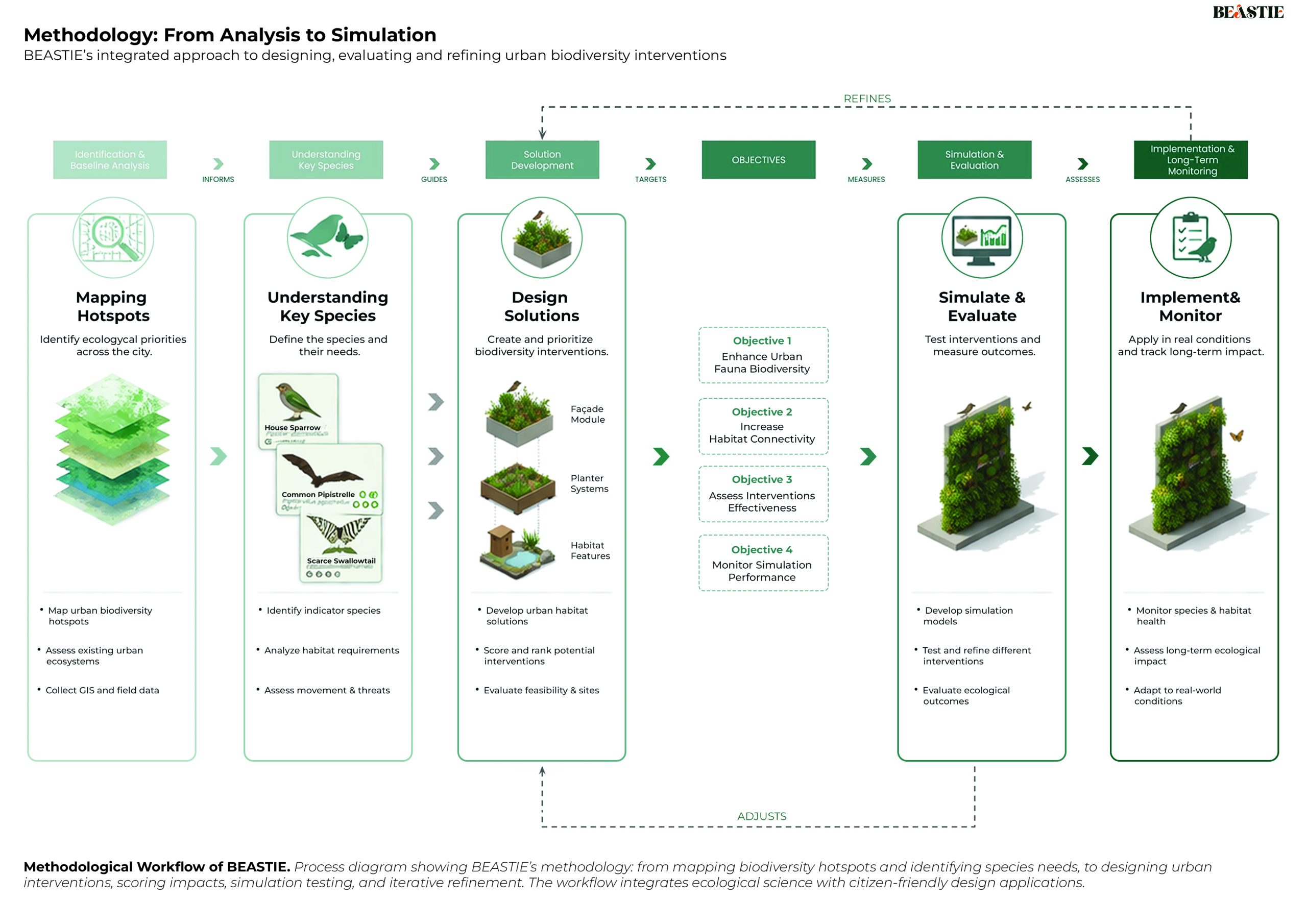
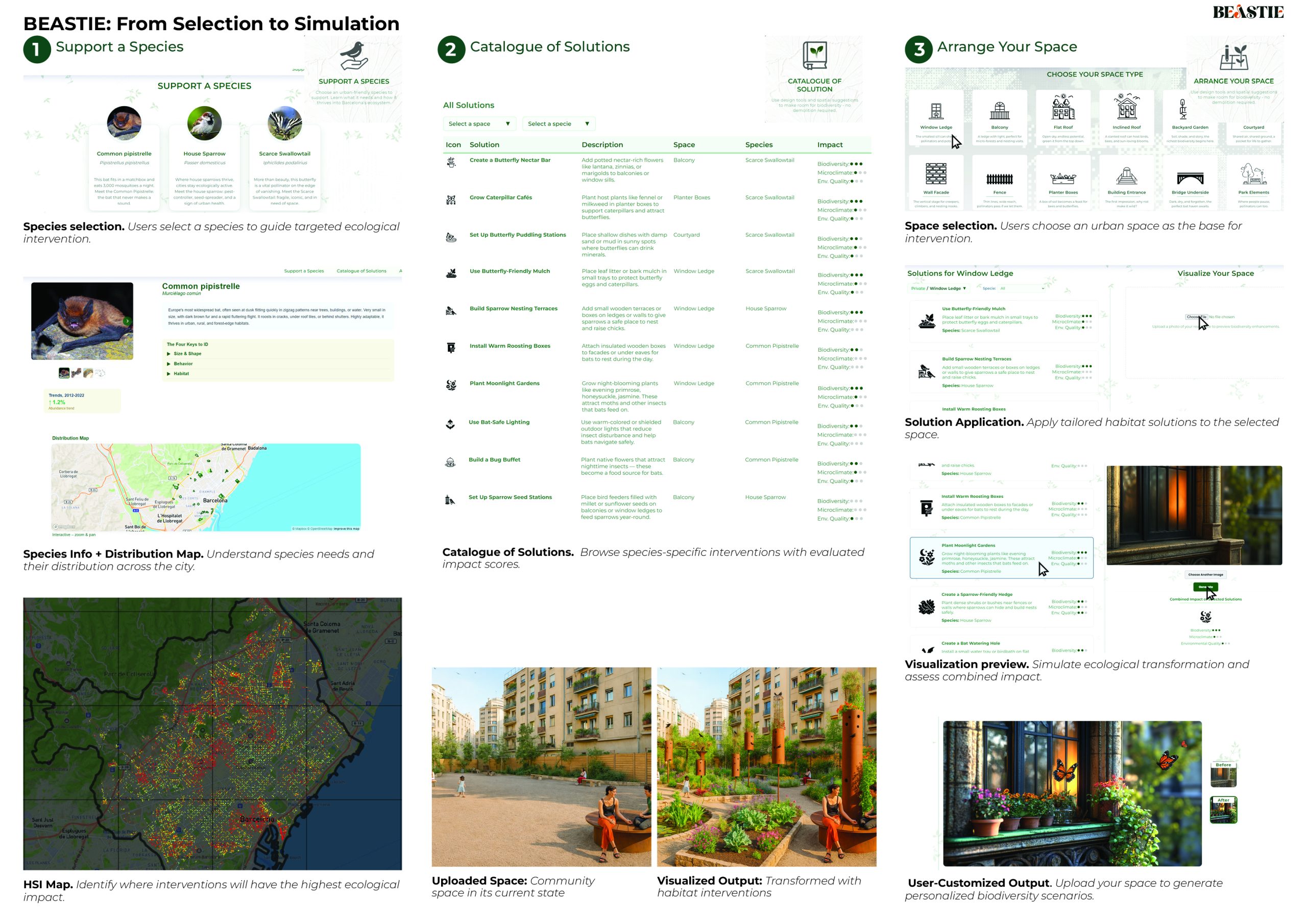
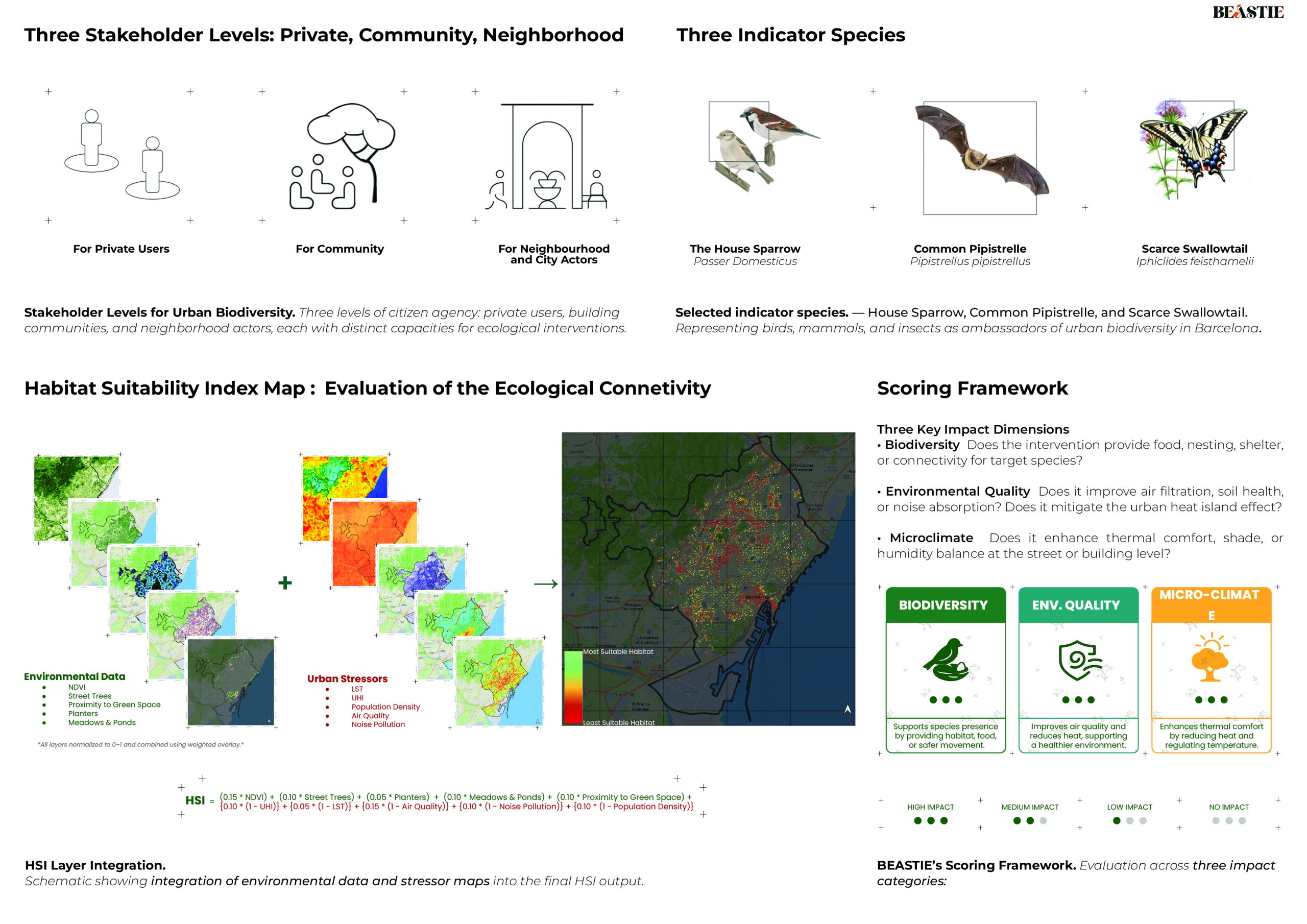
BEASTIE is a biodiversity design tool that translates ecological data into architectural interventions. The system operates through a structured workflow: mapping biodiversity hotspots, identifying species-specific requirements, generating spatial solutions, and simulating their impact. Users select a species and an available urban space, after which the platform proposes modular interventions such as nesting units, planter systems, and water features. These solutions are evaluated using a Habitat Suitability Index (HSI), measuring their impact on biodiversity, environmental quality, and microclimate. The platform visualizes transformations directly onto user-provided images, enabling informed decision-making. Designed as a scalable and adaptable system, BEASTIE bridges ecological science and architectural practice, transforming buildings into distributed habitat networks across the city.
What do you think makes your project innovative compared to the existing efforts and ideas in the field it addresses?
BEASTIE shifts architecture from designing isolated objects to creating an ecological operating system. Unlike conventional approaches that treat biodiversity as an afterthought, it integrates species-specific data, environmental metrics, and spatial design into a unified, interactive platform. Its key innovation lies in combining simulation with architectural application—allowing users to test, visualize, and evaluate interventions before implementation. The use of a Habitat Suitability Index (HSI) introduces measurable performance into biodiversity design, bridging the gap between ecological science and design practice. Additionally, BEASTIE operates at the scale of everyday urban elements—balconies, facades, courtyards—making it scalable and accessible. By transforming users into active participants, it redefines architecture as a participatory and data-informed ecological system.
Does it impact or reflect young people need(s) and how?
BEASTIE directly addresses the growing demand among young people for tools that enable meaningful environmental action. It transforms passive awareness into active participation by allowing users to design and visualize biodiversity interventions within their own spaces. The platform is intuitive, accessible, and adaptable, making it relevant for students, young designers, and communities seeking to engage with climate and ecological challenges. By combining digital tools with real-world impact, BEASTIE aligns with the way younger generations interact with technology—interactive, visual, and data-driven. It also promotes collaborative decision-making, enabling communities to collectively improve their environments. In doing so, it empowers young people to become active contributors to urban resilience and ecological restoration.