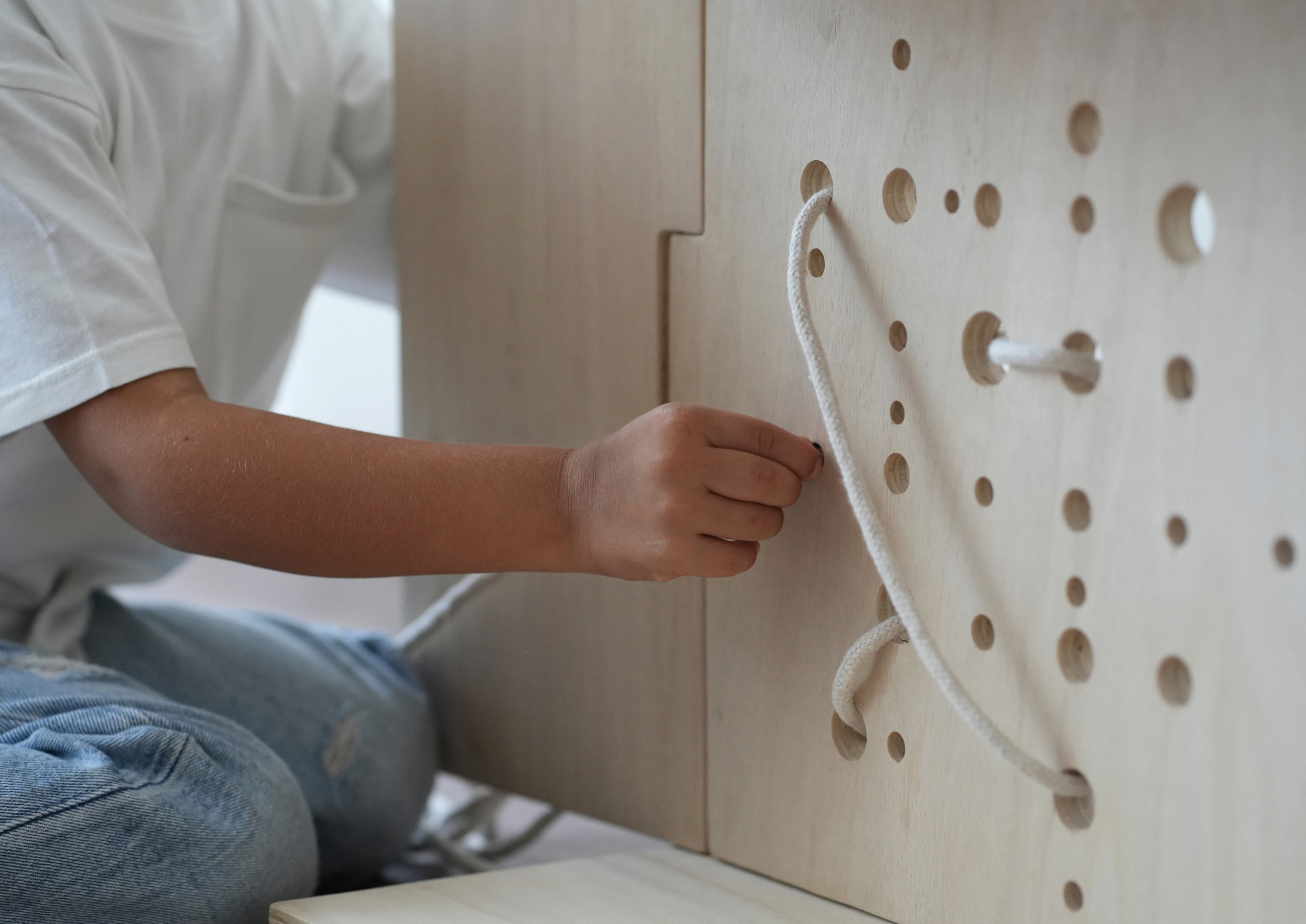
Tarnur is a modular system designed for toddlers that adapts to their changing needs, ensuring long-term use, sustainability, and flexibility through a multifunctional and user-driven design philosophy.
Define the problem/need you are solving or addressing with your project. How does it address the Open Call criteria, such as environmental impact, social engagement, circularity, user experience, resource efficiency, and community-driven solutions?
Tarnur tackles the scarcity of sustainable furniture options for preschool children by introducing a modular shelving system that evolves with their age and requirements. It promotes circularity and long-term use through tool-free assembly, repairability, and reconfigurability. Constructed from poplar plywood, a lightweight yet strong material, Tarnur minimizes ecological impact while facilitating easy packaging and transport. The design fosters interactive, educational play through tactile components that stimulate motor skills and creativity, making it suitable for homes, kindergartens, and shared learning spaces. The user-centered design process involved prototype testing with children, ensuring that their needs were prioritized. This project exemplifies sustainable design principles, environmental accountability, and community involvement, offering a versatile strategy that supports cognitive development while adhering to circular production practices.
Please describe your project, reflecting on the concept, inspiration, materials, technical aspects, methods and process(es).
Inspired by children’s natural curiosity and interaction with their environments, Tarnur emphasizes simplicity, sensory engagement, and spatial adaptability. Poplar plywood was selected for its natural texture, lightweight strength, and safety, aligning with environmental goals. Precision CNC machining was employed to produce perforated components that are both functional and educational. Early-stage prototyping involved full-scale cardboard models, tested with children to refine ergonomics and proportions. Insights gained influenced the creation of a tool-free assembly system that encourages intuitive use. Tarnur balances structure with open-ended functionality, empowering children to derive their own meaning from play. It accommodates multiple configurations suitable for various settings, including homes, kindergartens, and communal areas. More than just a product, Tarnur represents a research-based, human-centered design solution that nurtures creativity, inclusivity, and sustainable consciousness through a playful and adaptable approach.
What do you think makes your project innovative compared to the existing efforts and ideas in the field it addresses?
Tarnur distinguishes itself through its integration of modularity, sustainability, and child-centered adaptability into a cohesive system. Unlike traditional children’s furniture, which can be static and quickly outgrown, Tarnur evolves alongside the child, adjusting to changing developmental needs and spatial requirements. Its tool-free, reconfigurable design fosters independence and creativity, all while reducing waste and endorsing circular usage. The addition of tactile, perforated elements enhances the learning aspect, promoting motor skill development and sensory exploration—features often absent in conventional shelving. What makes Tarnur particularly innovative is its participatory design approach; early prototyping and testing with children directly influenced the design’s usability, safety, and scale. By seamlessly adapting to environments like homes, kindergartens, or shared learning spaces, Tarnur serves as not just a functional object but also as a dynamic learning companion facilitating emotional, cognitive, and social growth throughout childhood.
Does it impact or reflect young people need(s) and how?
Tarnur reflects children’s fundamental needs by acknowledging that learning and development extend beyond desks and classrooms—they thrive through play. This project empowers children to shape their surroundings actively, fostering independence and spatial awareness from a young age. The open-ended design invites exploration and experimentation, allowing children to assign their own purpose—whether as a shelf today or a play zone tomorrow. This adaptability respects their imaginations and need for change while supporting their evolving functions as they grow. Beyond the confines of traditional children’s furniture, Tarnur offers a comprehensive, long-term solution catering to various stages of development, fostering confidence and autonomy. By embracing children’s creativity and competence, Tarnur articulates a language of curiosity, flexibility, and discovery, ultimately aligning with the modern young person’s desire for engaging, meaningful experiences in their learning environments.