

Nawon Koo, originally from South Korea, spent her teenage years in Singapore, where she explored various art forms and immersed herself in a diverse cultural environment. This experience shaped her creative outlook and deepened her curiosity about design’s role in different societies. After graduating, she returned to South Korea, Seoul, to pursue a professional design education in her native language, allowing her to reflect critically on the power of design in shaping social structures. Seeking to expand her perspectives and engage with global design discourse, she moved to the Netherlands to study Social Design at the Design Academy Eindhoven.
Author: 9ve8c
Everything You Need to Know About WDCD Live Amsterdam 2025

Designing for complexity, community and climate resilience—WDCD’s one-day festival is back with a sharper edge.
By Next Gen Design
What does it take to design for real change? On 6 June, creatives from across the world will gather in Amsterdam to explore that question at WDCD Live 2025, the latest edition of What Design Can Do’s long-running festival for social and environmental impact. Set against the buzzing backdrop of Pakhuis de Zwijger, this year’s event feels more urgent, more critical—and more collaborative—than ever.
Rather than focus on design as a solution, this year’s edition asks: what is design obliged to do in a world shaped by inequality, ecological collapse, and disinformation?
Here’s what you can expect—and why it matters.
Three themes that cut deep
WDCD 2025 revolves around three interconnected themes, each unpacking a core challenge of our time.
- Climate Futurism invites us to rethink what progress looks like. Beyond carbon targets and efficiency metrics, how can design help regenerate systems and shift entire worldviews? This isn’t greenwashing—it’s about long-term resilience and radically local solutions.
- Truth to Power tackles the murky terrain of manipulation, disinformation, and AI’s role in shaping narratives. How can creatives wield new tools with integrity? Expect conversations on ethical storytelling, digital justice, and the politics of visibility.
- Belonging Beyond Borders is perhaps the most personal of the three. With growing tensions around migration and identity, this theme explores how design can build spaces—physical, cultural, emotional—where everyone feels seen and heard.
Together, they form a lens through which design is not just decorative or problem-solving, but deeply political.
Two parts, one mission
WDCD Live is structured as a day in two halves:
- The Work (afternoon): Intimate, hands-on workshops and discussions that invite deep dives into each theme. This is where festival-goers connect, test ideas, and co-create with experts and fellow participants.
- The Celebration (evening): A public gathering of talks, stories, and performances, spotlighting the next generation of design-led changemakers. There’ll be music, food, and more than a few surprises.
Throughout the day, you’ll also meet winners of recent WDCD open calls—projects pushing circularity, inclusion, and justice forward in surprising ways.
Why attend?
WDCD Live isn’t your standard design event. It’s less about shiny portfolios and more about bold provocations. It’s where creative practice meets protest, community organising, and climate action. And it’s where design isn’t just talked about—but lived, tested, celebrated.
Whether you’re a student, policymaker, strategist or storyteller, this is a chance to connect with people asking the hard questions—and proposing daring alternatives.
📍 WDCD Live Amsterdam 2025 takes place 6 June at Pakhuis de Zwijger.
🗓 More info at whatdesigncando.com/events
Nils Sorger

I’m Nils, a Berlin-based designer passionate about merging tradition with innovation. My work explores the interplay of materials, processes, and social contexts, creating products that resonate with cultural and technological dynamics.
Boldizsar Csongor Nagy

Boldi is a versatile visual artist engaged in a wide range of projects, from visual storytelling to immersive multimedia experiences. Currently pursuing a Master’s in Media Design at Moholy-Nagy University of Arts and Design, he excels in problem-solving and thrives on learning, adeptly navigating diverse projects and technologies. He enjoys taking on new challenges and bringing creative projects to life.
Szonja Somogyvári

Szonja is a graphic designer and illustrator in her final year at Moholy-Nagy Art University Budapest. She is specializing in experimental design, biodesign, and 2D animation. Her work explores new ways of expressing graphic design, often combining illustration with unconventional materials and sustainable concepts. She is very into conceptual designs. Currently as a freelancer, she focuses on book covers, illustrations, and motion design. She thrives in collaborative environments and enjoys pushing creative boundaries through hands-on experimentation.
Nora Gulya

Graduating from the Textile Design MA program at MOME, Nora now works as a research intern at the MOME Innovation Center while also developing her own projects. Her work centers on sustainability and innovation, with a focus on materials like textiles, biopolymers, and natural dyes. Passionate about the intersection of design and eco-conscious practices, she aims to push the boundaries of sustainable development and bring circular solutions to everyday life.
Quan Zheng

Software engineer, baker, and outdoor climbing enthusiast, Quan dedicated a year after his BSc degree to simplify his lifestyle to combine freelance web-development with travel. With his thirst for exploration quenched and hunger for new challenges, he is now working on hardware to create new ways of computer interaction with a focus on accessibility.
Nina Steiner

Nina booked a one way flight to Asia after finishing her masters in Interior Architect, and ended up traveling for over a year. Somehow she ended up in San Francisco, designing NotAMouse. She’s in love with Cats, Tea and Ux design.
Bacterial Brickbats
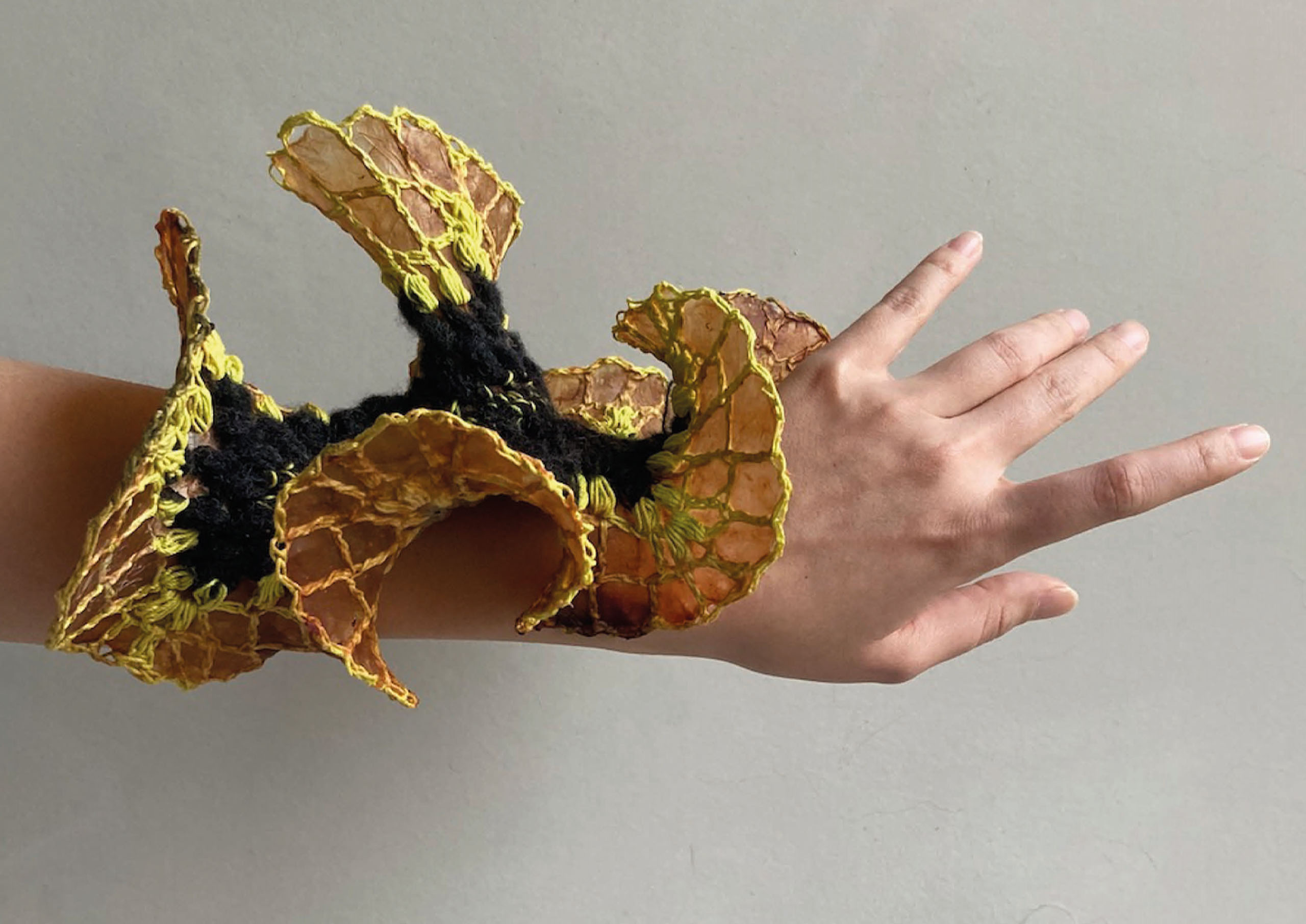
A foray into the aesthetic expressions of bacterial cellulose-knit textile composites challenging anthropocentric agency through human/non-human design collaboration
Define the problem/need you are solving or addressing with your project. How does it address the Open Call criteria, such as environmental impact, social engagement, circularity, user experience, resource efficiency, and community-driven solutions?
Bacterial Brickbats proposes self-assembling properties of bacterial cellulose (BC) delivering textiles for fashion applications BC is organic, compostable, and being treated only with beeswax, poses little environmental detriment. Scaffolds were manufactured from cotton yarn to maintain the library monomaterial, as this facilitated recycling and appeared to be BC’s preferred basal material. Making processes rely on bacterial organic growth processes, significantly reducing manufacturing costs, resource consumption, and chemical and water impact. Bacterial brickbats negotiates the systemic leap towards regenerative design by placing its main contribution in knowledge and its proposed method. It exemplifies what can be accomplished with available techniques and materials, but encourages investigative openness and iterations with different materials to better understand the interaction between living materials and textiles. This enhances localised design, as available materials will vary regionally and produce different results from the same methodology, and suggest a comparatively greater attachment formed between designer, artefact and non-human.
Please describe your project, reflecting on the concept, inspiration, materials, technical aspects, methods and process(es).
‘Bacterial Brickbats’ explores reassembly as a subsidiary property of bacterial-cellulose’s (BC) natural growth and self-assembling potential through a comprehensive material library. This consolidates the understanding of BC as a living textile and acknowledges BC’s organic intelligence as capable of designerly agency by rooting its design method in biological growth patterns and BC’s behaviour towards knitted textile scaffolds. From human perspectives, the proposed textiles probe for colour, texture and form studies exploring the optics of textile translation into artefact. Later stages speculate around situated artefact creation and body applications, emphasising transparency and light interaction as unique properties to BC-based composites. Proferring concurrence between bacterial processes and human design conventions, this multi-species approach heeds human and non-human roles in the design process by progressively and gradually shifting agency between them, affording the human the chance to observe, understand and design in synchrony with BC’s morphology and behaviour.
What do you think makes your project innovative compared to the existing efforts and ideas in the field it addresses?
Bacterial Brickbats takes a more-than-human approach to textile design-make potential by acknowledging the agency of non-human stakeholders collaboratively with the human designer. From technical perspectives, it relies on bacteria’s organic growth to assemble textiles and explores possible fashion future applications ; the artistry involved regales the human with the designerly expression of the non-human, and how to achieve this through collaboration. Artefact, partner, confidant,… the single-minded nature of living materials casts a unique light on design, as the nascent material itself dictates the final outcome. Deciphering what bacteria communicate in their own language illustrates the meticulousness of biodesign, a process that spills beyond textile making; from nurturing the bacteria to caring for them once the design flow concludes and the artefact moves on from the human designer’s hands. Through this approach, Bacterial Brickbats surpasses circular design, reaching for regenerative ways of designing and making textiles and fashion.
Does it impact or reflect young people need(s) and how?
By advocating for the inclusion of the non-human in textile and fashion design cycles, Bacterial Brickbats proposes novel pathways for design expression and development with a solid grounding in scientific investigation, facilitating the shift towards circular and regenerative economies crucial to our ecosystems’ wellbeing now and in future generations. Its roots in slow manufacturing encourages taking time to make and understand these textiles, as well as highlighting the importance of craft in the making of fashion and adapting its methods, visuals and ways of wearing/using to contemporary contexts, merging past with future, and illustrating how human needs are connected to nature and other species cohabiting these spaces.