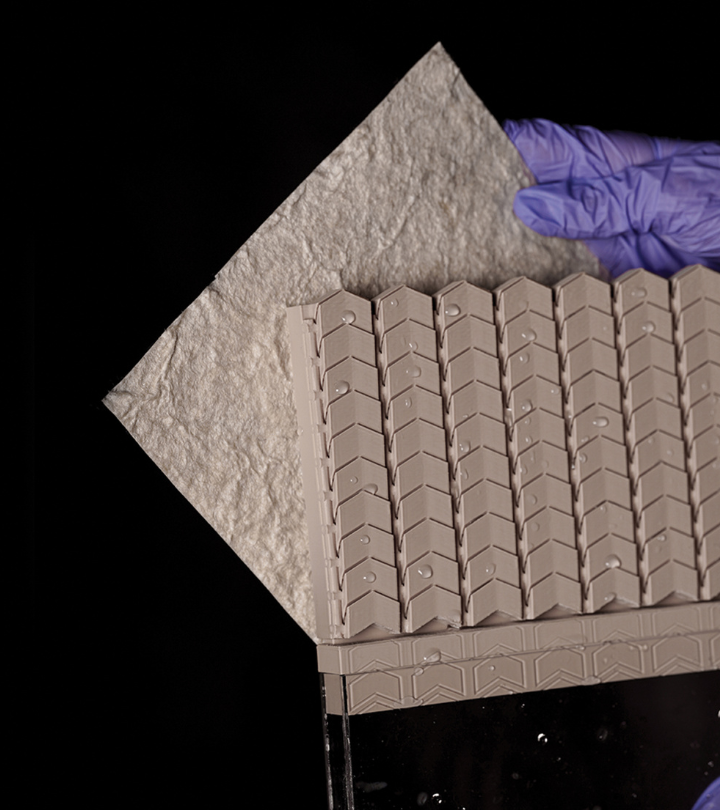
Thor(No) Tech is a biomimetic system inspired by the thorny devil’s skin that passively captures atmospheric humidity, transforming environmental moisture into a sustainable resource through adaptive design and bio-based materials.
Define the problem/need you are solving or addressing with your project. How does it address the Open Call criteria, such as environmental impact, social engagement, circularity, user experience, resource efficiency, and community-driven solutions?
Thor(No) Tech addresses the growing challenge of indoor humidity management and water scarcity by exploring passive, nature-inspired alternatives to energy-intensive climate control systems. Conventional dehumidification relies heavily on electricity and mechanical processes, contributing to environmental impact and resource consumption. Inspired by the microstructure of the thorny devil’s skin, Thor(No) Tech proposes a biomimetic system capable of capturing and channeling atmospheric moisture through capillary structures and hygroscopic bio-based materials.
The project combines computational design, biomaterials, and additive manufacturing to create a scalable and adaptable humidity-regulating system. By transforming excess humidity into a usable resource, the project promotes resource efficiency and circular thinking. Its modular and potentially customizable design supports different spatial conditions and user needs, improving indoor environmental quality while encouraging a more conscious relationship with natural processes. Thor(No) Tech ultimately explores how design can collaborate with nature to develop sustainable, low-energy solutions for everyday environments.
Please describe your project, reflecting on the concept, inspiration, materials, technical aspects, methods and process(es).
Thor(No) Tech is a biomimetic system for passive humidity control in indoor environments. Inspired by the Australian thorny devil lizard, the project translates the animal’s natural water-harvesting strategy into a design solution. The lizard’s textured skin forms a capillary network that passively collects and transports water across its body, allowing it to hydrate in arid conditions.
The system consists of a hybrid structure: a rigid, high-precision shell 3D printed in PHA and a removable bio-based insert that absorbs moisture from the surrounding air. The shell uses a concentric infill strategy to ensure structural stability while reducing warping, fabrication time, and material consumption.
The insert is composed entirely of renewable materials selected for their hygroscopic properties, biodegradability, and structural performance. Lightweight and efficient in humidity absorption and desorption, it fits precisely within the shell, supporting a quiet, energy-free system that responds to indoor conditions like a natural process.
What do you think makes your project innovative compared to the existing efforts and ideas in the field it addresses?
Thor(No) Tech is innovative because it challenges the environmental limitations of conventional humidity control systems. Both electric dehumidifiers and common low-cost passive alternatives rely on energy consumption, synthetic desiccants, or disposable components that generate material waste and require frequent replacement.
This project proposes a different approach by combining biomimicry, biodegradable materials, and digital fabrication to create a passive and regenerative system. Inspired by the thorny devil’s capillary skin, Thor(No) Tech translates this natural water-harvesting strategy into a hybrid structure composed of a precisely 3D printed PHA shell and a fully bio-based hygroscopic insert.
Unlike conventional solutions, the system operates without electricity, cords, or disposable cartridges. The insert is biodegradable and replaceable, while the shell is durable and material-efficient. By reducing energy use, waste, and synthetic materials, Thor(No) Tech introduces a more circular and nature-aligned approach to indoor humidity control.
Does it impact or reflect young people need(s) and how?
The project reflects the growing demand among younger generations for sustainable, low-impact alternatives to conventional technologies. Many young people are increasingly aware of the environmental cost of everyday appliances, electronic waste, and energy consumption, and are seeking solutions that align with circular and regenerative design principles.
By proposing a passive humidity control system that operates without electricity, or complex maintenance, Thor(No) Tech responds to this need for simpler and more responsible products. The use of bio-based materials, biodegradable components, and material-efficient digital fabrication reflects values of environmental responsibility and conscious resource use.
At the same time, the project encourages a different relationship between users and technology, and that emphasizes awareness of natural processes and environmental conditions. In this way, Thor(No) Tech supports a generation interested not only in functionality, but also in meaningful, sustainable design solutions.