Through this project, I aimed to demonstrate that waste can be integrated into everyday products, reducing the amount we generate. creating value by transforming our own production waste into functional design.
Define the problem/need you are solving or addressing with your project. How does it address the Open Call criteria, such as environmental impact, social engagement, circularity, user experience, resource efficiency, and community-driven solutions?
This project addresses the issue of overlooked industrial waste in furniture production—materials that are routinely discarded despite retaining functional value. Cardboard tubes, leftover textiles, foam remnants, and partially used tension straps are reimagined as resources rather than waste. By transforming these materials into functional furniture for internal use, the project applies circular design principles, extending material lifecycles and reducing waste at its source. It demonstrates resource efficiency by relying entirely on materials already available within the factory.
The reuse of discarded tension straps, reassembled into a structural binding element, reflects a hands-on, human-centred approach and highlights inefficiencies in existing practices. This intervention encourages more responsible everyday habits and greater awareness among workers. The project reduces environmental impact, supports circularity, and enhances user experience through interactive design. It proposes a scalable model where design transforms waste into value, contributing to more resilient and responsible industrial systems.
Please describe your project, reflecting on the concept, inspiration, materials, technical aspects, methods and process(es).
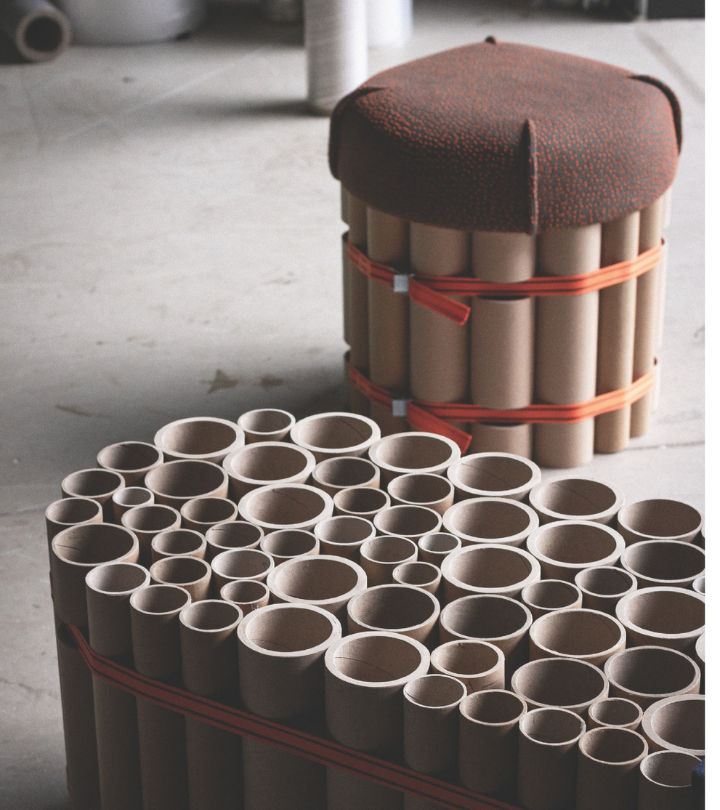
The Tubler system is a furniture project developed from industrial waste generated within a furniture factory. The concept is based on rethinking discarded materials, primarily cardboard tubes used for winding upholstery fabrics- as the main structural element of new products.
The design process focused on minimal intervention and maximum reuse. Cardboard tubes of varying diameters are assembled into stable structures, while discarded tension straps are repurposed and stitched together to function as a binding system. Additional materials, such as leftover foam and textile scraps, are used to create seating elements.
Technically, the project avoids adhesives by introducing notching in the tubes, allowing for better strap grip and structural stability. Through prototyping and testing, it was discovered that a solid top surface was unnecessary, resulting in a more open, interactive form.
The outcome is a coffee table and stool, fully made from waste, demonstrating a practical and scalable circular design approach.
What do you think makes your project innovative compared to the existing efforts and ideas in the field it addresses?
What makes this project innovative is its direct integration within an existing production system, using only in-house waste without additional processing or external materials. Rather than recycling through industrial means, it applies a hands-on, low-tech approach that preserves material value and reduces energy use. The repurposing of discarded tension straps as a structural binding element introduces an unconventional yet effective solution. Additionally, the project challenges standard furniture typologies by embracing openness and interactivity, showing how waste can shape not only material choices but also user experience and design thinking.
Does it impact or reflect young people need(s) and how?
Yes, the project reflects young people’s needs by promoting sustainability, creativity, and awareness of responsible consumption. It encourages a shift from passive use to active engagement through interactive design. By transforming industrial waste into functional furniture, it supports circular thinking and DIY culture, which are increasingly important to younger generations. The project makes production processes more transparent and accessible, fostering a mindset of reuse, adaptability, and critical thinking about materials and everyday objects.