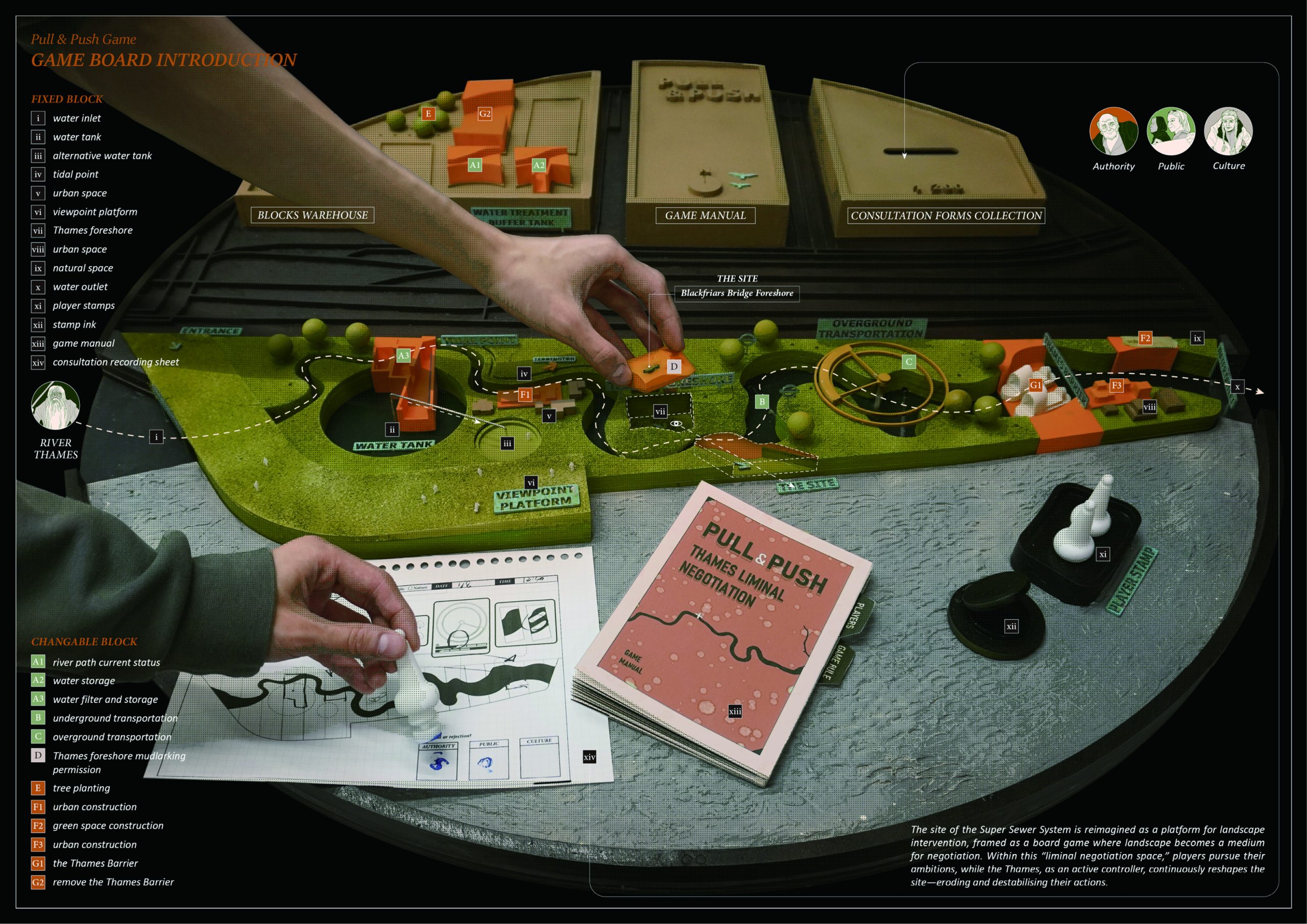
A participatory landscape game that reimagines the Thames as an active negotiator, where human decisions are continuously tested by natural forces, revealing how urban futures emerge through conflict, cooperation, and long-term environmental feedback.
Define the problem/need you are solving or addressing with your project. How does it address the Open Call criteria, such as environmental impact, social engagement, circularity, user experience, resource efficiency, and community-driven solutions?
Contemporary urban infrastructure prioritises control, efficiency, and permanence, often excluding public participation and suppressing ecological dynamics. The Thames Tideway “Super Sewer” exemplifies this—costly, disruptive, and socially detached. This project addresses the need for a more adaptive and inclusive approach to city-making by reframing infrastructure as a process of negotiation between human and environmental forces. Environmentally, it embraces river dynamics—erosion, flooding, and change—as active design agents. Socially, it transforms planning into a participatory system, enabling stakeholders to co-create outcomes. Circularity is embedded through reclaimed Thames materials, linking past and future landscapes. Resource efficiency is achieved through modular, reversible interventions rather than fixed construction.
By combining environmental feedback with collective decision-making, the project proposes a community-driven framework where urban form evolves through continuous negotiation rather than top-down control.
Please describe your project, reflecting on the concept, inspiration, materials, technical aspects, methods and process(es).
The project reimagines the abandoned Super Sewer site as a liminal negotiation platform, materialised as a physical, playable landscape along the Thames foreshore. Structured as a board game, participants assume roles—Authority, Public, or Culture—and collaboratively construct proposals using modular blocks representing infrastructure, ecology, and urban space. Decisions are collectively evaluated, and only approved proposals translate from model scale to real-world intervention. The River Thames acts as a fourth player—Nature—continuously eroding and reshaping the site, introducing unpredictability and long-term feedback. Operating across multiple scales—from a 20-minute game to decades of river transformation—the project integrates participation, material experimentation, and environmental processes. Built using reclaimed materials from the foreshore, it physically embeds local history into the design while revealing how short-term decisions generate long-term spatial consequences.
What do you think makes your project innovative compared to the existing efforts and ideas in the field it addresses?
The project is innovative in redefining landscape architecture as a dynamic system rather than a fixed solution. Instead of designing a final form, it constructs a framework where outcomes emerge through interaction between stakeholders and environmental forces. Unlike conventional participatory design, which often ends at consultation, this project embeds participation directly into spatial production through a playable system. The integration of real-time decision-making, physical modelling, and long-term environmental feedback creates a continuous loop between proposal, implementation, and transformation. By positioning the river as an active agent—rather than a constraint—the project challenges anthropocentric planning models and introduces uncertainty as a design driver. This shift from control to negotiation offers a new methodology for addressing complex urban and ecological systems, where adaptability, temporality, and collective authorship replace static, top-down solutions.
Does it impact or reflect young people need(s) and how?
The project directly engages young people by transforming complex urban and environmental systems into an accessible, interactive experience. Through the game-based format, participants can actively test decisions, negotiate with others, and observe long-term consequences, making abstract planning processes tangible and understandable. It addresses a key generational issue: young people will inherit the impacts of climate change and urban development but are rarely involved in shaping them. By enabling participation in decision-making, the project fosters agency, critical thinking, and environmental awareness. The emphasis on uncertainty, negotiation, and long-term feedback reflects the realities young generations face, encouraging a shift from passive observation to active engagement. Ultimately, the project empowers young people to see themselves not as future users of the city, but as current contributors to its ongoing formation.