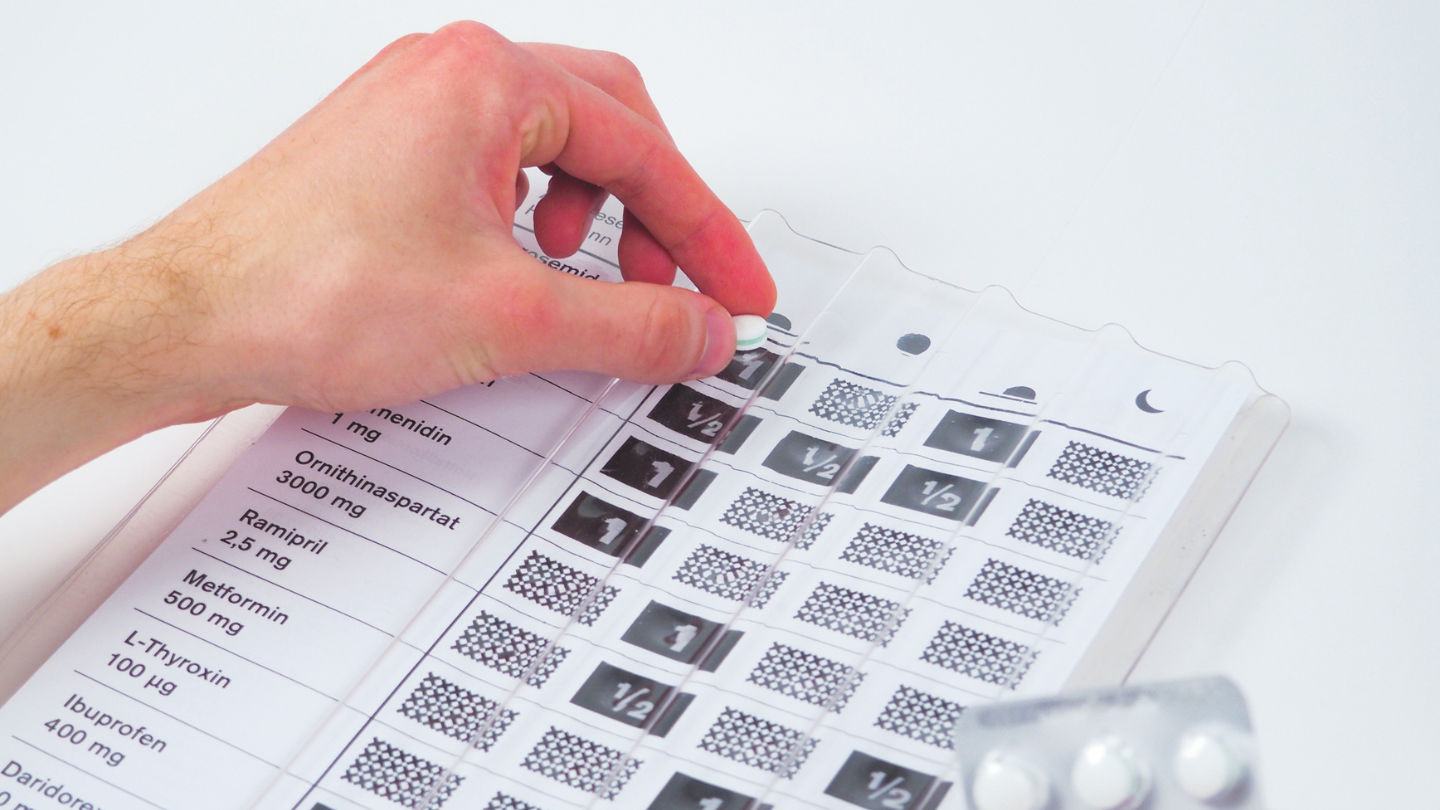
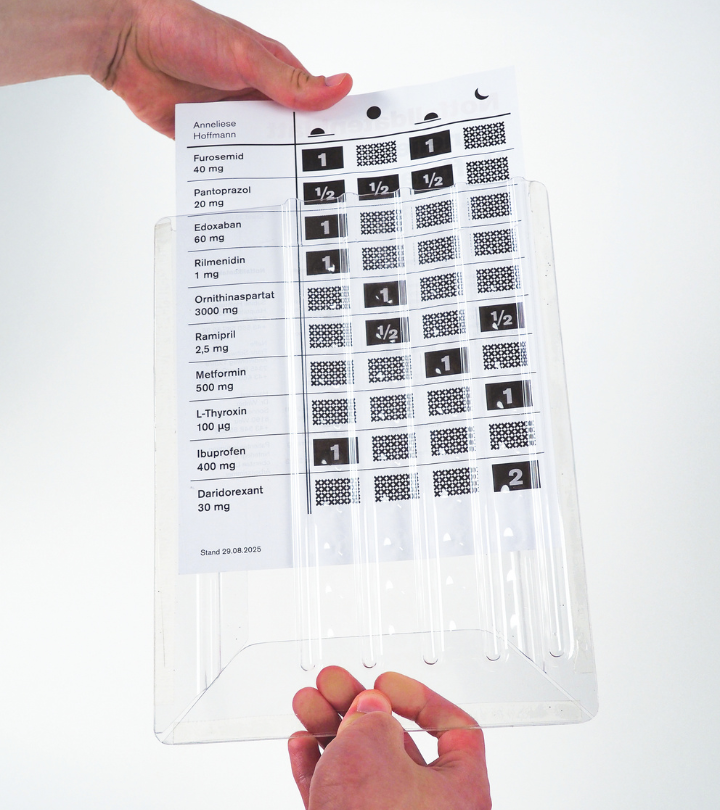
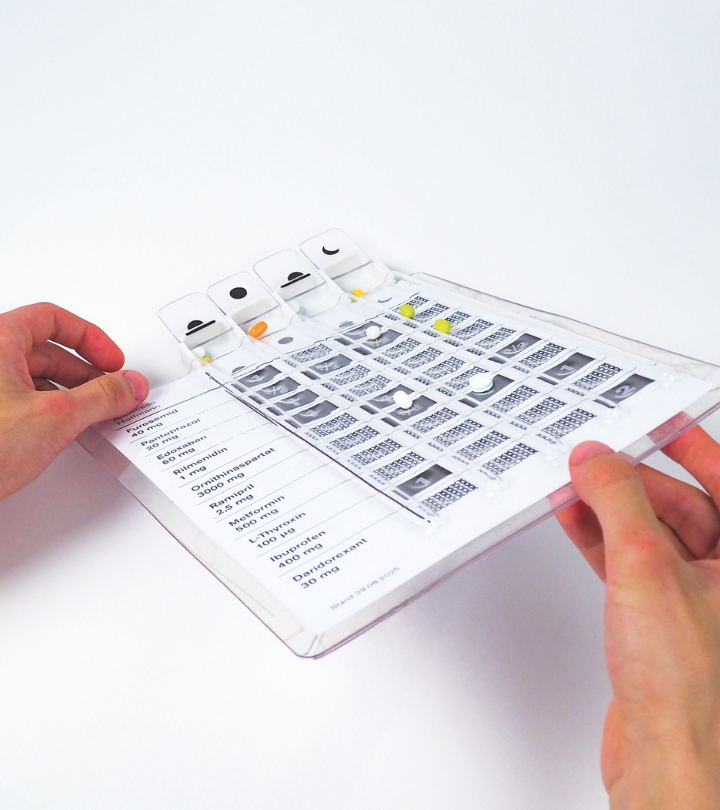
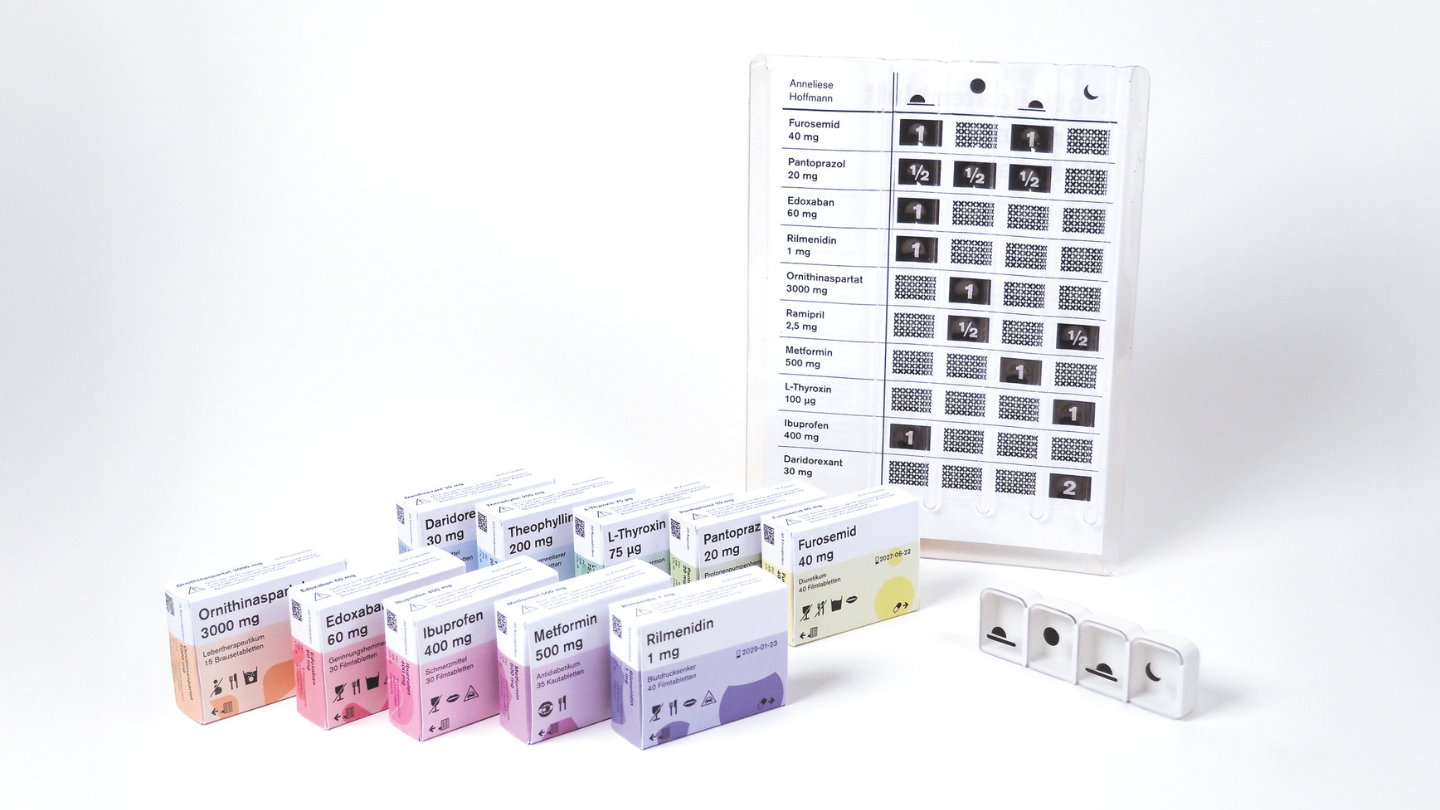
aescu consists of three functional aids that support and simplify preparation and intake of daily medication by focusing on essential information and offering clear visual and haptic orientation.
Define the problem/need you are solving or addressing with your project. How does it address the Open Call criteria, such as environmental impact, social engagement, circularity, user experience, resource efficiency, and community-driven solutions?
Up to 75% of older patients taking five or more medications daily regularly make self-medication errors at home, including dosage miscalculations, wrong timing or drug mix-ups, due to complex regimens, confusing brand-focused packaging, limited health literacy and age-related cognitive and motor decline. These errors lead to adverse events, an increase in hospital admissions and reduced quality of life. Many manage alone without structured support for routines or information sharing with caregivers and emergency services. This strains healthcare resources through preventable complications. Solutions must prioritize patient safety, accessibility, everyday compatibility and low-threshold design to enhance autonomy and support social equity.
Please describe your project, reflecting on the concept, inspiration, materials, technical aspects, methods and process(es).
aescu is an analogue support system that structures three key steps of home medication management: identification, preparation and intake. It was inspired by user interviews and observations, emergency medical service experience, and self-medication error research. Packaging uses a strict information hierarchy and pictograms to emphasize only the active ingredient, dosage and timing—inspired by mid-20th century Swiss pharmaceutical design. Brand names are omitted completely as they are irrelevant for patients. The sorting aid combines a printed paper schedule from the electronic health record with a transparent thermoformed tray. This allows direct tablet placement, visual checking and seamless transfer to the pillbox. The pillbox features four separately openable compartments with differently sized radii for clear haptic and visual orientation. Development included cardboard and foam models, thermoforming prototypes and 3D-printed functional models to optimize usability, manufacturability and everyday cleaning.
What do you think makes your project innovative compared to the existing efforts and ideas in the field it addresses?
aescu contributes to a shift in perspective away from medications as consumer goods shaped by market-driven design, towards functional aids that support patients in everyday use. Instead of adding another digital or electronic solution, the project deliberately focuses on simple, analogue, low‑cost tools that can be used without training and integrate into existing routines. Its innovation lies in tightly linking information design, product design and real‑life household workflows: from standardised, active‑ingredient‑centred packaging layouts to a sorting aid whose geometry mirrors the medication schedule, and a pillbox that is filled directly from the sorted tray. aescu also considers interfaces between patients, pharmacies and emergency services, for example through an integrated emergency data sheet and medication lists based on the electronic health record. This creates a systemic approach that combines safety, autonomy and clarity in home medication management.