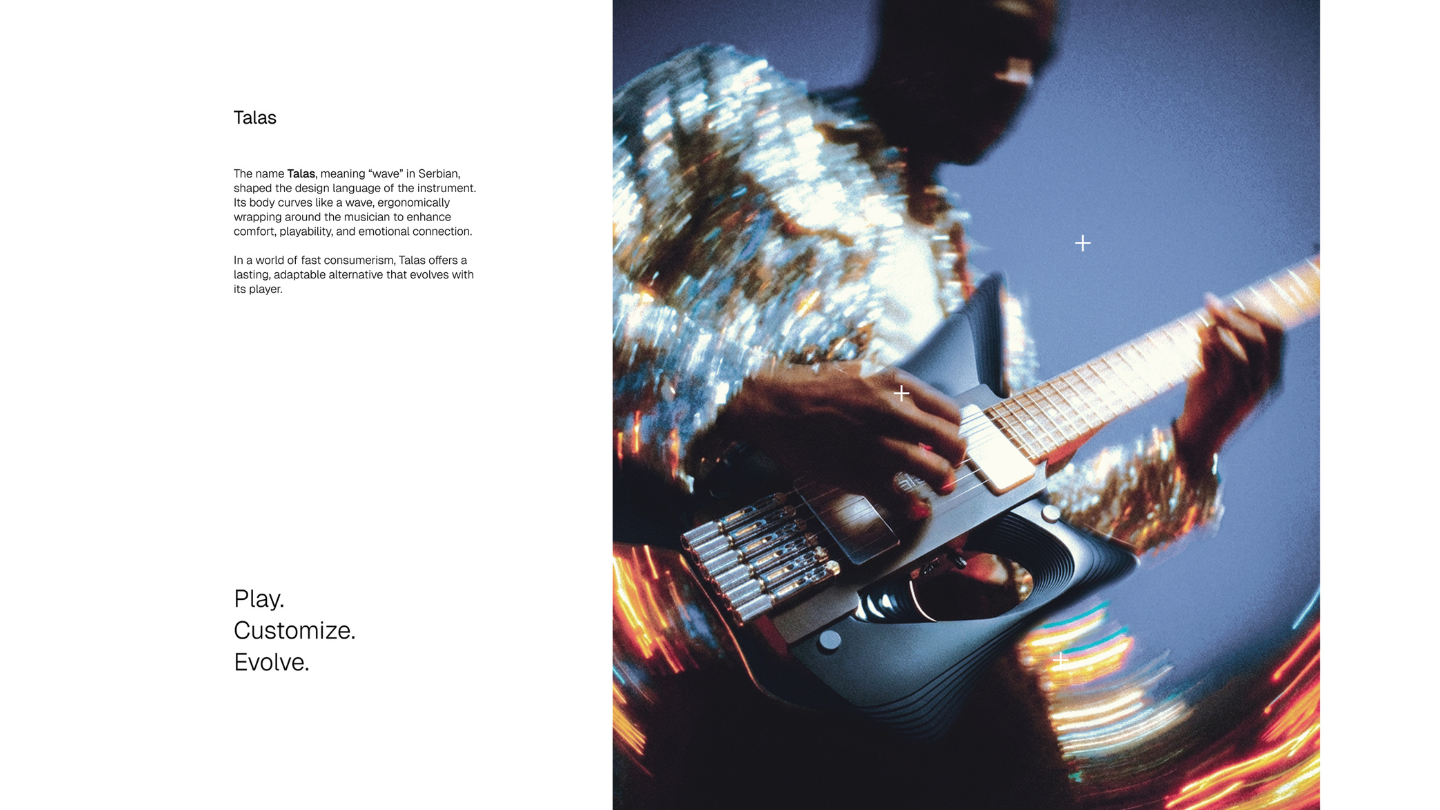
Talas bridges traditional guitar craftsmanship with contemporary product design, promoting longevity and repair over consumerism while highlighting material expression, hands-on making, and the visible human trace through a customizable and evolving instrument.
Define the problem/need you are solving or addressing with your project. How does it address the Open Call criteria, such as environmental impact, social engagement, circularity, user experience, resource efficiency, and community-driven solutions?
Talas addresses the disconnect between users and products in a market driven by fast consumption and short lifespans. Instruments are often fixed and difficult to repair or personalize. Talas introduces a human-centred approach that emphasizes craftsmanship, material awareness, and direct user interaction. Its construction allows for repair, replacement, and customization, extending product life and reducing waste.
Please describe your project, reflecting on the concept, inspiration, materials, technical aspects, methods and process(es).
With limited prior knowledge of guitars, the project began through in-depth research into construction, electronics, and ergonomics. This process revealed inefficiencies in space use, leading to a more compact, headless electric guitar format. Developed in collaboration with Oboss Guitar in Belgrade, the main structure was CNC-machined from high-quality wood and later hand-finished, resulting in a fully functional prototype. The body design, inspired by waves (“Talas” in Serbian), was shaped through ergonomic studies to naturally follow and support the player’s touchpoints. The project bridges traditional guitar making with contemporary design methods, emphasizing material understanding, hands-on processes, and the visible human trace, while allowing the player to evolve together with the instrument—from its form and aesthetics to more advanced gear and sound-shaping electronics.
What do you think makes your project innovative compared to the existing efforts and ideas in the field it addresses?
Talas approaches modularity in a practical and user-driven way, addressing a common gap where modular systems are often complex and underused. Its simplified core structure allows components to be easily adapted, replaced, or upgraded without compromising usability. In addition, the repositioning of electronic components introduces a new way of interacting with the instrument, control knobs are placed along the natural path of the player’s hand, enabling intuitive adjustments during play. By combining a clear structural logic with ergonomic innovation, Talas moves beyond conventional guitar design, offering a more adaptable, responsive, and human-centred instrument.
Does it impact or reflect young people need(s) and how?
Talas resonates with young creative individuals who are eager to experiment and rethink what is traditionally fixed or standardized. It reflects a need for freedom, personalization, and active participation in the creative process. By allowing the instrument to evolve with the user, it transforms playing into an open, exploratory experience rather than a predefined one. This adaptability encourages curiosity, hands-on engagement, and a deeper connection to both the object and the act of making.