
The Superpower of Boredom
CONCEPT
DO YOU REMEMBER THE LAST TIME YOU WERE BORED?
Do you remember the last time you were bored? Boredom is often seen as something to escape, but it can be a powerful tool for creativity and imagination. When we slow down and allow ourselves to do nothing, our minds begin to wander, making room for new ideas and unexpected connections. The Superpower of Boredom explores boredom as a skill set to pause in a world where technology constantly demands our attention, filling our lives with noise, notifications, and distractions.
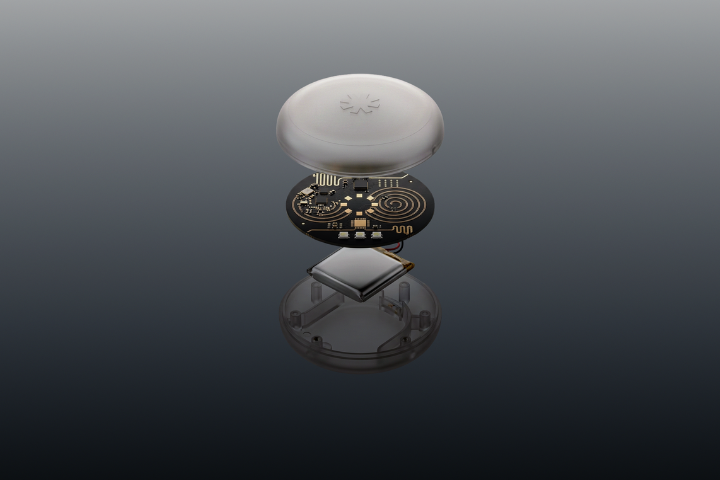
Through three stages of a progressive experience the project proposes a gradual journey towards embracing boredom. The Boring Gym is an entry-level device designed to guide users into a state of boredom. The Patch is a high-tech, second-skin wearable that explores the possibility of capturing signals, including data associated with nerve activity, to interpret and visualize the emergence of ideas during moments of boredom. The Archive provides a space to collect, revisit, and reflect on these imaginative experiences.
TEAM
Is an industrial designer originally from Sombor, Serbia. She completed her Bachelor’s degree at the Faculty of Applied Arts (FPU) in Belgrade and is currently pursuing a Master’s at the Umeå Institute of Design in Sweden. Her work focuses on human-centered design that responds to the challenges of contemporary life without being driven by what society dictates or passing design trends. She is particularly interested in creating thoughtful, sustainable solutions that balance environmental responsibility with real user needs. Alongside this, she explores how design can generate meaningful business value, bridging creativity with strategic thinking. Her projects combine functionality, clarity, and strong visual identity, aiming to improve everyday experiences through well-considered, impactful design.

Is an Icelandic designer and researcher, exploring material innovation and speculative narratives through experimental design. She graduated from the Iceland Academy of the Arts with a BA in Product Design in 2017 and from the Design Academy Eindhoven in 2025 with a Master’s in Social Design with cum laude and nomination for the Gjise Bakker Award. Valdís has received numerous awards for her design, including Formex Nova-Nordic Designer of the Year.

PROCESS
REFRAMING BOREDOM
BRAINSTORMS, WORKSHOPS AND INTERVIEWS ON HOW WE EXPERIENCE DOING NOTHING
The project began with brainstorming sessions, collaborative workshops, and speculative futuring exercises, exploring how boredom could be reframed as a human superpower. Through interviews, sticky-note explorations, and discussions with people from different backgrounds, we investigated how boredom is experienced, what triggers it, and how individuals respond to moments without stimulation.
Image not set.
FROM STIMULATION TO IMAGINATION
DUTCH DESIGN WEEK, A TARGET USER AND A JOURNEY TOWARDS EMBRACING BOREDOM
A visit to Dutch Design Week in Eindhoven provided further inspiration through exhibitions, conversations, and encounters with different approaches to speculative design. Returning with fresh perspectives, we defined our target user and mapped out a user journey, identifying how people could gradually transition from constant stimulation towards embracing boredom and unlocking their imagination.
Image not set.
THE BOREDOM SPECTRUM
MAPPING STATES OF BOREDOM, DAYDREAMING AND THE DATA BEHIND THEM
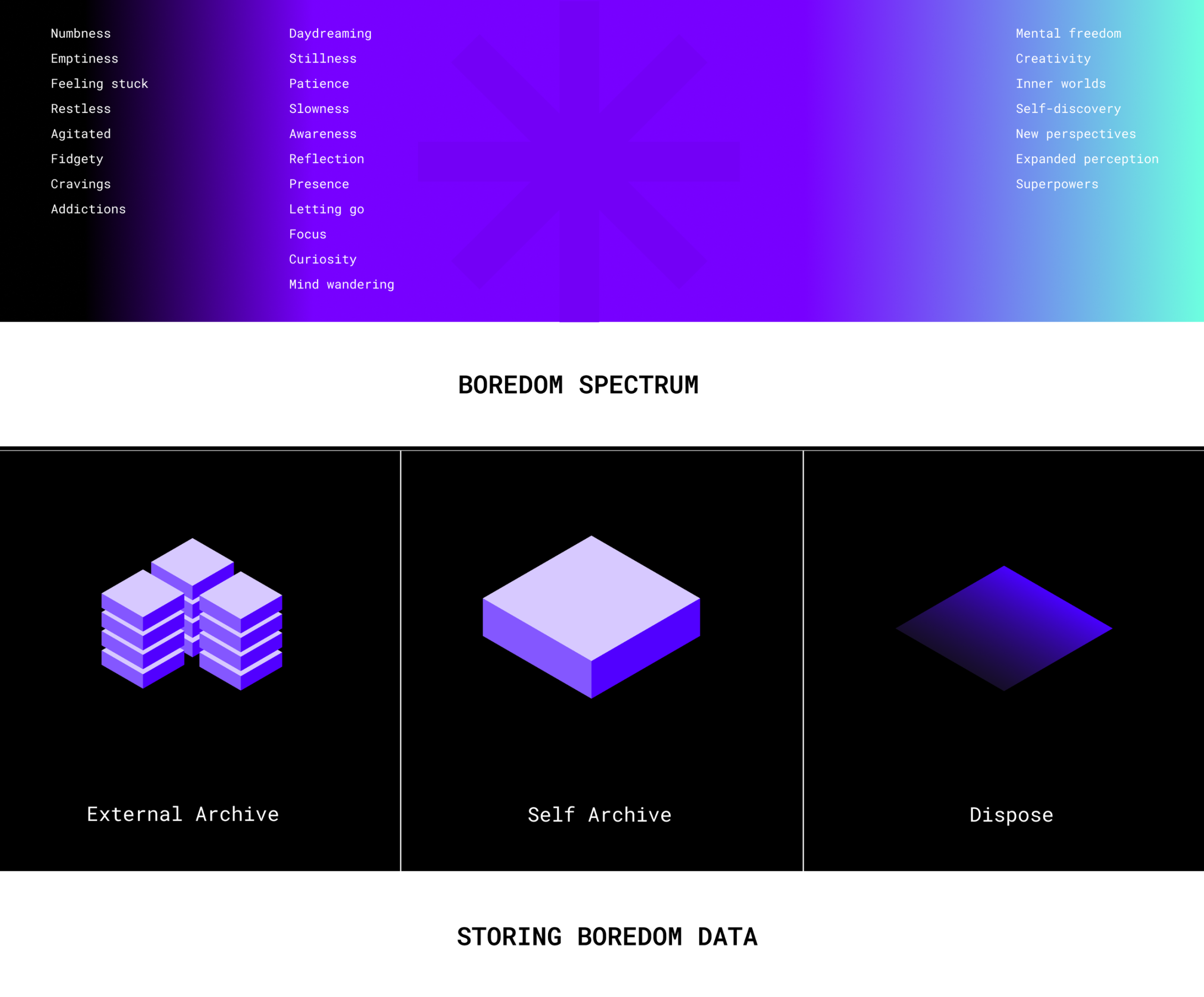
This led to the development of a boredom spectrum, exploring different states of boredom and their relationship to daydreaming and creative thinking. We further developed the interconnected artefacts, considering how physiological data could be interpreted, visualised, and archived as part of the experience.
MAKING IT TANGIBLE
FROM PHYSICAL ARCHETYPES TO AN IMMERSIVE PRESENTATION
The process continued through physical archetype exploration, translating speculative interactions into tangible forms and experiences. The project concluded with an immersive presentation, inviting the audience to experience and reflect on a future in which boredom becomes a superpower.
Image not set.
EXPERIENCE
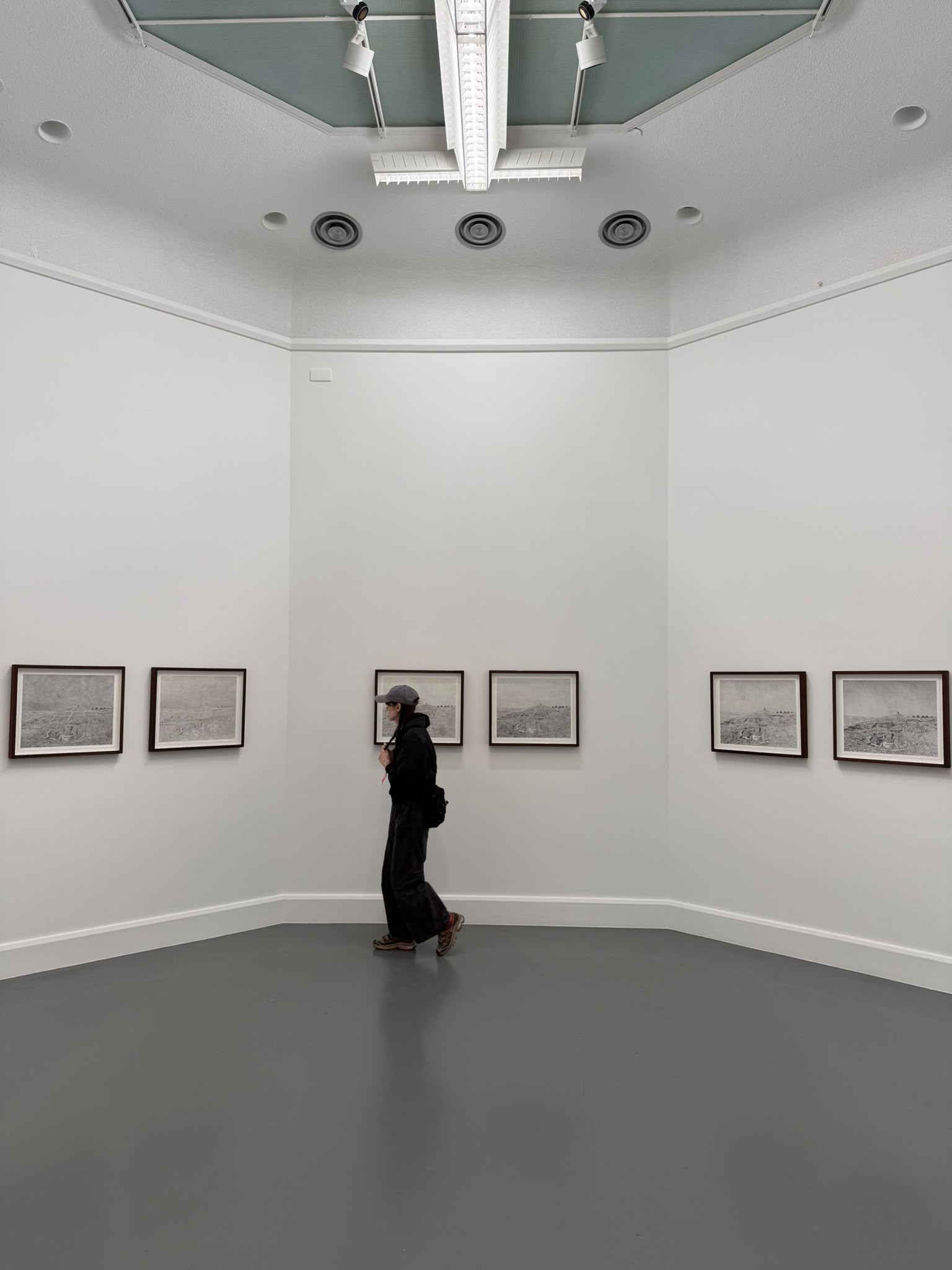
What we take away from this project is that boredom should not necessarily be eliminated or even immediately transformed into something productive. Its value lies in the freedom it gives our minds to explore without a predefined outcome.
Perhaps the real superpower is not boredom itself, but what happens when we finally give our imagination enough space to take over.
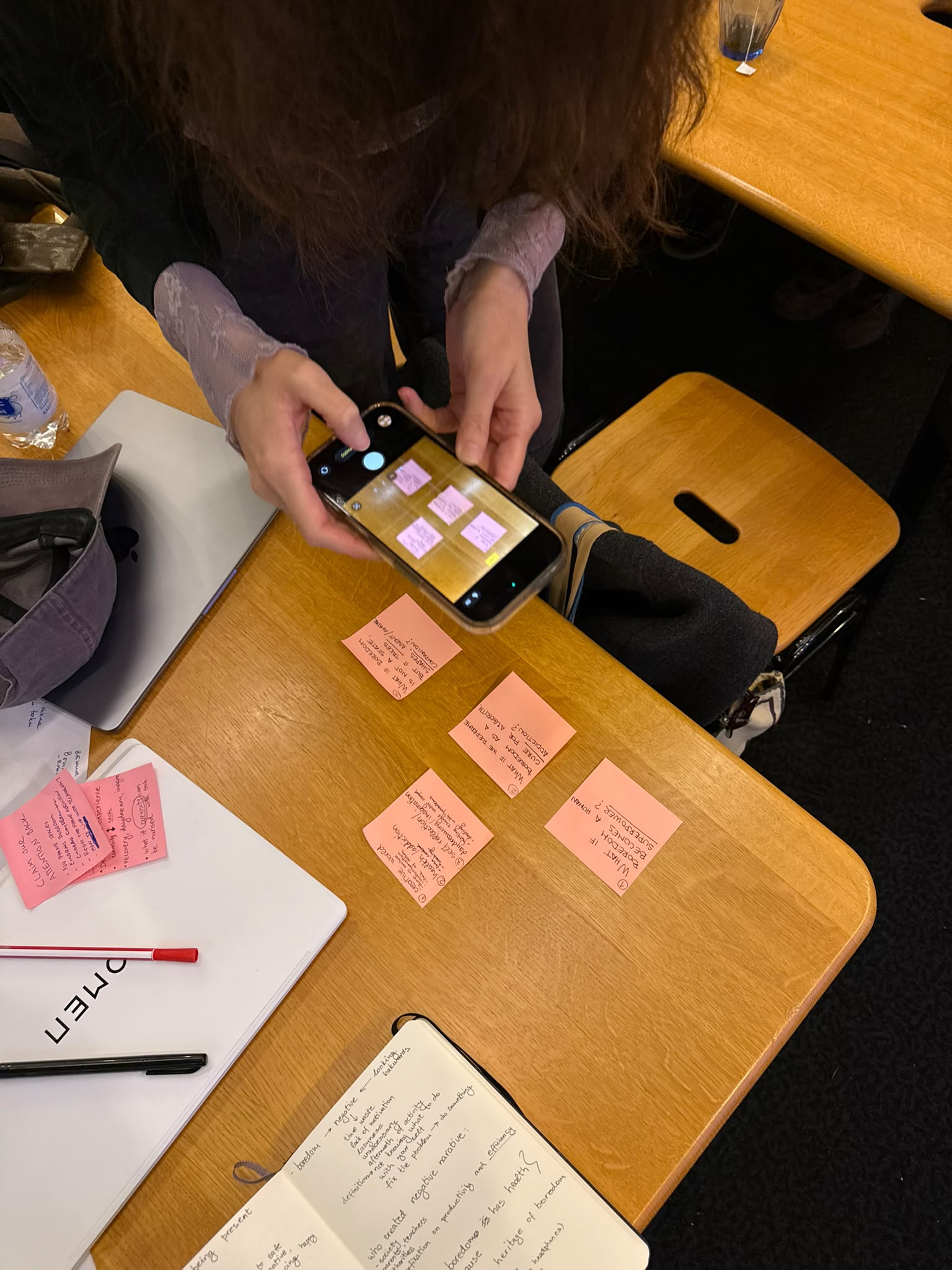
Our starting point was a wall of sticky notes. We mapped boredom across three territories: the creative world, where we saw dumping versus archiving, overconsumption and a lack of action; health and addiction, where boredom meets losing control and numbing; and self-reflection, daydreaming and imagination, where we either put things under the carpet or deal with our problems. From there we asked three questions. What if boredom becomes a human superpower? What if we reframe boredom as a cure for algorithmic addiction? What if boredom is not a state, but takes shape as an agent, an avatar or a companion? The first question became our project.
Concept
Through three stages of a progressive experience the project proposes a gradual journey towards embracing boredom. The Boring Gym is an entry-level device designed to guide users into a state of boredom, helping them gradually disconnect from external stimulation in a world where doing nothing no longer comes naturally. The Patch is a high-tech, second-skin wearable that explores the possibility of capturing physiological signals, including data associated with vagus nerve activity, to interpret and visualize the emergence of ideas during moments of boredom and free thought. The Archive provides a space to collect, revisit, and reflect on these imaginative experiences.
Rather than introducing technology that demands more attention, the project explores how products can gently guide people towards independence from constant stimulation. It presents boredom not as an absence of activity, but as a gateway to imagination, encouraging everyone, regardless of their profession or creative background, to discover the potential of their own inner world.
Process
We began by questioning our relationship with boredom and imagining a future in which the ability to do nothing becomes a human superpower. Through brainstorming, research, interviews, and visits to exhibitions during Dutch Design Week, we explored how people experience boredom and why they often associate it with discomfort or wasted time.
One of the most interesting realizations for me was that boredom is not necessarily something we can immediately enjoy. In a world of constant stimulation, being alone with our thoughts can initially feel uncomfortable. This led us to think about boredom as a gradual process, something that requires practice before its benefits can be fully experienced.
We developed three interconnected artifacts that represent different stages of this journey. The Boring Gym, The Patch and The Archive offer a space to collect and reflect on the imaginative experiences that emerge along the way. Together, these artifacts explore how design could support a shift from constant external stimulation towards a richer internal experience.
The outcome is The Superpower of Boredom, a speculative design project that explores how we can learn to embrace boredom in a world dominated by technology and constant stimulation. The project developed into three interconnected concepts that guide people through this process. The Boring Gym teaches people to practise doing nothing, The Patch visualises their progress as their daydreams become more vivid, and The Archive allows them to collect and reflect on their journey. Together, these concepts reframe boredom as a skill that can be developed.
Rather than introducing technology that demands more attention, the project explores how products can gently guide people towards independence from constant stimulation. It presents boredom not as an absence of activity, but as a gateway to imagination, encouraging everyone, regardless of their profession or creative background, to discover the potential of their own inner world.
Valdís Steinarsdóttir: Focused on developing concepts through material experiments, with an emphasis on hands-on making and material-driven design.
Marija Kucurski: My main interest throughout the project was exploring how speculative ideas could translate into tangible product experiences. I focused on the role of soft technology, product interactions, and the relationship between physical objects and human behaviour.
I was particularly interested in the paradox of using technology to help us disconnect from technology. How could a product encourage us to be less dependent on external stimulation without becoming another source of distraction?