
Blizina Raske
CONCEPT
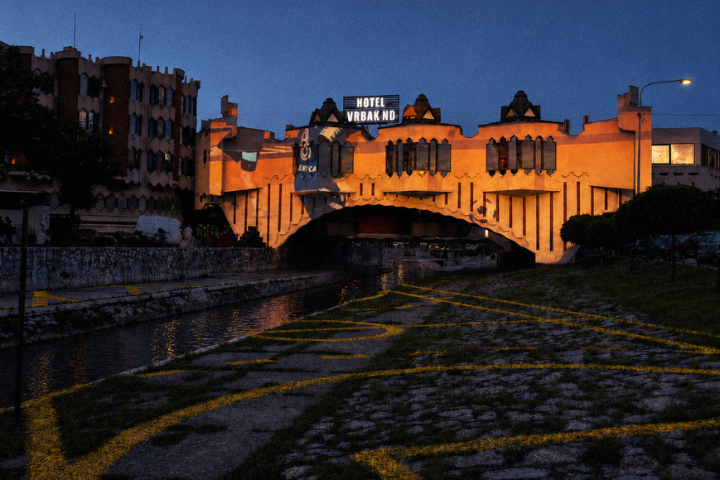
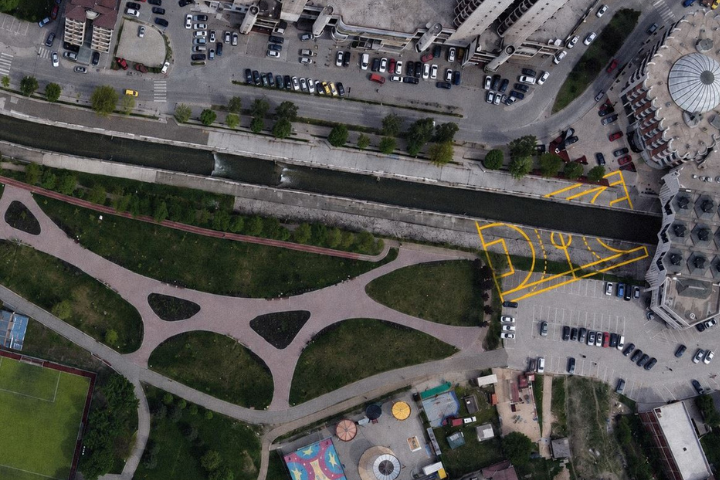
Blizina Raške is a temporary spatial intervention in Novi Pazar focused on the underused riverbank edge linking Zabavni Park, the existing sports field, the Raška river, and the rear side of Hotel Vrbak. The proposal extends the visual language of the sports field into this overlooked urban adjacency through ground markings, signage, spatial guidance, and moving-image projection.
The project approaches the Raška as a civic and ecological surface. Archival footage from the mid-1980s shows the river as an active recreational setting. Its current condition reveals concrete river management, uneven maintenance, and limited public attention. From this shift, the project responds through the idea of blizina (proximity): the lived scale of daily movement, practical negotiation, and shared spatial use.
Field observation, mapping, and interviews are translated into an sports-derived visual system. Lines, thresholds, and borders invite people to pause, cross, watch, and gather along a public edge with weak spatial support. At night, projection on the rear façade of the Hotel Vrbak brings together river textures, construction surfaces, footage of female teenagers during athletic practice. These images place bodily rhythm, momentum, and collective attention into dialogue with the riverbank.
Blizina Raške reads Novi Pazar through its layered urban condition, and gives proximity a temporary spatial form shaped by movement, care, and civic imagination.
TEAM
I use design to make infrastructural power sensible: to turn hidden systems, ecological costs, and contested territories into forms that can be felt, questioned, and shared.
Hanchen Zhang is a research-based designer and artist, his practice embraces sensorial intervention across moving image, sound, sensing device, and spatial installation. Hanchen’s research explores how technological infrastructures and extended supply chains shape socioecological relations, tracing how energy, data, and value circulate across natural and built environments. Through artefacts, generative sound, and sensing devices, he composes polyphonic narratives that render infrastructural operations perceptible without flattening them into metaphor.
Waste is not the end of a material, but the beginning of its next function in thoughtful design.
Graduated graphic designer, born on November 23, 1999, in Banja Luka. Completed undergraduate studies at the Academy of Arts, University of Banja Luka (2018–2022). Currently a final-year master’s student in Industrial Design at the Academy of Fine Arts and Design, University of Ljubljana. During his studies, he participated in an international exchange at NABA – Nuova Accademia di Belle Arti (2024–2025), specializing in Product and Service Design. Currently working as a product designer for GMP Company and the brand Volumen, focusing on furniture development. As part of his master’s thesis, he explores design opportunities for products and services aimed at supporting children with autism and sensory processing challenges, with the goal of improving their everyday quality of life.

PROCESS
FIELD WORK
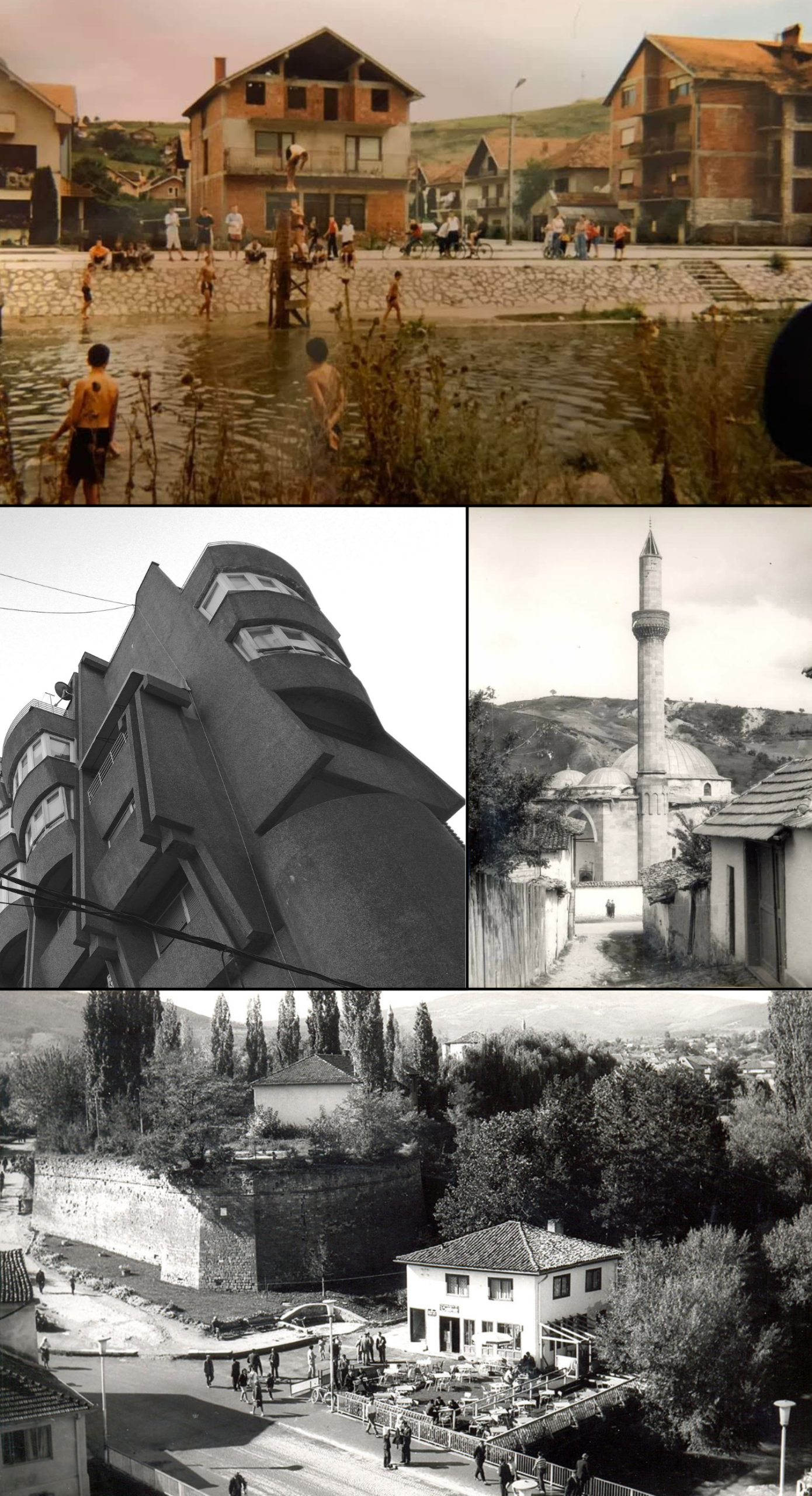
The development of Blizina Raške began with field research, observation, and interviews in Novi Pazar. This phase focused on how the city discloses itself through circulation, trade, building surfaces, repair, and everyday routine. The research moved across historical relics, brutalist landmarks, renovation sites layered over older foundations, commercial pattern, and the Raška river corridor. These visits established the city as a stack formation shaped by successive political regimes, religious histories, trading systems, and local adaptations.
Dr Semir Poturak, architectural researcher, contributed a locally grounded reading of this formation. His guidance clarified the historical role of Novi Pazar as a trading city and emphasized its organic growth pattern, produced through commerce, kinship, religion, and incremental construction. This account sharpened the project’s understanding of palimpsest as an active urban structure, where older formations remain active within present-day surfaces and habits.
Jelena Suka, Coordinator at Mikser, contributed a comparative perspective shaped by her position outside the region. Her observation focused on the social patterning between Novi Pazar and the north, especially in the visibility of cultural, religious, and ethnic distinctions within everyday life. Her contribution linked historical divisions to daily phenomena, economic structures, and public rhythms. This reading extended the project beyond architecture toward the ways locality is sensed, performed, and negotiated at an intimate scale.
Together, these encounters defined the project’s conceptual ground. Novi Pazar emerged as a city whose spatial complexity appears through adjacency, overlap, and incremental forms of coexistence.
SITE SELECTION
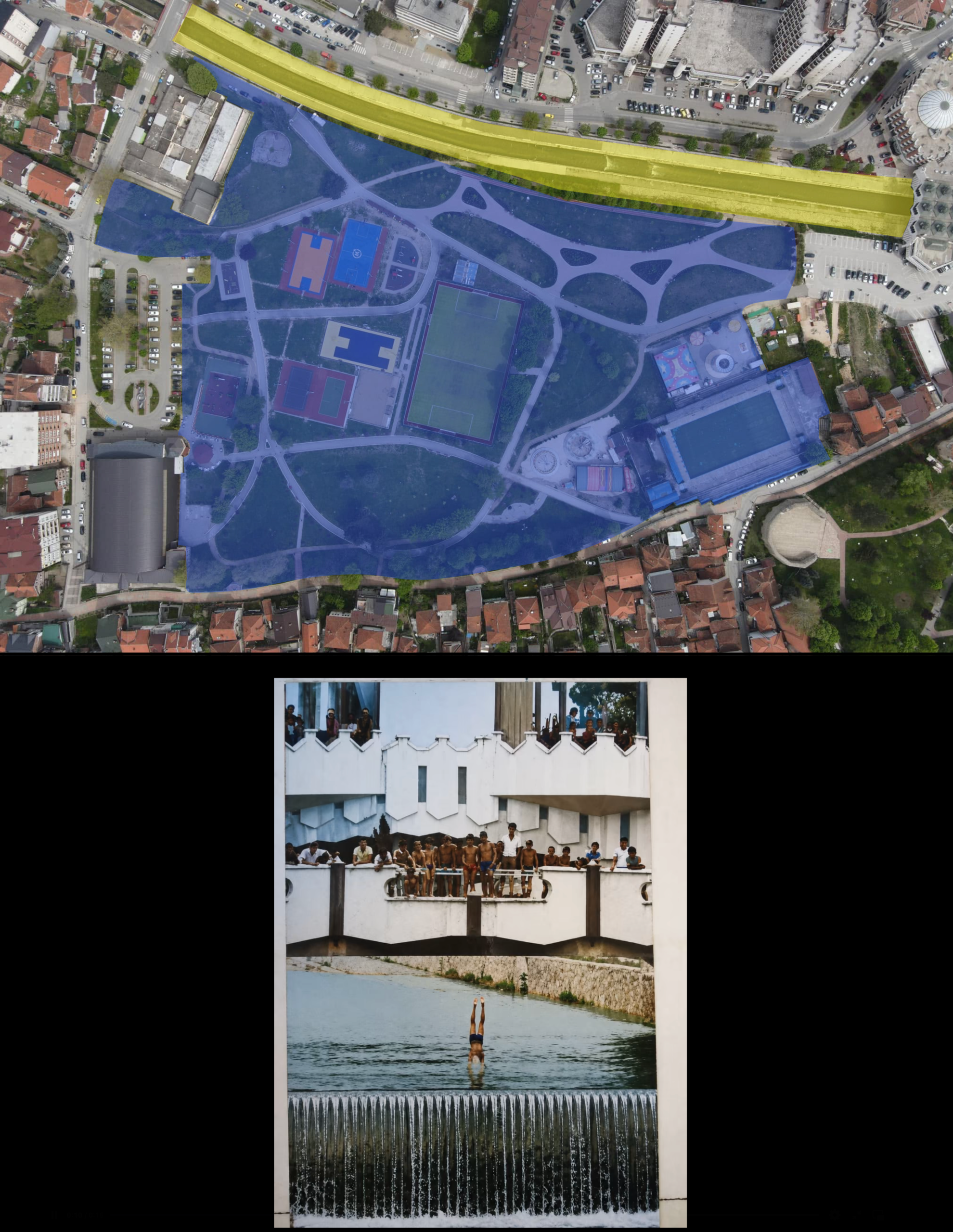
Site selection emerged through comparison across several locations documented during the field visit. The review focused on which location could bring historical density, everyday use, and formal intervention into one legible spatial condition. The final choice settled on the edge connecting Zabavni Park, the existing sports field, the Raška riverbank, and the rear side of Hotel Vrbak.
An archival image from the mid-1980s became central to this decision. It shows a young man jumping from the bridge in front of Hotel Vrbak into the Raška. The image introduced the river as a place once associated with leisure, bodily confidence, and civic visibility. The present site showed another reality: concrete engineering, uneven maintenance, reduced access, and fragmented public use. This contrast established the project its central argument.
The selected site brought two spatial registers into direct contact. The sports field carries order, regulation, division, rhythm, spectatorship, and negotiation. The adjacent riverbank carried repair, smell, residual occupation, and uneven exposure. Their proximity provided a threshold with strong spatial legibility.
The edge concentrates movement, gathering, maintenance, and passage within one compressed urban edge. It gave the project a precise ground from which to operate.
VISUALISATION
The visualisation phase focused on shaping a temporary intervention for the site. Drawing on the concept of palimpsest, the project developed a spatial language that remains legible in public use while retaining interpretive openness. The format was defined as temporary, reversible, and low-impact.
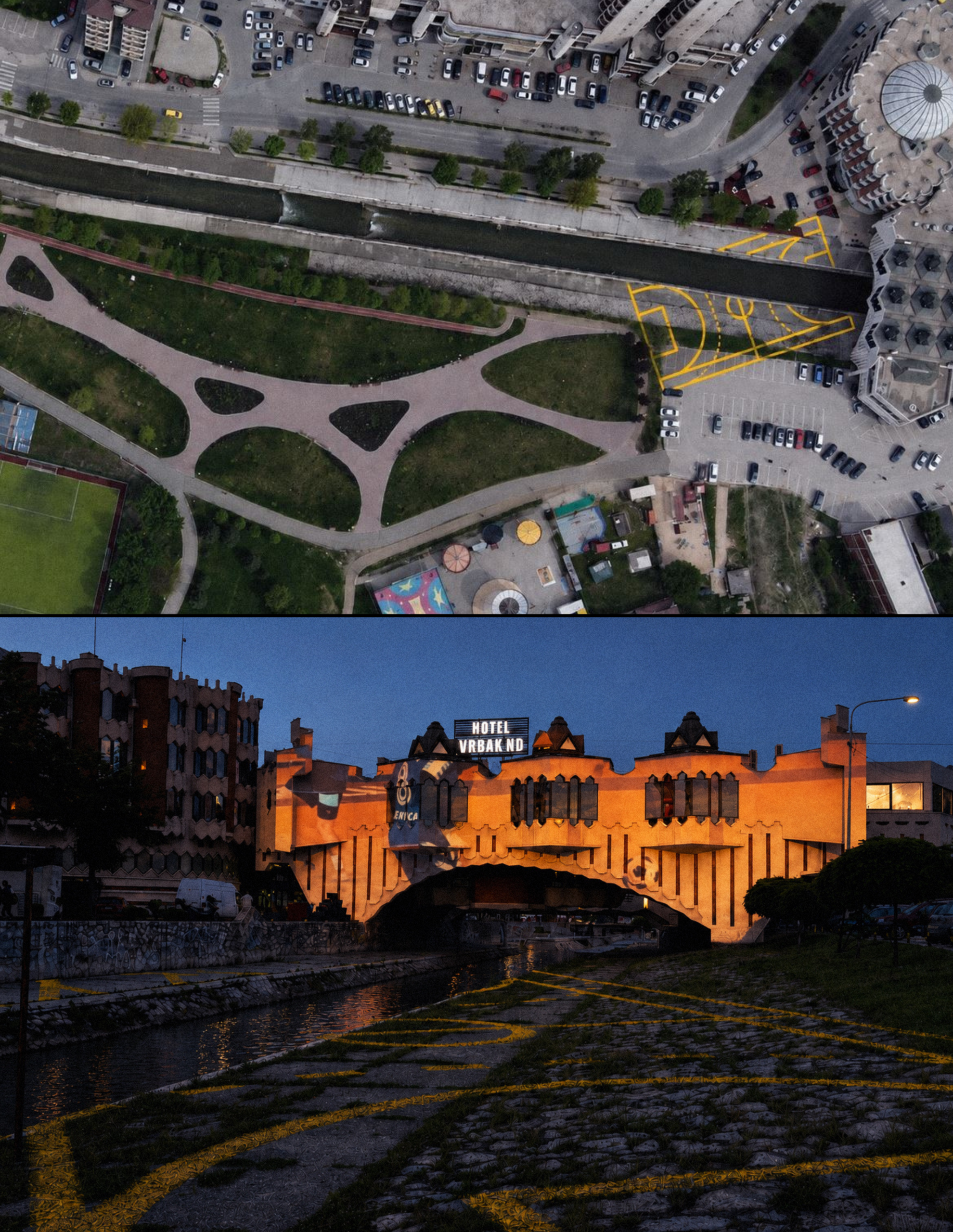
The concept drew from the coded structure of the sports field. Its floor layout became the starting point for a graphic system shaped by line, regulation, rhythm, and possible passage The project reworked these elements on the river edge to open more varied forms of negotiation, participation, and encounter within a space usually read through separation and functional division.
The intervention took form as a two-part visual system: ground marking and projection. On the ground, lines, thresholds, and graphic cues derived from sports markings were reorganised across the riverbank as a field of invitation. These elements structured ways of sitting, crossing, slowing, watching, and gathering without fixing the site into a single program, hierarchy, or use.
Projection formed the second layer. The rear façade or arch-facing section of Hotel Vrbak provided a surface where moving image could extend the intervention beyond the ground plane. The footage combined built surfaces, river textures, and scenes of female teenagers in athletic training. Their training introduced rhythm, repetition, discipline, and momentum into the composition. These gestures brought bodily tempo into contact with the roughness of the river edge and the exposed condition of the surrounding structures.
This phase established a temporary, site- responsive form that made the research publicly legible through use.
EXPERIENCE
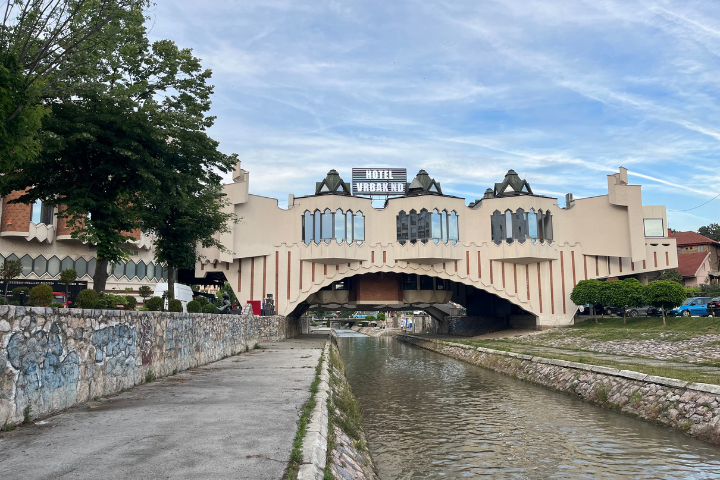
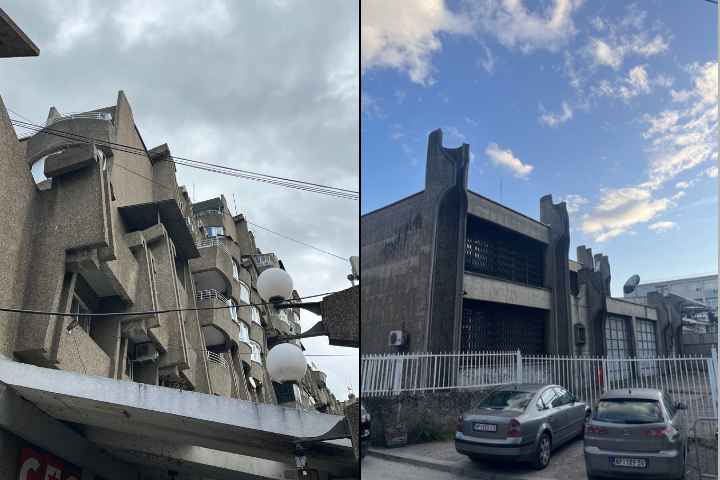
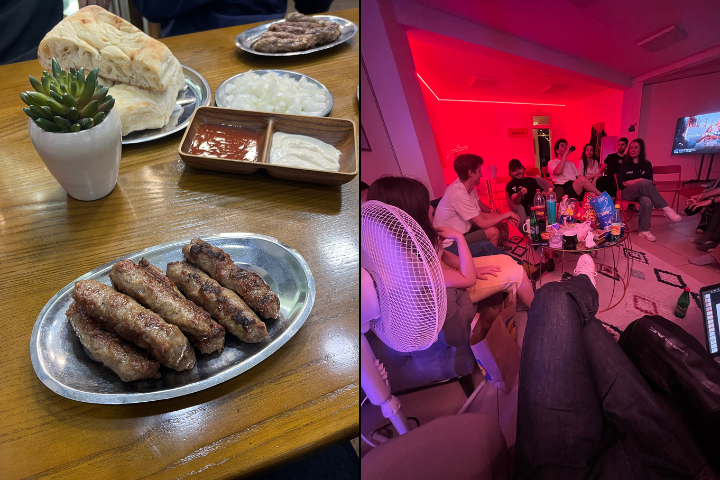
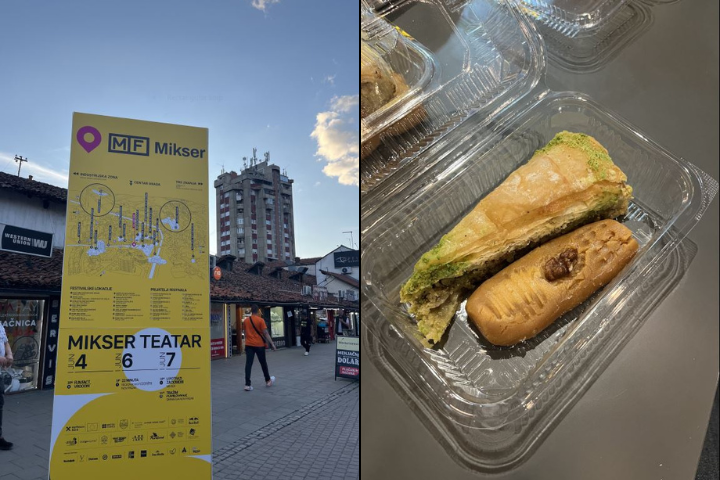
Our overall experience in Novi Pazar was truly enriching. It gave us the opportunity to discover a new culture, learn about the local traditions, and enjoy the region’s authentic cuisine. We also had the chance to meet designers from different parts of the world, exchange ideas and experiences, and learn from one another. We were also able to experience the city s diverse architectural landscape, witnessing a fascinating contrast between traditional Ottoman- influenced architecture and striking examples of Brutalist architecture, each reflecting a different chapter of Novi Pazar’s history and identity. Through this experience, we gained a deeper appreciation of Novi Pazar’s rich cultural heritage and the unique character of the city.