A mental health campus that shifts away from hospital-as-machine toward a spatial ecosystem, where patients move through gradients of care, autonomy, and privacy, and architecture becomes part of the healing process.
Define the problem/need you are solving or addressing with your project. How does it address the Open Call criteria, such as environmental impact, social engagement, circularity, user experience, resource efficiency, and community-driven solutions?
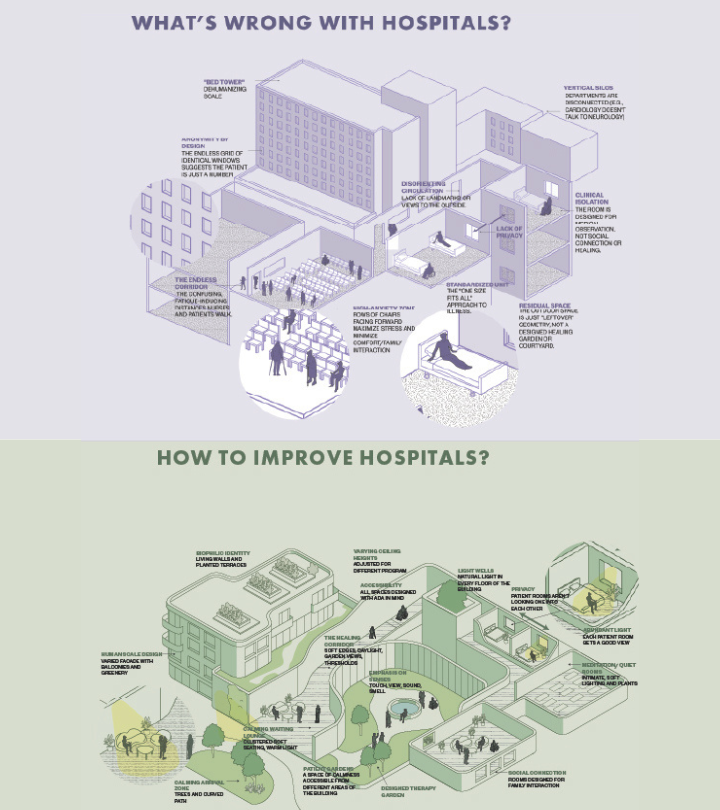
Most mental health facilities still feel like systems of control rather than places of healing. Spaces are designed around observation, liability, and efficiency, which often strips patients of autonomy and reinforces stigma instead of supporting recovery. At the same time, mental health issues are becoming more visible and widespread, but the environments we treat them in haven’t meaningfully evolved. There’s a disconnect between how complex and personal mental health is, and how standardized and rigid the spaces are. This project starts from that gap. Instead of treating architecture as a neutral backdrop, it asks what happens if space itself becomes part of the care system. It explores how design can support different emotional states, levels of independence, and forms of therapy, and how a more flexible, human-centered environment could lead to better long-term outcomes.
Please describe your project, reflecting on the concept, inspiration, materials, technical aspects, methods and process(es).
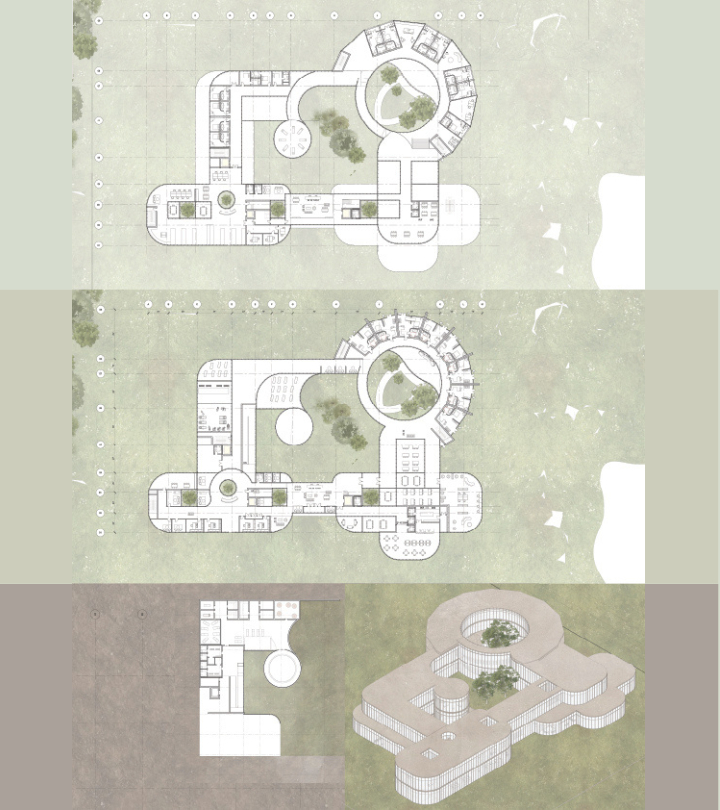
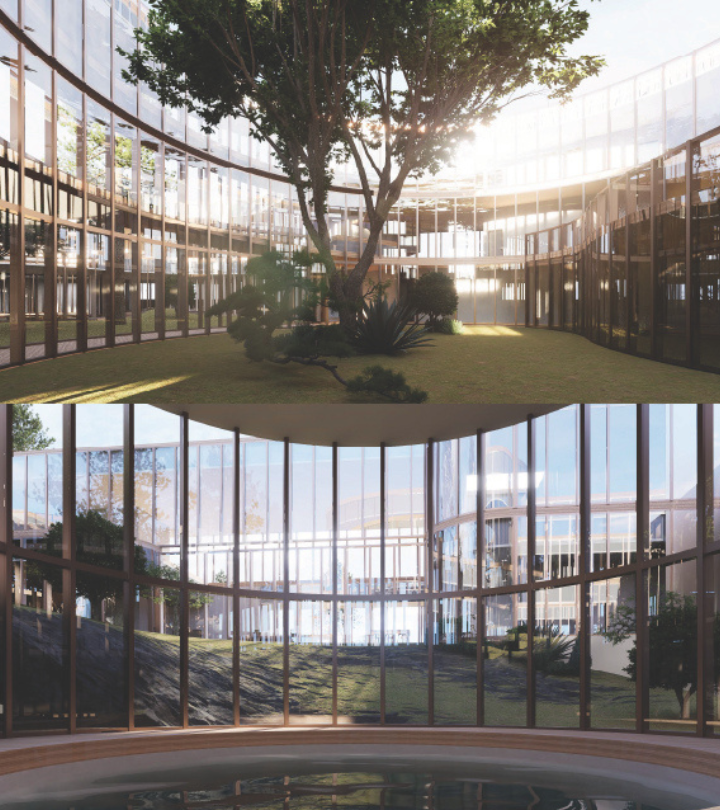
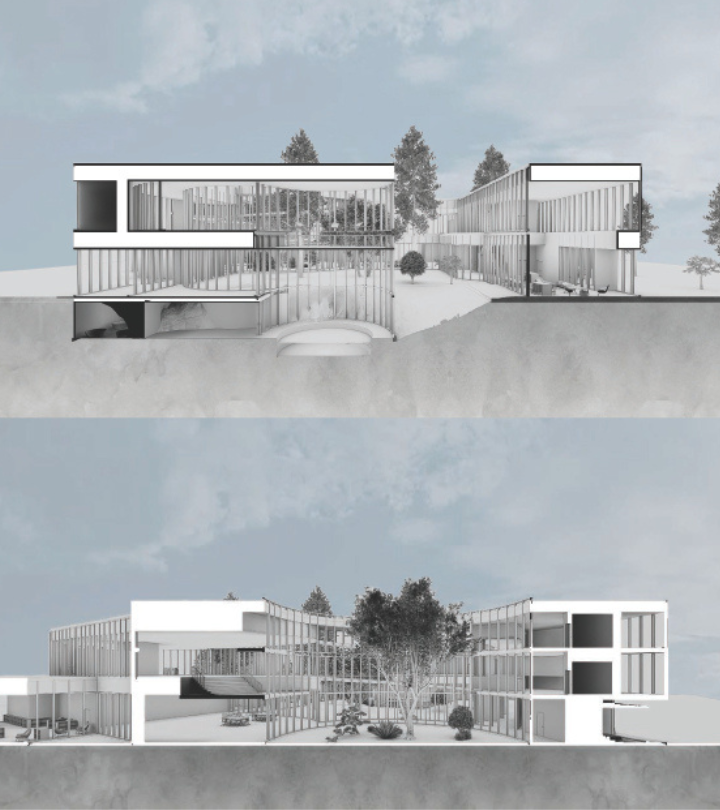
The project proposes a “healing campus” at the Brooklyn Navy Yard, replacing the idea of a single institutional building with a series of interconnected spaces that operate more like a small neighborhood. Different programs—treatment, recovery, research, and community—are distributed across the site rather than stacked into one controlled system. Circulation is organized as a gradient, not a corridor. Patients move through spaces with varying levels of privacy, intensity, and independence, depending on where they are in their recovery. The architecture combines more structured linear elements with softer, curving forms to balance clarity and comfort. Outdoor spaces, gardens, and smaller-scale pavilions are integrated throughout, so movement between programs always includes moments of decompression. Instead of isolating patients, the project creates a system where they can gradually reconnect with themselves, with others, and with the surrounding environment.
What do you think makes your project innovative compared to the existing efforts and ideas in the field it addresses?
What’s different here is not just the program, but the way it’s organized. The project treats mental healthcare as something that happens across a system of spaces, not inside a single building. That allows for more flexibility in how people receive care, and more control over how they move through it. It also challenges the idea that these environments need to feel closed off. Parts of the campus are intentionally more public, creating points of overlap between patients, staff, and the broader community, which can help reduce stigma over time. The project isn’t proposing a perfect solution, but a different framework—one that prioritizes choice, spatial variation, and long-term adaptability. If applied more broadly, this approach could influence how future healthcare environments are designed, shifting them toward systems that are less institutional and more responsive to the people using them.
Does it impact or reflect young people need(s) and how?
Young people today are more open about mental health, but the spaces designed to support them haven’t really caught up. Most facilities still feel institutional, controlled, and disconnected from everyday life, which can make it harder to seek help or stay engaged in recovery. This project responds to that gap by rethinking mental health care as something more flexible and spatially diverse. Instead of a single, rigid environment, it offers a range of spaces that support different emotional states, levels of independence, and ways of interacting—whether someone needs privacy, community, or something in between. It also reflects how younger generations move through space more fluidly, valuing choice, informality, and connection to nature. By creating an environment that feels less like a hospital and more like a place people can actually exist in, the project aims to make care more accessible, less stigmatized, and more aligned with how young people live.