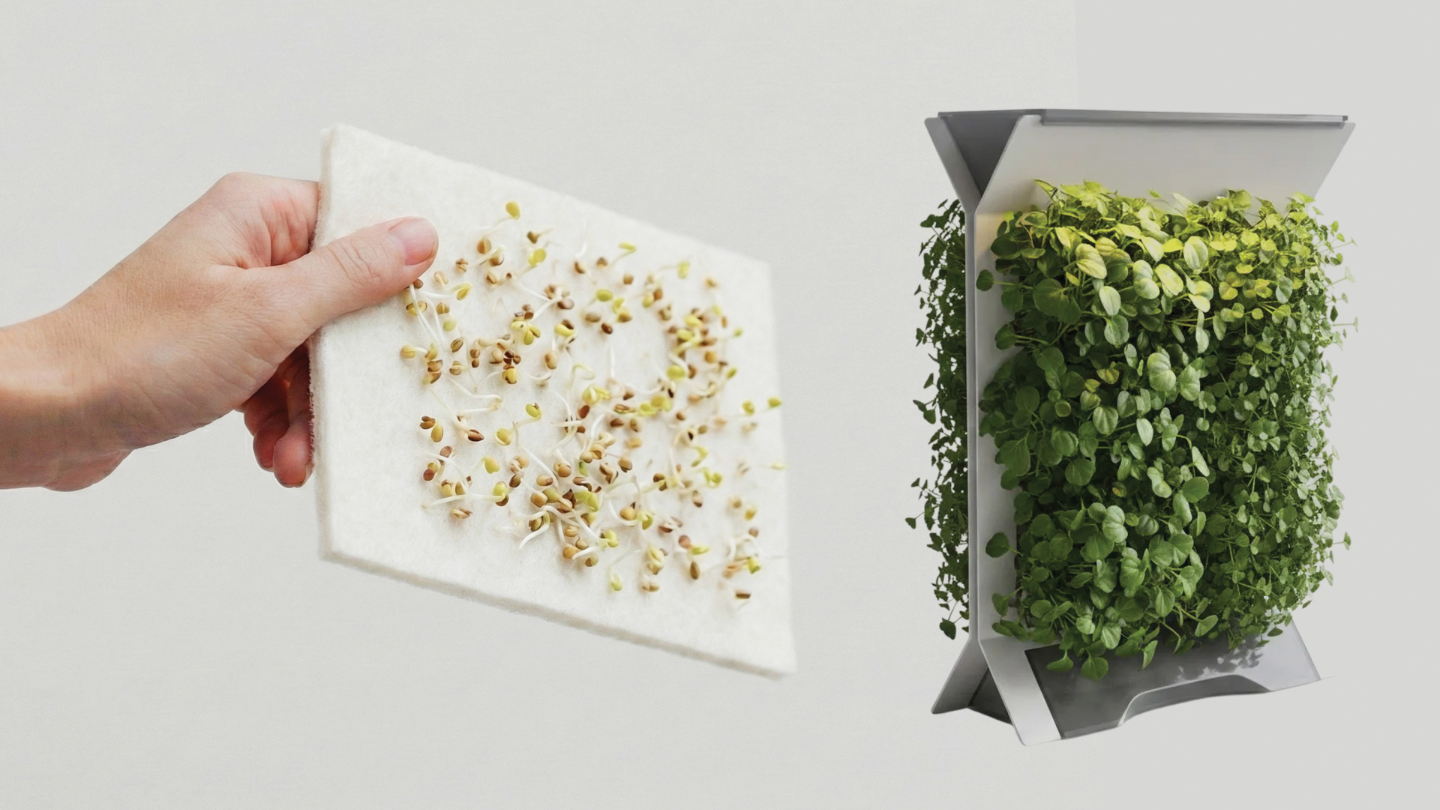
Square Greens is a compact microgreen-growing ecosystem that delivers fresh harvests in just four days. Our mission is to reduce waste and reconnect people with fresh, nutrient-rich food through a simple circular experience.
Define the problem/need you are solving or addressing with your project. How does it address the Open Call criteria, such as environmental impact, social engagement, circularity, user experience, resource efficiency, and community-driven solutions?
Modern food systems are deeply disconnected from everyday life, generating enormous waste, long supply chains, and poor nutritional access. Square Greens addresses this by bringing food cultivation directly into homes, restaurants, and schools through a compact, intuitive microgreen-growing ecosystem.
Environmentally, it shortens supply chains, eliminates packaging waste through returnable bio-pods, and uses low-energy LEDs. Its corrugated metal structure is durable, prefabricated, and designed for longevity. Circularity is built into the model: pods are distributed and returned through an integrated delivery service. Resource efficiency is achieved through capillary water distribution requiring no mechanical components.
Socially, it reconnects users with food production as a daily, tangible habit — fostering awareness and healthier behaviours across diverse contexts. The modular, intuitive design lowers barriers for non-expert users, making sustainable eating an accessible, educational, and community-driven experience rather than an abstract environmental concern.
Please describe your project, reflecting on the concept, inspiration, materials, technical aspects, methods and process(es).
Square Greens enables the domestic cultivation of microgreens, —young edible plants known for their high nutritional density and rapid growth. Harvested at an early stage, microgreens concentrate vitamins A, C, E, and K, along with folate, iron, magnesium, potassium, and zinc, as well as bioactive compounds associated with dietary balance and wellbeing. Designed for everyday use, Square Greens brings fresh, nutrient-rich food production into ordinary indoor environments.
Conceived as an open-source and adaptable system, Square Greens encourages customization, experimentation, and shared knowledge. By simplifying cultivation and anticipating early growth, the project supports healthier eating habits and fosters a more direct, conscious relationship with food production.
What do you think makes your project innovative compared to the existing efforts and ideas in the field it addresses?
The system’s key innovation lies in activating growth directly within the packaging. Instead of starting from dry seeds, users receive a pod in which the earliest phase of growth has already taken place, allowing cultivation to begin from an advanced stage facilitating the experience. Seeds are embedded in a hygroscopic cotton matrix that retains moisture and allows controlled oxygen exchange, initiating germination before purchase. These conditions remain stable during distribution through local retailers and organic markets. When the pod reaches the user, growth is already underway, enabling immediate continuation and a significantly shorter time to harvest.
Does it impact or reflect young people need(s) and how?
Square Greens is directly shaped around the needs and behaviours of younger generations, who increasingly seek meaningful, hands-on ways to engage with sustainability without added complexity.
By transforming food growing into a simple, visual, and rewarding daily ritual, it builds environmental awareness organically — not through lectures, but through experience. In school environments, Square Greens becomes an educational tool, connecting students to food origins, nutrition, and ecological responsibility in a tangible way. Its playful modularity and fast four-day harvest cycle match the expectation of immediacy typical of younger audiences, sustaining engagement over time.
By embedding fresh food production into everyday routines, it empowers young people to make conscious, informed choices — positioning them as active participants in a more sustainable food future.